Tidal

Capturing energy from tidal fluctuations.

Gravity from the moon and sun cause water in the ocean to bulge in a cyclical pattern as the Earth rotates, causing water to rise and fall relative to the land in what are known as tides. Land constrictions such as straits or inlets can create high velocities at specific sites, which can be captured with the use of devices such as turbines. As seawater is about 800 times denser than air, tidal turbines can collect energy with slower water currents and smaller turbines than wind energy. Modern tidal power generating turbines operate on the same principles as wind turbines. While the moving water passes the turbine’s blades, the kinetic energy of moving water is converted into mechanical energy as the rotating blades spin a drive shaft. The mechanical energy in the drive shaft is then converted to electrical energy using a generator, often through a gearbox. Power may also be produced by extracting potential energy from the rise and fall of the tides in a manner similar to conventional hydropower.

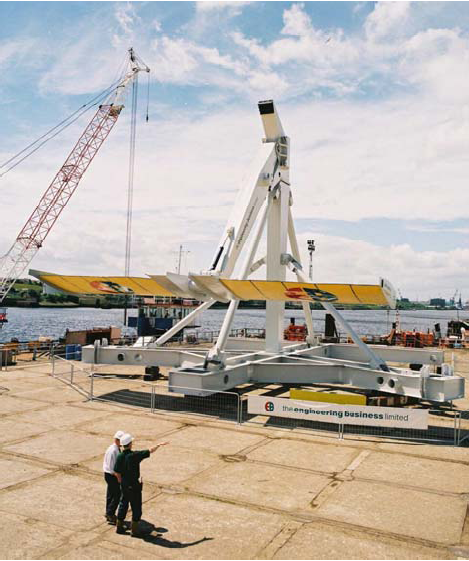
Sabella D10 Axial Flow Tidal Turbine

Axial Flow Turbine

  • These turbines are the most similar to traditional wind turbines, where the kinetic energy of moving water is captured by spinning blades facing the direction of flow. Turbines can be open or ducted (shrouded) and placed anywhere in the water column, though bottom-mounted is the most common. Turbines may use active or passive measures to yaw or vane in the direction of flow. They can have pitching blades allowing them to change their hydrodynamic performance based on flow conditions or control settings.
  • The main environmental concern is collision between turbine blades and marine organisms due to natural animal movements, attraction to the device, or inability to avoid the turbines within strong currents. There is also concern that noise from turbines can affect animals that use sound for communication, social interaction, orientation, predation, and evasion. As with all electricity generation, there is a slight concern that electromagnetic fields generated by power cables and moving parts of the turbines may affect animals that use Earth's natural magnetic field for orientation, navigation, and hunting. Likewise, chemicals such as anti-corrosion paint and small amounts of oil and grease may enter the waterbody during spills, though some turbine designs do not require lubrication, and affect water quality. Large-scale tidal changes in flow (from arrays) may disrupt natural physical systems to cause degradation in water quality or changes in sediment transport, potentially affecting ecosystem processes.

Photo Credit: BALAO-SABELLA

Cross Flow Turbine

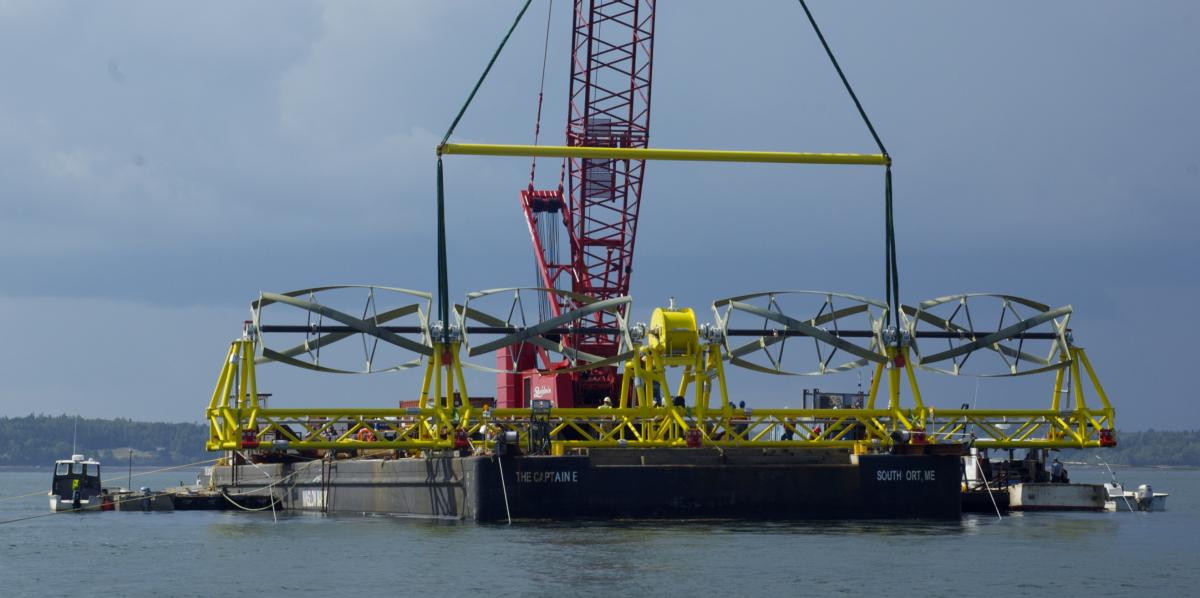
  • These turbines capture kinetic energy of moving water with spinning blades oriented perpendicular to the direction of flow. They can be mounted in either vertical or horizontal orientations. When mounted vertically, these devices can operate regardless of the direction of flow. They typically have cylindrical cross-sections amenable to placement in confined channels or allowing tight array spacing. Turbines can be open or ducted (shrouded) and placed anywhere in the water column, though bottom-mounted is the most common. The electricity production mechanism is similar to axial-flow turbines.
  • There is typically less environmental concern for collision between turbine blades and marine organisms because, depending on the design, blades are spinning in the same direction to the flow of water. Concerns about noise, electromagnetic fields, changes in flow, and impacts on water quality are similar to that of axial flow turbines.

Photo Credit: Ocean Renewable Power Company (ORPC)

ORPC TidGen Cross Flow Tidal Turbine
Reciprocating Tidal Device

Reciprocating Device

  • Reciprocating devices do not have rotating components and instead have a hydrofoil that is pushed back and forth transverse to the flow direction by lift or drag. Oscillating devices are the most common form of reciprocating devices. Oscillating hydrofoils operate via passive or active manipulation of one or more foils to induce hydrodynamic lift and drag forces due to pressure differences on the foils. They may be oriented horizontally or vertically, though like axial-flow turbines, they must face the direction of flow for maximum energy extraction. Linear motion of the foils may be converted to rotary motion for electricity generation, or linear generators may be used.
  • Reciprocating devices often move slower than turbines, but move more freely in the water, resulting in some concern for collision. Depending on the design and generator, reciprocating devices often produce little noise. Concerns about electromagnetic fields, impacts on water quality, and changes in flow are similar to that of other tidal devices.

Tidal Kite

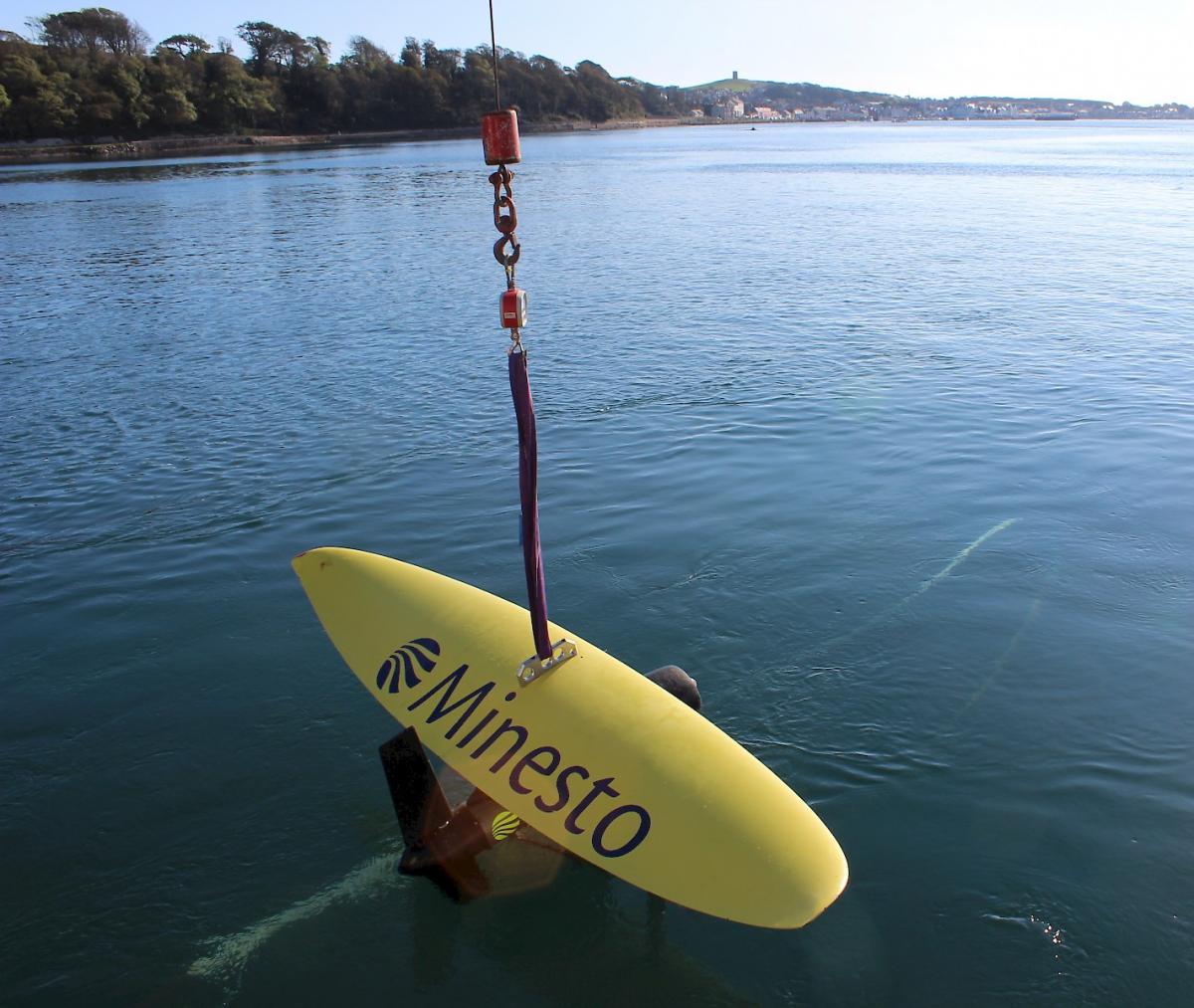
  • A tidal kite is comprised of a hydrodynamic wing, with a turbine attached, tethered by a cable to a fixed point that leverages flow to lift the wing. As the kite 'flies' loops through the water, the speed increases around the turbine, allowing more energy extraction for slower currents. The kite is neutrally buoyant so as not to fall as the tide changes direction. Electricity production is by means of a generator coupled to the turbine. Power is transferred through a cable coupled to or as part of the tether.
  • Collision risk may be of some concern with tidal kites. Although animals are more likely to collide with the tether than the kite itself, little is known about the ability of animals to detect the free movement of some tidal kites. Tidal kites can emit noise over a larger frequency than horizontal axis turbines depending on the design and generator. Concerns about electromagnetic fields, impacts on water quality, and changes in flow are similar to that of other tidal devices.
Minesto DG500 Tidal Kite
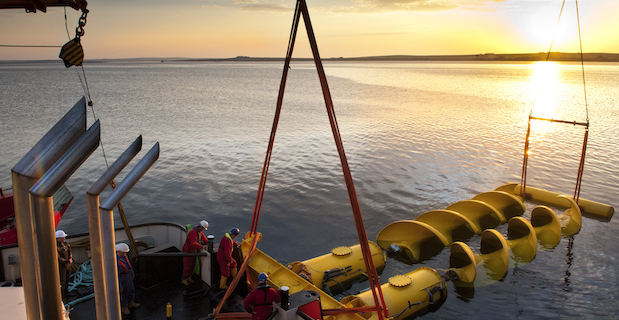
Archimedes Screw Tidal Energy Device

Archimedes' Screw

  • Historically designed to efficiently transfer water up a tube, an Archimedes screw is a helical surface surrounding a ventral cylindrical shaft. Energy is generated as water flow moves up the spiral and rotates the device. The slow rotation implies coupling to a generator through a gearbox.
  • The helical turbine moves very slowly relative to other tidal technologies and is likely to have little collision risk. Archimedes screws often produce little noise, though this depends on the design and generator. Concerns about electromagnetic fields, impacts on water quality, and changes in flow are similar to that of other tidal devices.

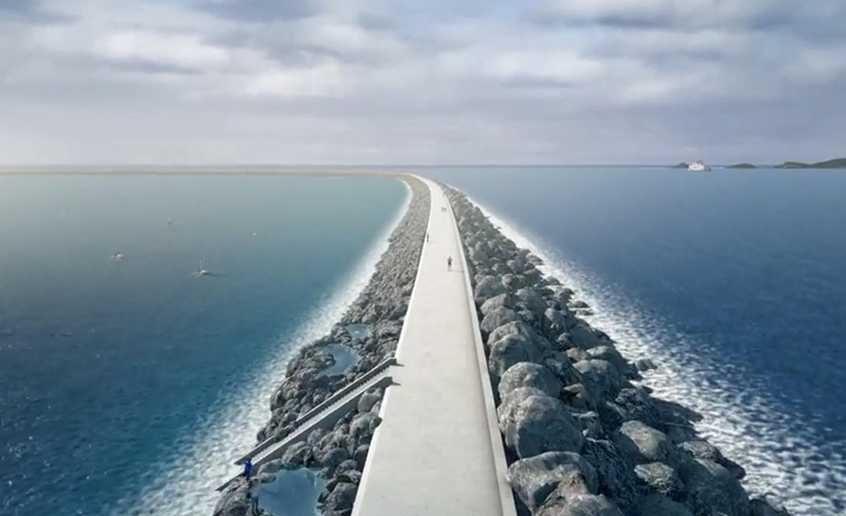
Tidal Lagoon

  • Tidal lagoons are comprised of retaining walls embedded with low-head turbines that surround a large reservoir of water. Functioning similar to a hydroelectric dam, tides cause a difference in the water height inside and outside the walls of tidal lagoons. The ecosystem within the reservoir undergoes significant transformation, potentially yielding positive impacts with a more diverse seabed, depending on site selection.
  • Changes to the physical environment are expected to be similar to conventional marine engineering projects and can include changes in flow and ecosystem processes. Decreased flushing of the reservoir may cause some problems for water quality. There are some collision concerns that arise if fish and invertebrates try to traverse the retaining wall through the turbines. Impacts from noise depend on turbine selection. There is little concern for electromagnetic fields because cables are embedded in the retaining wall and are not openly exposed to water. The new reservoir may also create calmer waters that allow for new recreation and tourism opportunities.
Swansea Bay Tidal Lagoon
La Rance Tidal Barrage

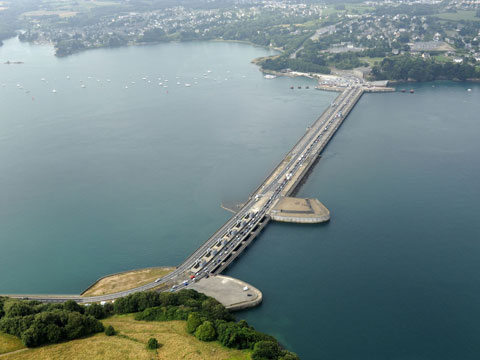
Tidal Barrage

  • Tidal barrages capture water in a holding area, making use of the difference in water height from one side of the barrage to the other. Water is then released through a large turbine or turbines as it flows out with the ebb of the tide. They are typically built across the entrance to a bay or estuary and generate electricity using the difference in water height inside and outside of the structure. A minimum height fluctuation of 5 meters (16.4 feet) is typically required to justify the construction of tidal barrages, so only 40 locations worldwide have been identified as feasible.
  • Installing a tidal barrage impacts bay or estuary ecosystems due to changes in flow and can have negative effects such as changing the shoreline and important tidal flats. Inhibiting the flow of water in and out of the bay, may also lead to less flushing of the bay or estuary, altering the water quality, and potentially causing additional turbidity (suspended solids) and less saltwater, which may result in the death of fish that act as a vital food source to birds and marine mammals. Migrating fish may also be unable to access breeding streams, and may attempt to pass through the turbines and risk collision. Impacts from noise depend on turbine selection, similar to tidal lagoons. Decreasing shipping accessibility can become a major socio-economic issue, though locks can be added to allow slow passage. However, the barrage may improve the local economy by increasing land access when used as a bridge and allowing for more recreation and tourism opportunities due to calmer waters.

Marine and Wind Energy Environmental Documents

Tethys is a knowledge hub that contains documents on the environmental effects of wind and marine energy. The table below contains all of the documents in the Tethys Knowledge Base associated with Tidal.

Total: 1291

Title Author Date Content Type Technology Stressor Receptor
Assessing impacts of tidal power lagoons of a consistent design Mackie, L., Kramer, S., Piggott, M. Journal Article Marine Energy, Tidal Changes in Flow Physical Environment
Bourne Tidal Test Site Draft Pilot License Application Barrett, S. Report Marine Energy, Tidal Human Dimensions
The rebirth and eco-friendly energy production of an artificial lake: A case study on the tidal power in South Korea Park, E., Lee, T. Journal Article Marine Energy, Tidal Changes in Flow Ecosystem Processes, Physical Environment, Water Quality
Cost Efficiency of Environmental DNA as Compared to Conventional Methods for Biodiversity Monitoring Purposes at Marine Energy Sites Fu, M., Hemery, L., Sather, N. Report Marine Energy, Ocean Current, Tidal, Wave Habitat Change Human Dimensions, Social & Economic Data
A new seabed mobility index for the Irish Sea: Modelling seabed shear stress and classifying sediment mobilisation to help predict erosion, deposition, and sediment distribution Coughlan, M., Guerrini, M., Creane, S. Journal Article Marine Energy, Tidal, Wave, Wind Energy, Fixed Offshore Wind Changes in Flow Physical Environment, Sediment Transport
Environmental Information for Siting and Operation of Floating Tidal Turbines in U.S. Waters Copping, A., Garavelli, L., Overhus, D. Report Marine Energy, Tidal Collision, Displacement, EMF, Entanglement, Habitat Change, Noise Birds, Seabirds, Fish, Marine Mammals
Environmental Impacts of Tidal and Wave Energy Converters Hutchison, Z., Lieber, L., Miller, R. Journal Article Marine Energy, Tidal, Wave Changes in Flow, Collision, EMF, Habitat Change, Noise Invertebrates, Marine Mammals, Physical Environment
Are fish in danger? A review of environmental effects of marine renewable energy on fishes Copping, A., Hemery, L., Viehman, H. Journal Article Marine Energy, Riverine, Tidal, Wave Avoidance, Collision, Displacement, EMF, Entanglement, Habitat Change, Noise Fish
State of Maine Offshore Wind Energy Research Array: Application for an Outer Continental Shelf Renewable Energy Research Lease State of Maine Report Tidal, Wind Energy, Fixed Offshore Wind, Floating Offshore Wind Bats, Birds, Fish, Marine Mammals, Reptiles, Sea Turtles, Human Dimensions, Stakeholder Engagement
Shetland Tidal Array Monitoring Report: Subsea video monitoring Smith, K. Report Marine Energy, Tidal Attraction, Avoidance, Collision, Noise Birds, Seabirds, Fish, Pelagic Fish, Marine Mammals
Moving from scientific research to consenting guidance for MRE environmental risk Copping, A., Rose, D., Freeman, M. Conference Paper Marine Energy, Tidal, Wave Changes in Flow, EMF, Habitat Change, Noise Human Dimensions, Environmental Impact Assessment, Legal & Policy, Social & Economic Data, Stakeholder Engagement
Statistical power analysis of seabird monitoring methods in strong tidal streams Couto, A., Williamson, B., Long, C. Conference Paper Marine Energy, Tidal Birds, Seabirds
What is the value of innovative offshore renewable energy deployment to the UK economy? Cochrane, C., Pennock, S., Jeffrey, H. Report Marine Energy, Tidal, Wave, Wind Energy, Floating Offshore Wind Human Dimensions, Social & Economic Data
Shetland Tidal Array Monitoring Report: Vantage point surveys Smith, K., Date, H., Waggitt, J. Report Marine Energy, Tidal Birds, Fish, Marine Mammals
Fast & Flexible: streamlining a simulation- based approach to collision risk assessments Horne, N., Schmitt, P., Culloch, R. Conference Paper Marine Energy, Tidal Collision Marine Mammals, Human Dimensions, Environmental Impact Assessment
Understanding seabird and marine mammal occupancy of tidal stream environments at annual and seasonal scales Brown, K. Thesis Marine Energy, Tidal Displacement Birds, Marine Mammals
Harbour porpoises exhibit localized evasion of a tidal turbine Gillespie, D., Palmer, L., Macaulay, J. Journal Article Marine Energy, Tidal Avoidance, Collision Marine Mammals, Cetaceans
A study into the potential economic value offered to Europe from the development and deployment of wave and tidal energy to 2050 University of Edinburgh Report Marine Energy, Tidal, Wave Human Dimensions, Social & Economic Data
Marine Evidence packages ABP Marine Environmental Research Ltd (ABPmer) Webpage Marine Energy, Tidal, Wave Changes in Flow, Collision, Displacement, EMF, Habitat Change, Lighting, Noise Birds, Fish, Marine Mammals, Physical Environment
Cost-benefit analysis of tidal energy production in a coastal lagoon: The case of Ria Formosa – Portugal Rodrigues, N., Pintassilgo, P., Calhau, F. Journal Article Marine Energy, Tidal Changes in Flow Physical Environment, Sediment Transport, Human Dimensions, Social & Economic Data
Legal and Political Barriers and Enablers to the Deployment of Marine Renewable Energy Apolonia, M., Fofack-Garcia, R., Noble, D. Journal Article Marine Energy, Tidal, Wave Human Dimensions, Legal & Policy, Social & Economic Data
Research on the environmental impact of tidal power generation in China Ma, Z., Li, B., Liu, Y. Journal Article Marine Energy, Tidal Ecosystem Processes, Physical Environment, Human Dimensions, Legal & Policy
Information Flow to Increase Support for Tidal Energy Development in Remote Islands of a Developing Country: Agent-Based Simulation of Information Flow in Flores Timur Regency, Indonesia Ramachandran, R., Kularathna, A., Matsuda, H. Journal Article Marine Energy, Tidal Human Dimensions, Social & Economic Data, Stakeholder Engagement
Sustainable energy planning for remote islands and the waste legacy from renewable energy infrastructure deployment Kouloumpis, V., Yan, X. Journal Article Marine Energy, Tidal, Wind Energy, Fixed Offshore Wind Chemicals, Habitat Change Physical Environment, Water Quality, Human Dimensions, Life Cycle Assessment, Social & Economic Data
Review of monitoring methodologies and technologies, suitable for deployment in high energy environments in Wales, to monitor animal interactions with tidal energy devices Clarke, D., Bertelli, C., Cole, E. Report Marine Energy, Tidal Birds, Seabirds, Fish, Marine Mammals
SafeWave DELIVERABLE 5.1 Legal and institutional review of national consenting processes O'Hagan, A., Bourhis, E., Soulard, T. Report Marine Energy, Tidal, Wave Human Dimensions, Legal & Policy
Tidal stream use by black guillemots Cepphus grylle in relation to a marine renewable energy development Johnston, D., Furness, R., Robbins, A. Journal Article Marine Energy, Tidal Collision, Habitat Change Birds, Seabirds
Unbalanced sediment transport by tidal power generation in Lake Sihwa Kim, J., Ha, H., Woo, S-B. Journal Article Marine Energy, Tidal Changes in Flow Physical Environment, Sediment Transport
Modelling Morphological Changes and Migration of Large Sand Waves in a Very Energetic Tidal Environment: Banks Strait, Australia Auguste, C., Marsh, P., Nader, J. Journal Article Marine Energy, Tidal Physical Environment, Sediment Transport
Relative Performance of Surface vs. Bottom-Mounted Hydrophones in a Tidal Channel Hasselman, D., Boucher, T., Douglas, J. Report Marine Energy, Tidal Noise Marine Mammals, Cetaceans
A systemic view of potential environmental impacts of ocean energy production Martinez, M., Vázquez, G., Pérez-Maqueo O. Journal Article Marine Energy, Ocean Current, OTEC, Salinity Gradient, Tidal, Wave Collision, Habitat Change, Noise Birds, Physical Environment, Fish, Marine Mammals
Variability of sediment processes around a tidal farm in a theoretical channel Auguste, C., Nader, J., Marsh, P. Journal Article Marine Energy, Tidal Changes in Flow Physical Environment, Sediment Transport
Acoustic risk balancing by marine mammals: anthropogenic noise can influence the foraging decisions by seals Hastie, G., Lepper, P., McKnight, C. Journal Article Marine Energy, Tidal Avoidance, Noise Marine Mammals, Pinnipeds
Assessment of the Tidal Current Energy Resources and the Hydrodynamic Impacts of Energy Extraction at the PuHu Channel in Zhoushan Archipelago, China Wu, H., Yu, H., Fang, Y. Journal Article Marine Energy, Tidal Changes in Flow Physical Environment
Regulating wave, tidal and ocean thermal energy Adimazoya, T., Doelle, M. Book Chapter Marine Energy, OTEC, Tidal, Wave Human Dimensions, Legal & Policy
Tidal turbines in the estuarine environment: From identifying optimal location to environmental impact Ross, L., Sottolichio, A., Huybrechts, N. Journal Article Marine Energy, Tidal Changes in Flow Physical Environment, Sediment Transport
A bird's-eye view on turbulence: seabird foraging associations with evolving surface flow features Lieber, L., Langrock, R., Nimmo-Smith, A. Journal Article Marine Energy, Tidal Attraction, Changes in Flow Birds, Seabirds
Evaluating the eutrophication risk of an artificial tidal lagoon Kadiri, M., Zhang, H., Angeloudis, A. Journal Article Marine Energy, Tidal Changes in Flow Physical Environment, Water Quality
Orbital Marine Power O2 at EMEC Orbital Marine Power Project Site Marine Energy, Tidal
An Evaluation of the Potential Impact of Extracting Marine Renewable Energy in the Coastal Environment of the Black Sea Zburlea, L., Rusu, E. Journal Article Marine Energy, Tidal, Wave, Wind Energy, Fixed Offshore Wind Changes in Flow, Collision, EMF, Habitat Change, Noise Birds, Fish, Marine Mammals, Physical Environment

Displaying 241 - 280 of 1291 results