Wave

Capturing energy from waves.

Ocean surface waves are generated by wind passing over the ocean surface. The friction between the wind and ocean surface causes energy to be transferred from the faster moving air to the surface layer of the ocean. Wave development depends on the length of ocean, or “fetch,” over which the wind blows in a constant direction. Longer fetches with higher wind velocities will produce larger waves. Waves can travel thousands of miles with little energy loss and can combine with waves from storms and other wind-driven events to create very energetic seas. The energy of ocean waves is concentrated at the surface and decays rapidly with depth. Wave energy technologies, also known as wave energy converters (WECs), capture energy directly from the surface motion of ocean waves. WECs can be deployed at offshore, nearshore, and shore-based locations and are intended to be modular and deployed in arrays. Due to the diverse nature of waves in different regions of the world, there is a wide variety of WECs in various stages of research and development.
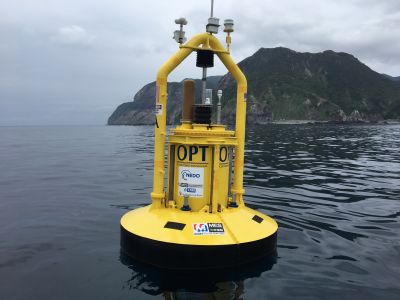
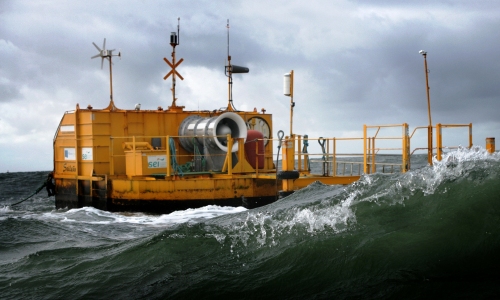
OPT Point Absorber

Point Absorber

  • Point absorbers extract energy through the relative motion between a body that moves in response to wave forcing and fixed or immobile structures. The moving body may be on the surface or submerged, and the 'fixed' body may be the seabed or another structure less affected by wave action. Their principal dimension is small relative to the length of waves they are absorbing energy from. Electricity may be produced using a linear or rotary generator, or a fluid may be pumped using mechanical force and motion directly.
  • The presence of these buoys may affect fish, marine mammals, and birds as they pose a minor collision risk or they may either attract organisms to the device or cause them to avoid the site. As with all electricity generation, there is some concern that electromagnetic fields generated by power cables and moving parts may affect animals that use Earth's natural magnetic field for orientation, navigation, and hunting. Large-scale changes in flow (from arrays) may disrupt natural physical systems to cause degradation in water quality or changes in sediment transport, potentially affecting ecosystem processes. Alternatively, devices absorbing wave energy may positively act as shoreline defense.

Photo Credit: Ocean Power Technologies

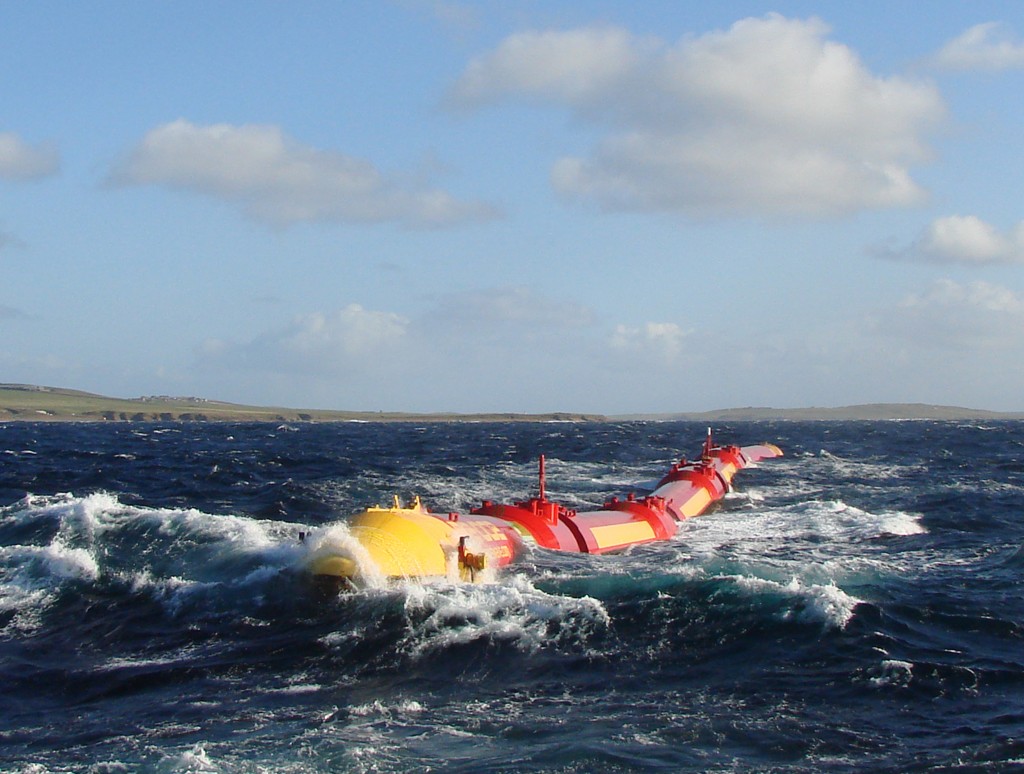
Surface Attenuator

  • Surface attenuators generally have multiple segments connected to one another and that are oriented parallel with incoming waves. They use the rise and fall of swells to create a flexing motion that may be converted into rotation or drive hydraulic pumps to generate electricity. Some attenuator designs consist of a single long, flexible surface expression instead of multiple segments.
  • Concerns about collision, attraction or avoidance, electromagnetic fields, impacts on water quality, and changes in flow are similar to that of a point absorber, with an additional concern that organisms could be pinched in the joints.


Pelamis Wave Attenuator
Ocean Energy Oscillating Water Column

Oscillating Water Column

  • Oscillating water column devices use wave action to pressurize air in a chamber, forcing it through an air turbine. As water recedes from the chamber, the resulting vacuum pulls air back through the turbine and into the chamber. They can be located onshore or in deeper waters offshore. The turbine may be coupled to a rotary generator to produce electricity.
  • Significant noise is produced as air is pushed through the turbines, potentially affecting birds, marine mammals, and other marine organisms within the vicinity of the device. There is also concern about marine organisms getting entrapped within the air chambers. When located offshore, concerns about collision, attraction or avoidance, electromagnetic fields, and changes in flow are similar to that of a point absorber buoy; located onshore, these concerns are no different than for a standard shoreline structure.

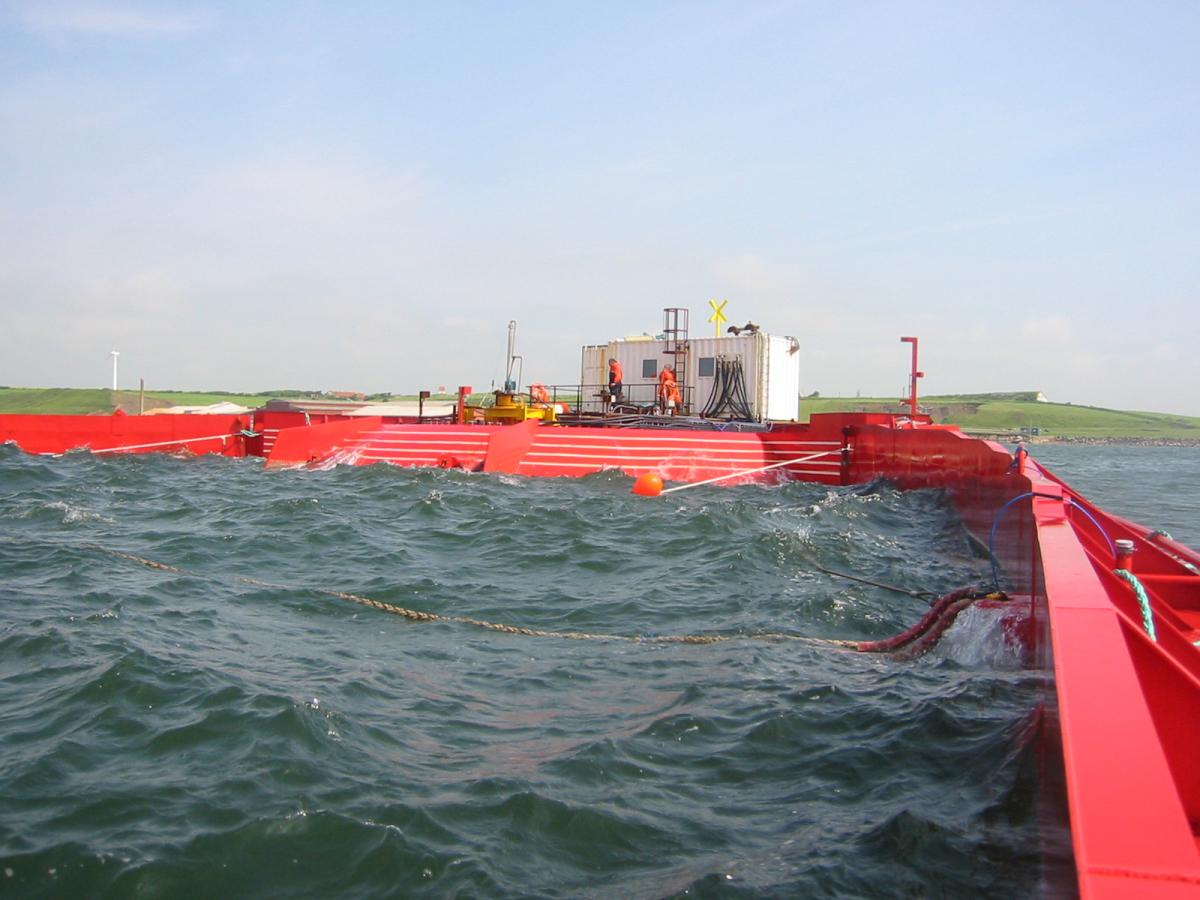
Overtopping Device

  • Overtopping devices are long structures that allow wave motion to fill a reservoir to a higher water level than the surrounding ocean. The difference in pressure between water in the reservoir and water at the surface forces fluid through a low-head turbine coupled to a generator, where electricity is produced similar to conventional hydropower. Devices can be either onshore or floating offshore.
  • There is some concern regarding low levels of turbine noise, marine organisms getting entrapped within the reservoir, or collision with the slow-moving turbines. When located offshore, concerns about attraction or avoidance, electromagnetic fields, and changes in flow are similar to that of a point absorber buoy; located onshore these concerns are no different than for a standard shoreline structure.
Wave Dragon Overtopping Device
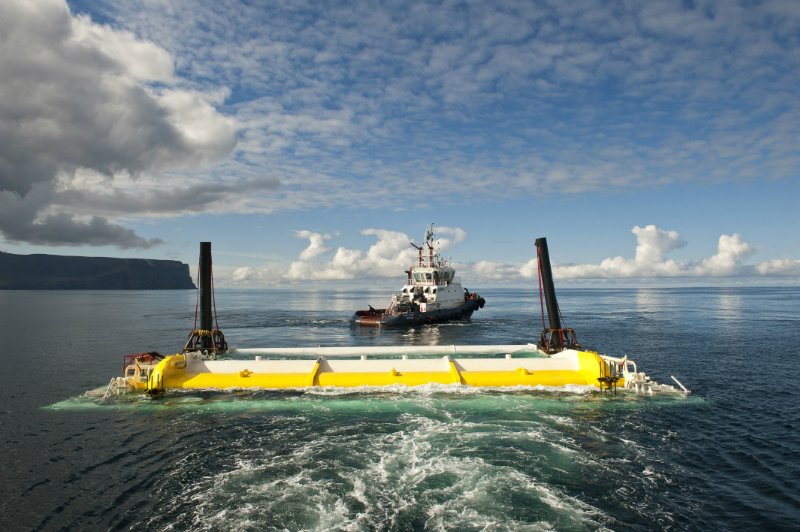
Oyster Oscillating Wave Surge Converter

Oscillating Wave Surge Converter

  • Oscillating wave surge devices typically have one end fixed to a substructure or the seabed while the other end is free to move. Energy is collected from the relative motion of the body, driven by the horizontal motion of waves (surge), to the fixed point. Oscillating wave surge converters often come in the form of floats, flaps, or membranes. Rotary motion at a hinge may drive a generator to produce electricity, or the moving body may be used to pressurize a fluid.
  • Environmental concerns include minor risk of collision or attraction, such as artificial reefing near the fixed point. Concerns about electromagnetic fields, impacts to water quality, and changes in flow are similar to that of a point absorber.

Photo Credit: Aquamarine Power

Marine and Wind Energy Environmental Documents

Tethys is a knowledge hub that contains documents on the environmental effects of wind and marine energy. The table below contains all of the documents in the Tethys Knowledge Base associated with Wave.

Total: 1018

Title Author Date Content Type Technology Stressor Receptor
Environmental impacts on marine energy systems: collision risks for marine animals and priority species for monitoring in Brazil Silva, C., Dagola, P., Moreira, M. Journal Article Marine Energy, Tidal, Wave Collision Birds, Fish, Marine Mammals
To fly or not to fly? Comparing vantage point and uncrewed aerial vehicle surveys for assessments of seabird abundance and fine-scale distribution Costagliola-Ray, M., Lieber, L., Nimmo-Smith, A. Journal Article Marine Energy, Tidal, Wave, Wind Energy, Fixed Offshore Wind Birds, Seabirds
SafeWAVE Deliverable 7.4: A Framework for Education and Public Engagement Smith, L., Quinlivan, L., Dunphy, N. Report Marine Energy, Wave Human Dimensions, Stakeholder Engagement
Development of a model for the identification of suitable areas for the development of wave energy projects in the European Atlantic region in the context of maritime spatial planning and its implementation into a Decision Support Tool Galparsoro, I., Mandiola, G., Gariner, R. Report Marine Energy, Wave Human Dimensions, Marine Spatial Planning
Introduction to Marine Energy National Renewable Energy Laboratory (NREL) Video Marine Energy, Tidal, Wave
Mapping potential environmental impacts of offshore renewable energy Galparsoro, I., Menchaca, I., Seeger, I. Report Marine Energy, Tidal, Wave, Wind Energy, Fixed Offshore Wind, Floating Offshore Wind Ecosystem Processes, Human Dimensions, Marine Spatial Planning
Mitigating Negative Impacts of Marine Renewable Energy on Biodiversity: The Role of International Environmental Law Marauhn, T., Böhringer, A-M., Jaś-Nowopolska, M. Journal Article Marine Energy, Tidal, Wave, Wind Energy, Fixed Offshore Wind, Floating Offshore Wind Human Dimensions, Legal & Policy
Implementation of the Spatial Environmental Assessment Toolkit McWilliams, S., Jones, C., Roberts, J. Presentation Marine Energy, Riverine, Tidal, Wave Habitat Change, Noise
Acoustic Characterization around the CalWave Wave Energy Converter Raghukumar, K., Chang, G., Spada, F. Presentation Marine Energy, Wave Noise
Ocean-Based Climate Solutions and the Blue Economy McMahon, S., Busch, J. Podcast Marine Energy, Tidal, Wave, Wind Energy Human Dimensions
Case study on the novel permitting and authorization of PacWave South, a US grid-connected wave energy test facility: Development, challenges, and insights Freeman, M., O'Neil, R., Garavelli, L. Journal Article Marine Energy, Wave Human Dimensions, Legal & Policy
Wave energy: history, implementations, environmental impacts, and economics Li, H., Sun, X., Zhou, H. Conference Paper Marine Energy, Wave Chemicals, Collision, Displacement Birds, Fish, Marine Mammals, Human Dimensions, Legal & Policy, Social & Economic Data
An ecosystem-based natural capital evaluation framework that combines environmental and socio-economic implications of offshore renewable energy developments Trifonova, N., Scott, B., Griffin, R. Journal Article Marine Energy, Tidal, Wave, Wind Energy, Fixed Offshore Wind, Floating Offshore Wind Ecosystem Processes, Human Dimensions, Fisheries, Legal & Policy, Marine Spatial Planning
A study into the potential social value offered to Europe from the development and deployment of wave and tidal energy to 2050 Ruiz-Minguela, P., Villate, J., Uriarte, X. Report Marine Energy, Tidal, Wave Human Dimensions, Social & Economic Data
MRE Regulator Survey Report: Australia Rose, D., Freeman, M. Report Marine Energy, Tidal, Wave
Life cycle assessment of a point-absorber wave energy array Pennock, S., Vanegas-Cantarero, M., Bloise-Thomaz, T. Journal Article Marine Energy, Wave Human Dimensions, Life Cycle Assessment
Experimental study of bed level changes in the vicinity of flap-type wave energy converters Taheri, O., Kolahdoozan, M., Faghihirad, S. Journal Article Marine Energy, Wave Changes in Flow, Habitat Change Physical Environment, Sediment Transport
Marine Renewable Energy (MRE) in the Tropics: An Overview of MRE Potential in Oaxaca, Mexico Oman, J. Report Marine Energy, Ocean Current, OTEC, Wave Changes in Flow, Collision, EMF, Entanglement, Habitat Change, Noise Birds, Seabirds, Fish, Pelagic Fish, Marine Mammals, Cetaceans, Human Dimensions, Environmental Impact Assessment, Legal & Policy, Recreation & Tourism, Social & Economic Data
Wave Energy in the Pacific Island Countries: A New Integrative Conceptual Framework for Potential Challenges in Harnessing Wave Energy Posterari, J., Waseda, T. Journal Article Marine Energy, Wave Human Dimensions, Social & Economic Data, Stakeholder Engagement
UK Ocean Energy Review 2021 University of Edinburgh, Jeffrey, H., Grattan, K. Report Marine Energy, Tidal, Wave
UK Offshore Energy Strategic Environmental Assessment 4 (OESEA4) UK Department for Business, Energy and Industrial Strategy (BEIS) Report Marine Energy, Tidal, Wave, Wind Energy, Fixed Offshore Wind Human Dimensions, Environmental Impact Assessment, Stakeholder Engagement
Coupled Wave Energy Converter and Nearshore Wave Propagation Models for Coastal Impact Assessments Flanagan, T., Wengrove, M., Robertson, B. Journal Article Marine Energy, Wave Changes in Flow Physical Environment
Project Summary of Outcomes and Results of Wave Energy in Southern Europe (WESE) Project Bald, J., Uyarra, M., Menchaca, I. Report Marine Energy, Tidal, Wave EMF, Habitat Change, Noise Physical Environment, Human Dimensions, Marine Spatial Planning
Environmental Effects from Wave Power: Artificial Reefs and Incidental No-take Zones Bender, A. Thesis Marine Energy, Wave Attraction, Habitat Change Fish, Invertebrates
Combining wind power and farmed fish: Coastal community perceptions of multi-use offshore renewable energy installations in Europe Billing, S., Charalambides, G., Tett, P. Journal Article Marine Energy, Wave, Wind Energy, Fixed Offshore Wind, Floating Offshore Wind Human Dimensions, Fisheries, Social & Economic Data
Field Observations of Scour Behavior around an Oscillating Water Column Wave Energy Converter Lancaster, O., Cossu, R., Heatherington, C. Journal Article Marine Energy, Wave Changes in Flow Physical Environment, Sediment Transport
Wave-Energy Devices Might Affect the Natural Environment: Scientists plan research to better understand effects Oregon State University, Pacific Marine Energy Center (PMEC), Northwest National Marine Renewable Energy Center (NNMREC) Magazine Article Marine Energy, Wave EMF, Entanglement, Noise Birds, Seabirds, Fish, Marine Mammals
Riding the wave: Challenges and opportunities for marine renewable energies in Canada’s energy transition Forrest, D., Li, X., Aviles, M. Report Marine Energy, Tidal, Wave, Wind Energy, Fixed Offshore Wind, Floating Offshore Wind
Socioeconomic Impacts of Wave Energy Knowledge and Service Providers to Oregon Garrett, J., Thompson, P., Conway, F. Report Marine Energy, Wave Human Dimensions, Social & Economic Data, Stakeholder Engagement
Use of Our Future Seas: Relevance of Spatial and Temporal Scale for Physical and Biological Indicators Trifonova, N., Scott, B., De Dominicis, M. Journal Article Marine Energy, Tidal, Wave, Wind Energy, Fixed Offshore Wind Habitat Change Ecosystem Processes, Physical Environment
The Potential of Wave Energy Conversion to Mitigate Coastal Erosion from Hurricanes Ozkan, C., Mayo, T., Passeri, D. Journal Article Marine Energy, Wave Changes in Flow Human Dimensions
Sector Locational Guidance: Enabling Evidence for Sustainable Development Wave Energy Welsh Government Report Marine Energy, Wave Birds, Fish, Marine Mammals, Physical Environment, Human Dimensions, Social & Economic Data, Stakeholder Engagement
SafeWAVE Deliverable 4.4 Use cases and profiles Leitão, J., Cardoso, S., Santos, H. Report Marine Energy, Wave Noise Birds, Invertebrates, Human Dimensions, Environmental Impact Assessment
A Review of Modeling Approaches for Understanding and Monitoring the Environmental Effects of Marine Renewable Energy Buenau, K., Garavelli, L., Hemery, L. Journal Article Marine Energy, Ocean Current, Tidal, Wave Changes in Flow, Collision, Displacement, EMF, Habitat Change, Noise
Wave Energy Roadmap - Realising the Potential of Wave Energy in the next 10 to 15 years Supergen Offshore Renewable Energy Hub Report Marine Energy, Wave
Predicting coastal impacts by wave farms: A comparison of wave-averaged and wave-resolving models David, D., Rijnsdorp, D., Hansen, J. Journal Article Marine Energy, Wave Changes in Flow Human Dimensions, Environmental Impact Assessment
Multi-use platforms at sea: A sustainable solution for aquaculture and biodiversity Demmer, J., Lewis, M., Neill, S. Book Chapter Marine Energy, Tidal, Wave Invertebrates, Human Dimensions, Fisheries
Grid connection and system services of a wave power plant - a case study Vrana, T., Akerberg, J., Flynn, D. Journal Article Marine Energy, Wave
Marine Energy Test Area (META) Pembrokeshire Coastal Forum Project Site Marine Energy, Tidal, Wave
NREL Programs Channel Students Toward the Future Water Power Workforce National Renewable Energy Laboratory (NREL) Report Marine Energy, Tidal, Wave Human Dimensions, Social & Economic Data

Displaying 161 - 200 of 1018 results