Wave

Capturing energy from waves.

Ocean surface waves are generated by wind passing over the ocean surface. The friction between the wind and ocean surface causes energy to be transferred from the faster moving air to the surface layer of the ocean. Wave development depends on the length of ocean, or “fetch,” over which the wind blows in a constant direction. Longer fetches with higher wind velocities will produce larger waves. Waves can travel thousands of miles with little energy loss and can combine with waves from storms and other wind-driven events to create very energetic seas. The energy of ocean waves is concentrated at the surface and decays rapidly with depth. Wave energy technologies, also known as wave energy converters (WECs), capture energy directly from the surface motion of ocean waves. WECs can be deployed at offshore, nearshore, and shore-based locations and are intended to be modular and deployed in arrays. Due to the diverse nature of waves in different regions of the world, there is a wide variety of WECs in various stages of research and development.
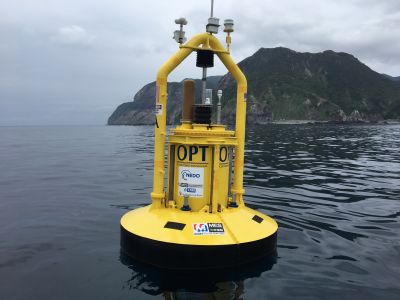
OPT Point Absorber

Point Absorber

  • Point absorbers extract energy through the relative motion between a body that moves in response to wave forcing and fixed or immobile structures. The moving body may be on the surface or submerged, and the 'fixed' body may be the seabed or another structure less affected by wave action. Their principal dimension is small relative to the length of waves they are absorbing energy from. Electricity may be produced using a linear or rotary generator, or a fluid may be pumped using mechanical force and motion directly.
  • The presence of these buoys may affect fish, marine mammals, and birds as they pose a minor collision risk or they may either attract organisms to the device or cause them to avoid the site. As with all electricity generation, there is some concern that electromagnetic fields generated by power cables and moving parts may affect animals that use Earth's natural magnetic field for orientation, navigation, and hunting. Large-scale changes in flow (from arrays) may disrupt natural physical systems to cause degradation in water quality or changes in sediment transport, potentially affecting ecosystem processes. Alternatively, devices absorbing wave energy may positively act as shoreline defense.

Photo Credit: Ocean Power Technologies

Surface Attenuator

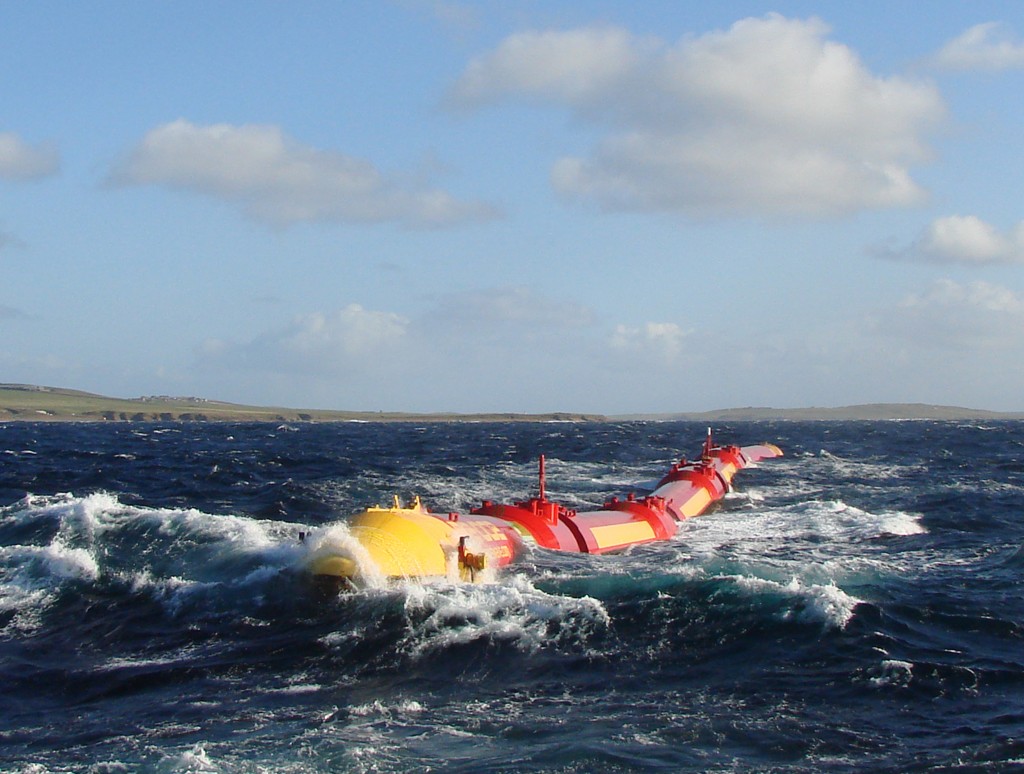
  • Surface attenuators generally have multiple segments connected to one another and that are oriented parallel with incoming waves. They use the rise and fall of swells to create a flexing motion that may be converted into rotation or drive hydraulic pumps to generate electricity. Some attenuator designs consist of a single long, flexible surface expression instead of multiple segments.
  • Concerns about collision, attraction or avoidance, electromagnetic fields, impacts on water quality, and changes in flow are similar to that of a point absorber, with an additional concern that organisms could be pinched in the joints.


Pelamis Wave Attenuator
Ocean Energy Oscillating Water Column

Oscillating Water Column

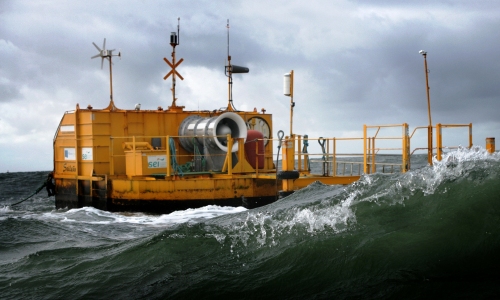
  • Oscillating water column devices use wave action to pressurize air in a chamber, forcing it through an air turbine. As water recedes from the chamber, the resulting vacuum pulls air back through the turbine and into the chamber. They can be located onshore or in deeper waters offshore. The turbine may be coupled to a rotary generator to produce electricity.
  • Significant noise is produced as air is pushed through the turbines, potentially affecting birds, marine mammals, and other marine organisms within the vicinity of the device. There is also concern about marine organisms getting entrapped within the air chambers. When located offshore, concerns about collision, attraction or avoidance, electromagnetic fields, and changes in flow are similar to that of a point absorber buoy; located onshore, these concerns are no different than for a standard shoreline structure.

Overtopping Device

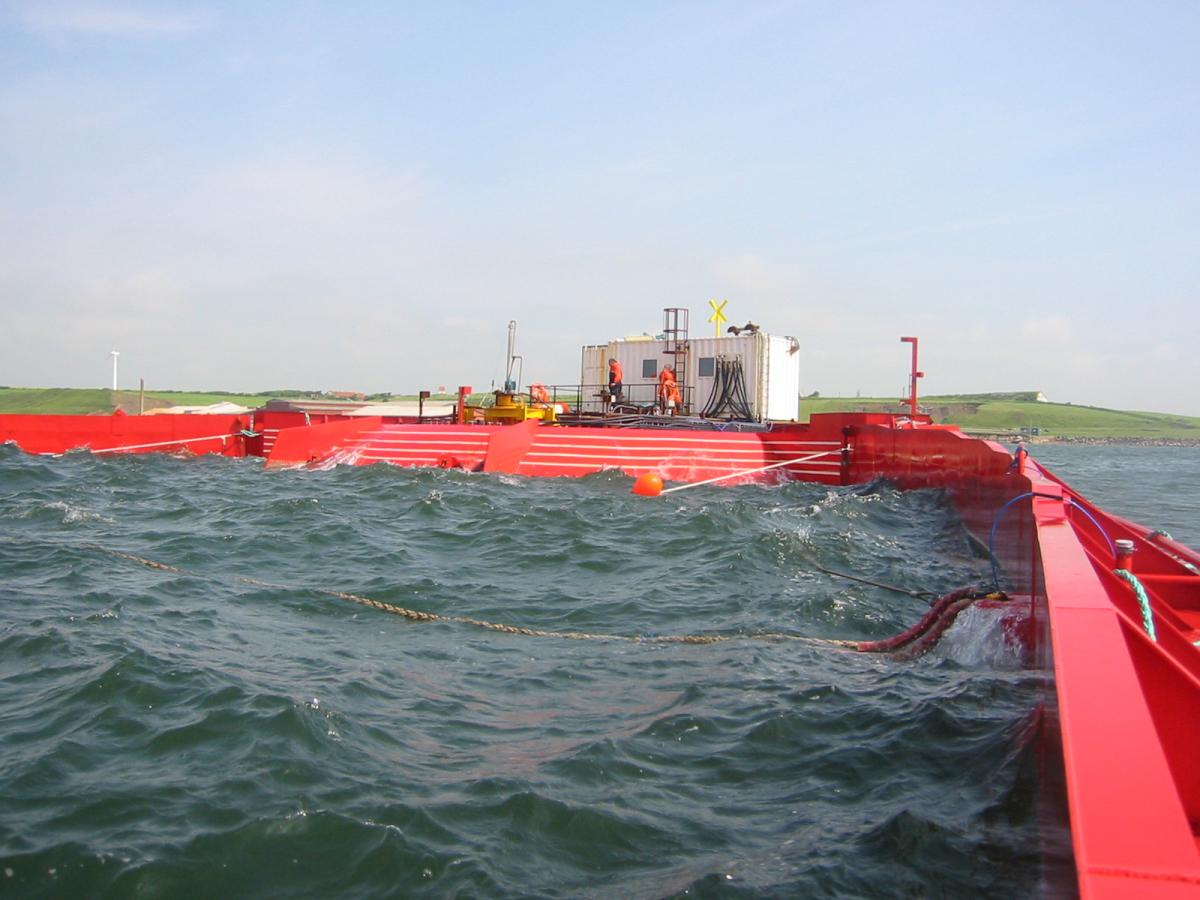
  • Overtopping devices are long structures that allow wave motion to fill a reservoir to a higher water level than the surrounding ocean. The difference in pressure between water in the reservoir and water at the surface forces fluid through a low-head turbine coupled to a generator, where electricity is produced similar to conventional hydropower. Devices can be either onshore or floating offshore.
  • There is some concern regarding low levels of turbine noise, marine organisms getting entrapped within the reservoir, or collision with the slow-moving turbines. When located offshore, concerns about attraction or avoidance, electromagnetic fields, and changes in flow are similar to that of a point absorber buoy; located onshore these concerns are no different than for a standard shoreline structure.
Wave Dragon Overtopping Device
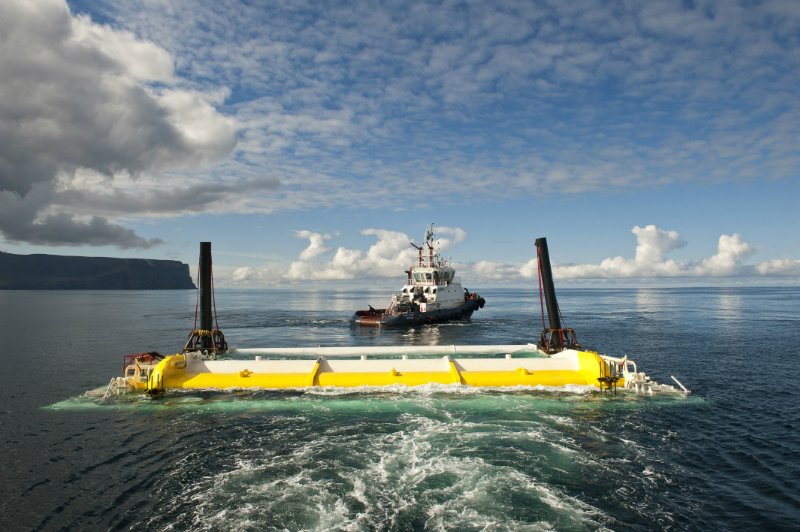
Oyster Oscillating Wave Surge Converter

Oscillating Wave Surge Converter

  • Oscillating wave surge devices typically have one end fixed to a substructure or the seabed while the other end is free to move. Energy is collected from the relative motion of the body, driven by the horizontal motion of waves (surge), to the fixed point. Oscillating wave surge converters often come in the form of floats, flaps, or membranes. Rotary motion at a hinge may drive a generator to produce electricity, or the moving body may be used to pressurize a fluid.
  • Environmental concerns include minor risk of collision or attraction, such as artificial reefing near the fixed point. Concerns about electromagnetic fields, impacts to water quality, and changes in flow are similar to that of a point absorber.

Photo Credit: Aquamarine Power

Marine and Wind Energy Environmental Documents

Tethys is a knowledge hub that contains documents on the environmental effects of wind and marine energy. The table below contains all of the documents in the Tethys Knowledge Base associated with Wave.

Total: 1024

Title Author Date Content Type Technology Stressor Receptor
The Role of Wave Energy Converter Farms on Coastal Protection in Eroding Deltas, Guadalfeo, Southern Spain Bergillos, R., López-Ruiz, A., Medina-López, E. Journal Article Wave, Marine Energy Changes in Flow Sediment Transport, Physical Environment
Assessment of Chemicals Released in the Marine Environment by Dielectric Elastomers Useful as Active Elements in Wave Energy Harvesters Zaltariov, M., Bele, A., Vasiliu, L. Journal Article Wave, Marine Energy Chemicals
The State of Knowledge for Environmental Effects: Driving Consenting/Permitting for the Marine Renewable Energy Industry Copping, A. Report Marine Energy, Tidal, Wave Human Dimensions
Seabird Counts at North Caithness Cliffs SPA in 2015 and 2016 for Marine Renewable Casework Swann, B. Report Marine Energy, Tidal, Wave, Wind Energy, Fixed Offshore Wind Birds, Seabirds
CorPower HiWave-3 at EMEC CorPower Ocean Project Site Marine Energy, Wave
Wave and Tidal Energy Johnson, K., Kerr, S. Book Chapter Wave, Tidal, Marine Energy
Stakeholder requirements for commercially successful wave energy converter farms Babarit, A., Bull, D., Dykes, K. Journal Article Wave, Marine Energy Stakeholder Engagement, Human Dimensions
Life Cycle Assessment of a multi-use offshore platform: Combining wind and wave energy production Elginoz, N., Bas, B. Journal Article Marine Energy, Wave, Wind Energy, Floating Offshore Wind Human Dimensions, Life Cycle Assessment
Project: The Pacific Marine Energy Center South Energy Test Site (PMEC-SETS) Final Report: Final Site Selection, Preliminary Facility Design, and Cost & Schedule Estimates Alcorn, R., Amon, E., Armstrong, S. Report Marine Energy, Wave
Assessing cumulative human activities, pressures, and impacts on North Sea benthic habitats using a biological traits approach Kenny, A., Jenkins, C., Wood, D. Journal Article Tidal, Wave, Wind Energy Human Dimensions
The Forward Look; an Ocean Energy Environmental Research Strategy for the UK Aquatera Ltd, MarineSpace Ltd Report Marine Energy, Tidal, Wave
ORJIP Ocean Energy: The Forward Look; an Ocean Energy Environmental Research Strategy for the UK [2017] Offshore Renewables Joint Industry Programme (ORJIP) Report Marine Energy, Tidal, Wave
Measuring Changes in Ambient Noise Levels from the Installation and Operation of a Surge Wave Energy Converter in the Coastal Ocean Henkel, S., Haxel, J. Report Marine Energy, Wave Noise
Large Scale Three-Dimensional Modelling for Wave and Tidal Energy Resource and Environmental Impact: Methodologies for Quantifying Acceptable Thresholds for Sustainable Exploitation Gallego, A., Side, J., Baston, S. Journal Article Wave, Tidal, Marine Energy Changes in Flow Physical Environment
Developing Methodologies for Large Scale Wave and Tidal Stream Marine Renewable Energy Extraction and its Environmental Impact: An Overview of the TeraWatt Project Side, J., Gallego, A., James, M. Journal Article Wave, Tidal, Marine Energy Changes in Flow
Numerical modelling of wave energy resources and assessment of wave energy extraction by large scale wave farms Venugopal, V., Nemalidinne, R., Vögler, A. Journal Article Marine Energy, Wave Changes in Flow Physical Environment
Wave and Tidal Range Energy Devices Offer Environmental Opportunities as Artificial Reefs Callaway, R., Bertelli, C., Lock, G. Conference Paper Marine Energy, Tidal, Wave Attraction, Habitat Change Invertebrates
Phase-resolving wave modeling for the wave characterization of coastal and nearshore Marine Renewable Energy sites Varing, A., Filipot, J-F., Roeber, V. Conference Paper Marine Energy, Wave Ecosystem Processes, Human Dimensions
Albatern WaveNet Device Isle of Muck Deployment Campbell, D. Report Marine Energy, Wave
Demonstration of a Socio-economic Cost of Energy Analysis of a Wave Energy Converter Array Crooks, D., de Andres, A., Medina-López, E. Conference Paper Marine Energy, Wave Human Dimensions, Social & Economic Data
Seasonal occurrence of seabirds and marine mammals at a wave energy test site Hunt, W., Nykänen, M., Bennison, A. Conference Paper Marine Energy, Wave Birds, Marine Mammals, Cetaceans
Final Report Feasibility Study for the California Wave Energy Test Center (CalWave) Volume 1 Blakeslee, S., Toman, W., Willaims, R. Report Marine Energy, Wave
Final Report Feasibility Study for the California Wave Energy Test Center (CalWave) Volume 2 Dooher, B., Toman, W., Davy, D. Report Marine Energy, Wave
Biodiversity Characterisation and Hydrodynamic Consequences of Marine Fouling Communities on Marine Renewable Energy Infrastructure in the Orkney Islands Archipelago, Scotland, UK Want, A., Crawford, R., Kakkonen, J. Journal Article Marine Energy, Tidal, Wave Habitat Change Invertebrates
Ocean Wave Energy in the United States: Current Status and Future Perspectives Lehmann, M., Karimpour, F., Goudey, C. Journal Article Wave, Marine Energy Social & Economic Data, Human Dimensions
Assessment of the Motion of Wave Power Generation by Water Tank Test Yoshida, T., Kitazawa, D., Mizukami, Y. Conference Paper Marine Energy, Wave
Measuring waves and currents at the European marine energy centre tidal energy test site: Campaign specification, measurement methodologies and data exploitation Sellar, B., Sutherland, D., Ingram, D. Conference Paper Marine Energy, Tidal, Wave
Coastal protection through wave farms: Feasibility assessment using numerical wave modelling and parametric study Flocard, F., Hoeke, R. Conference Paper Marine Energy, Wave Changes in Flow Physical Environment, Sediment Transport
Acoustic Life Cycle Assessment of Offshore Renewables - Implications from a Wave-Energy Converter Deployment in Falmouth Bay, UK Blondel, P., Walsh, J. Journal Article Wave, Marine Energy Noise
Characterisation of the Biofouling Community on a Floating Wave Energy Device Nall, C., Schläppy, M., Guerin, A. Journal Article Wave, Marine Energy Habitat Change Invertebrates
Acoustic characterization of wave energy converters Polagye, B., Murphy, P., Cross, P. Report Marine Energy, Wave Noise
The Impact of Marine Renewable Energy Extraction on Sediment Dynamics Neill, S., Robins, P., Fairley, I. Book Chapter Marine Energy, Tidal, Wave Changes in Flow Physical Environment, Sediment Transport
Wave energy and flow reduce the abundance and size of benthic species on oyster reefs Lunt, J., Reustle, J., Smee, D. Journal Article Wave, Marine Energy Invertebrates
Acoustic characterization of Mutriku OWC Plant Bald, J., Uriarte, A., Ruiz-Minguela, P. Presentation Marine Energy, Wave Noise
Monitoring the Condition of Marine Renewable Energy Devices through Underwater Acoustic Emissions: Case study of a Wave Energy Converter in Falmouth Bay, UK Walsh, J., Bashir, I., Garrett, J. Journal Article Wave, Marine Energy Noise
Impact of Climate Change on Wave Energy Resource: The Case of Menorca (Spain) Sierra, J., Casas-Prat, M., Campins, E. Journal Article Wave, Marine Energy Human Dimensions
Integration of wave energy and other marine renewable energy sources with the needs of coastal societies Manasseh, R., Sannasiraj, S., McInnes, K. Journal Article Wind Energy, Wave, Tidal, OTEC, Fixed Offshore Wind, Ocean Current, Marine Energy Social & Economic Data, Human Dimensions
Wind Wave Behavior in Fetch and Depth Limited Estuaries Karimpour, A., Chen, Q., Twilley, R. Journal Article Marine Energy, Wave
Experimental Measurement of Wave Field Variations around Wave Energy Converter Arrays O'Boyle, L., Elsäßer, B., Whittaker, T. Journal Article Marine Energy, Wave Changes in Flow Physical Environment
Wave hazards on microtidal shore platforms: testing the relationship between morphology and exposure Kennedy, D., Ierodiaconou, D., Weir, A. Journal Article Marine Energy, Wave Physical Environment

Displaying 441 - 480 of 1024 results