Wave

Capturing energy from waves.

Ocean surface waves are generated by wind passing over the ocean surface. The friction between the wind and ocean surface causes energy to be transferred from the faster moving air to the surface layer of the ocean. Wave development depends on the length of ocean, or “fetch,” over which the wind blows in a constant direction. Longer fetches with higher wind velocities will produce larger waves. Waves can travel thousands of miles with little energy loss and can combine with waves from storms and other wind-driven events to create very energetic seas. The energy of ocean waves is concentrated at the surface and decays rapidly with depth. Wave energy technologies, also known as wave energy converters (WECs), capture energy directly from the surface motion of ocean waves. WECs can be deployed at offshore, nearshore, and shore-based locations and are intended to be modular and deployed in arrays. Due to the diverse nature of waves in different regions of the world, there is a wide variety of WECs in various stages of research and development.
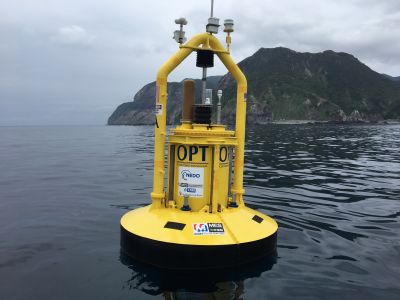
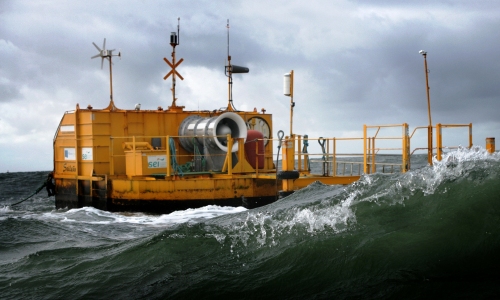
OPT Point Absorber

Point Absorber

  • Point absorbers extract energy through the relative motion between a body that moves in response to wave forcing and fixed or immobile structures. The moving body may be on the surface or submerged, and the 'fixed' body may be the seabed or another structure less affected by wave action. Their principal dimension is small relative to the length of waves they are absorbing energy from. Electricity may be produced using a linear or rotary generator, or a fluid may be pumped using mechanical force and motion directly.
  • The presence of these buoys may affect fish, marine mammals, and birds as they pose a minor collision risk or they may either attract organisms to the device or cause them to avoid the site. As with all electricity generation, there is some concern that electromagnetic fields generated by power cables and moving parts may affect animals that use Earth's natural magnetic field for orientation, navigation, and hunting. Large-scale changes in flow (from arrays) may disrupt natural physical systems to cause degradation in water quality or changes in sediment transport, potentially affecting ecosystem processes. Alternatively, devices absorbing wave energy may positively act as shoreline defense.

Photo Credit: Ocean Power Technologies

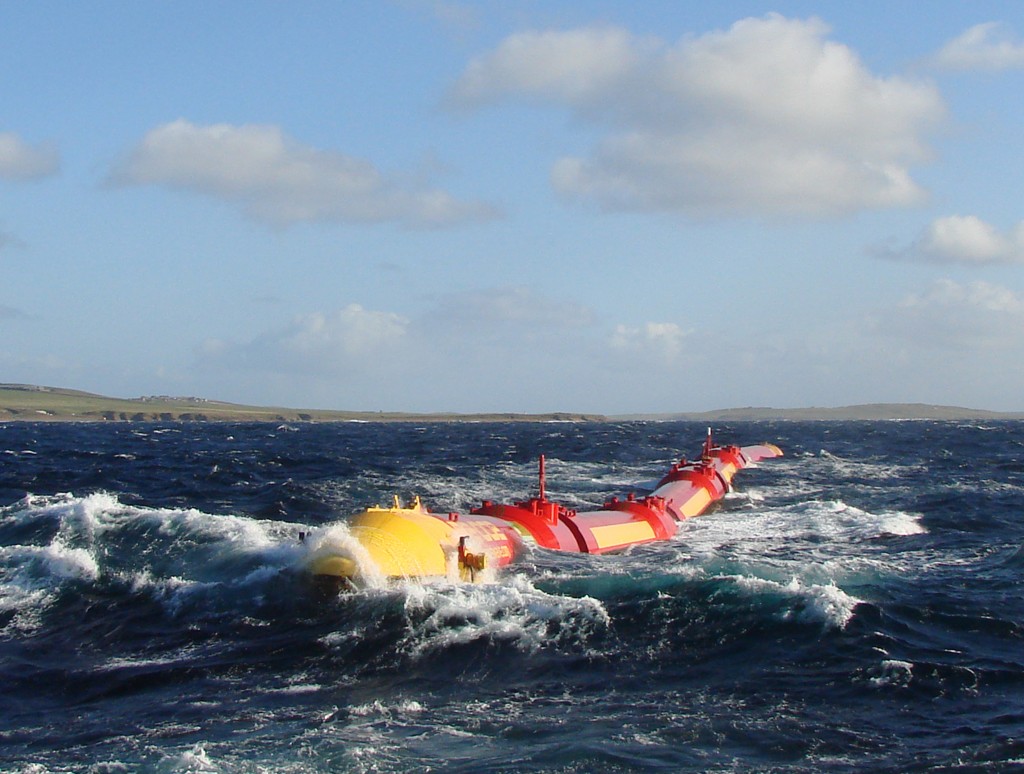
Surface Attenuator

  • Surface attenuators generally have multiple segments connected to one another and that are oriented parallel with incoming waves. They use the rise and fall of swells to create a flexing motion that may be converted into rotation or drive hydraulic pumps to generate electricity. Some attenuator designs consist of a single long, flexible surface expression instead of multiple segments.
  • Concerns about collision, attraction or avoidance, electromagnetic fields, impacts on water quality, and changes in flow are similar to that of a point absorber, with an additional concern that organisms could be pinched in the joints.


Pelamis Wave Attenuator
Ocean Energy Oscillating Water Column

Oscillating Water Column

  • Oscillating water column devices use wave action to pressurize air in a chamber, forcing it through an air turbine. As water recedes from the chamber, the resulting vacuum pulls air back through the turbine and into the chamber. They can be located onshore or in deeper waters offshore. The turbine may be coupled to a rotary generator to produce electricity.
  • Significant noise is produced as air is pushed through the turbines, potentially affecting birds, marine mammals, and other marine organisms within the vicinity of the device. There is also concern about marine organisms getting entrapped within the air chambers. When located offshore, concerns about collision, attraction or avoidance, electromagnetic fields, and changes in flow are similar to that of a point absorber buoy; located onshore, these concerns are no different than for a standard shoreline structure.

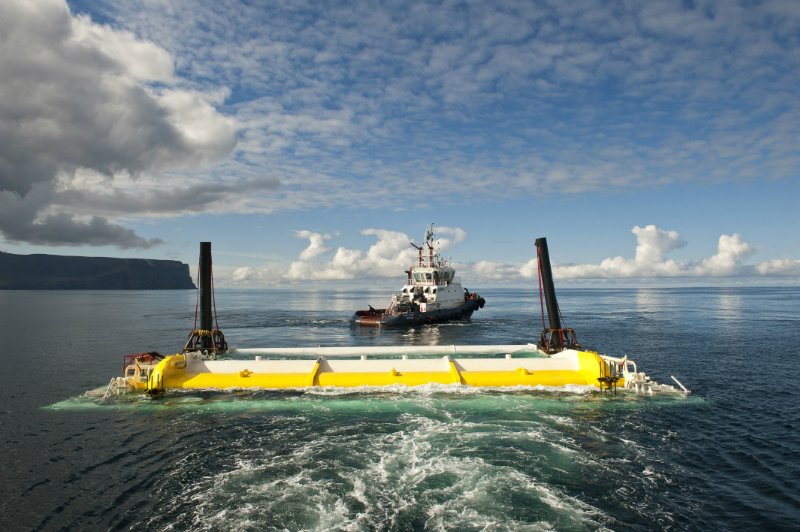
Overtopping Device

  • Overtopping devices are long structures that allow wave motion to fill a reservoir to a higher water level than the surrounding ocean. The difference in pressure between water in the reservoir and water at the surface forces fluid through a low-head turbine coupled to a generator, where electricity is produced similar to conventional hydropower. Devices can be either onshore or floating offshore.
  • There is some concern regarding low levels of turbine noise, marine organisms getting entrapped within the reservoir, or collision with the slow-moving turbines. When located offshore, concerns about attraction or avoidance, electromagnetic fields, and changes in flow are similar to that of a point absorber buoy; located onshore these concerns are no different than for a standard shoreline structure.
Wave Dragon Overtopping Device
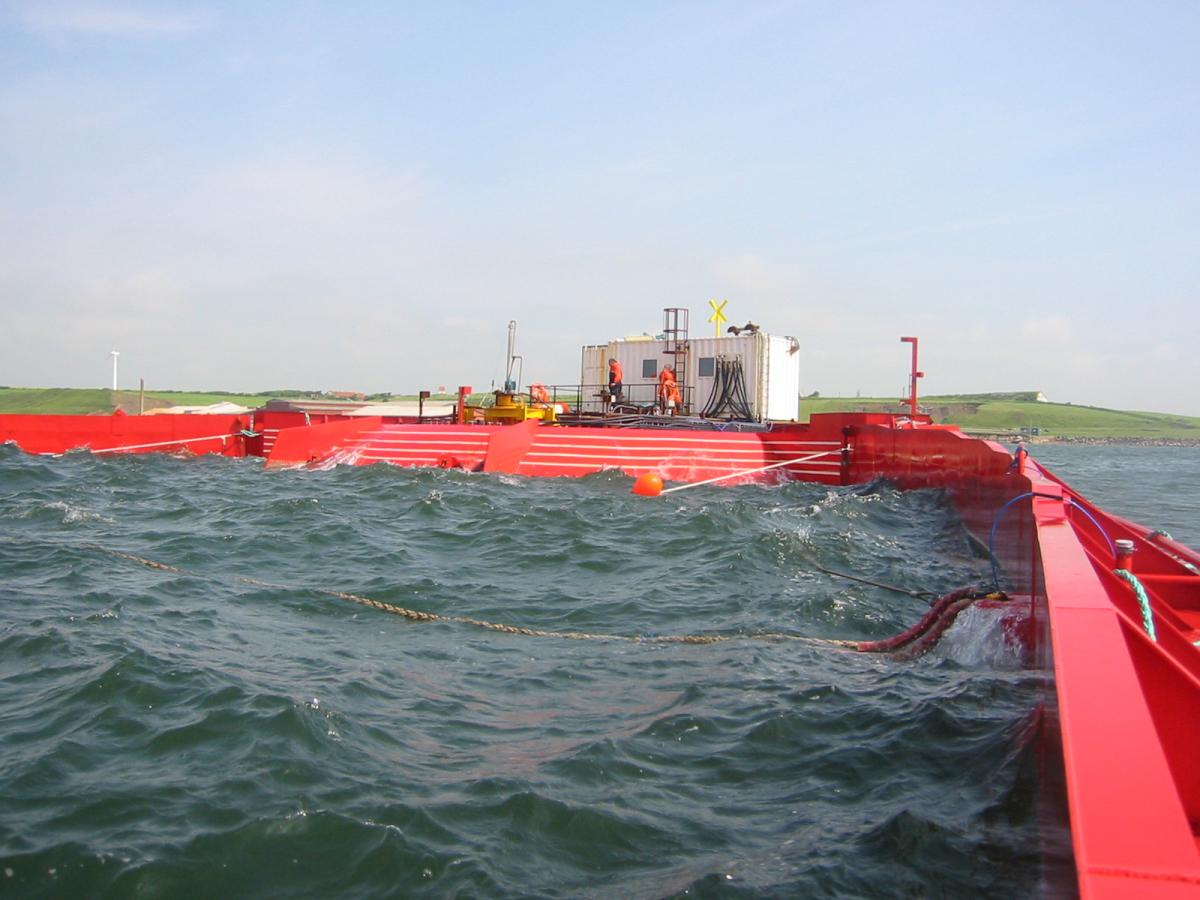
Oyster Oscillating Wave Surge Converter

Oscillating Wave Surge Converter

  • Oscillating wave surge devices typically have one end fixed to a substructure or the seabed while the other end is free to move. Energy is collected from the relative motion of the body, driven by the horizontal motion of waves (surge), to the fixed point. Oscillating wave surge converters often come in the form of floats, flaps, or membranes. Rotary motion at a hinge may drive a generator to produce electricity, or the moving body may be used to pressurize a fluid.
  • Environmental concerns include minor risk of collision or attraction, such as artificial reefing near the fixed point. Concerns about electromagnetic fields, impacts to water quality, and changes in flow are similar to that of a point absorber.

Photo Credit: Aquamarine Power

Marine and Wind Energy Environmental Documents

Tethys is a knowledge hub that contains documents on the environmental effects of wind and marine energy. The table below contains all of the documents in the Tethys Knowledge Base associated with Wave.

Total: 1024

Title Author Date Content Type Technology Stressor Receptor
Global ecological success of Thalassoma fishes in extreme coral reef habitats Fulton, C., Wainwright, P., Hoey, A. Journal Article Marine Energy, Wave Fish, Demersal Fish
EcoWatt2050 Project Summary Side, J. Report Marine Energy, Tidal, Wave Human Dimensions, Marine Spatial Planning
Acoustic Characteristics of the Lifesaver Wave Energy Converter Polagye, B., Murphy, P., Cross, P. Conference Paper Marine Energy, Wave Noise
WETS Acoustic Measurement Field Reports Sea Engineering Inc Report Marine Energy, Wave Noise
Sonar for environmental monitoring of marine renewable energy technologies Francisco, F. Thesis Marine Energy, Tidal, Wave, Wind Energy, Fixed Offshore Wind Noise Fish, Physical Environment, Human Dimensions
Fine-scale harbour seal at-sea usage mapping around Orkney and the North coast of Scotland Jones, E., Smout, S., Blight, C. Report Marine Energy, Tidal, Wave Marine Mammals, Pinnipeds
MARMOK-A-5 Wave Energy Converter IDOM Project Site Marine Energy, Wave
Multi-criteria evaluation of wave energy projects on the south-east Australian coast Flocard, F., Ierodiaconou, D., Coghlan, I. Journal Article Marine Energy, Wave Human Dimensions, Marine Spatial Planning
The location of offshore wave power devices structures epifaunal assemblages Langhamer, O. Journal Article Marine Energy, Wave Habitat Change Invertebrates
The role of nature-based infrastructure (NBI) in coastal resiliency planning: A literature review Saleh, F., Weinstein, M. Journal Article Marine Energy, Wave Fish
Progress in Renewable Energies Offshore Soares, C. Book Marine Energy, OTEC, Tidal, Wave, Wind Energy, Fixed Offshore Wind
MeyGen Tidal Energy Project Phase 1 Project Environmental Monitoring Programme Rollings, E., Donovan, C., Eastham, C. Report Marine Energy, Tidal, Wave
Effective Energy-Saving Device of Eco-Ship by Using Wave Propulsion Huang, S., Wu, T., Hsu, Y. Conference Paper Marine Energy, Wave
Camera technology for monitoring marine biodiversity and human impact Bicknell, A., Godley, B., Sheehan, E. Journal Article Wind Energy, Wave, Tidal, Fixed Offshore Wind, Marine Energy Invertebrates, Fish
Underwater Noise Propagation Models and its Application in Renewable Energy Parks: WaveRoller Case Study Rocha, A. Thesis Marine Energy, Wave Noise
Semi-Active Control of Sound Radiated From an Elastic Circular Plate Integrated With Adaptive Tuned Vibration Absorbers Hemmatian, M., Sedaghati, R. Conference Paper Marine Energy, Wave Noise
Biocide-Free Antifouling on Insulating Surface by Wave-Driven Triboelectrification-Induced Potential Oscillation Zhao, X., Tian, J., Kuang, S. Journal Article Marine Energy, Wave Chemicals
Hybrid Wave and Offshore Wind Farms: A Comparative Case Study of Co-located Layouts Astariz, S., Perez-Collazo, C., Abanades, J. Journal Article Wind Energy, Wave, Fixed Offshore Wind, Marine Energy
The role of agents for change in the sustainable development of wave energy in the Highlands and Islands region of Scotland Billing, S. Thesis Marine Energy, Wave Human Dimensions, Stakeholder Engagement
Numerical Modelling of Wave Energy Converters: Environmental Impact Assessment Kregting, L., Elsäßer, B. Book Chapter Marine Energy, Wave Changes in Flow, Chemicals Physical Environment
Are Wave and Tidal Energy Plants New Green Technologies? Douziech, M., Hellweg, S., Verones, F. Journal Article Marine Energy, Tidal, Wave
Environmental Impact Assessment: Gathering Experiences from Wave Energy Test Centres in Europe Greaves, D., Conley, D., Magagna, D. Journal Article Wave, Marine Energy Human Dimensions, Environmental Impact Assessment
Wave energy in Europe: Views on experiences and progress to date O'Hagan, A., Huertas, C., O'Callaghan, J. Journal Article Wave, Marine Energy Stakeholder Engagement, Legal & Policy, Human Dimensions
Direct drive surge wave energy converter with grid integration functionality Enferad, E., Nazarpour, D., Golshannavaz, S. Journal Article Marine Energy, Wave
Nearshore assessment of wave energy resources in central Chile (2009–2010) Mediavilla, D., Sepulveda, H. Journal Article Wave, Marine Energy
Eco Wave Power Wave Energy Power Station Gibraltar Eco Wave Power Ltd. Project Site Marine Energy, Wave
Wave and Tidal Current Energy - A Review of the Current State of Research Beyond Technology Uihlein, A., Magagna, D. Journal Article Wave, Tidal, Marine Energy
A Portable, Real-Time Passive Acoustic System and Autonomous Hydrophone Array for Noise Monitoring of Offshore Wave Energy Projects Haxel, J., Turpin, A., Matsumoto, H. Conference Paper Marine Energy, Wave Noise
Wave Energy Converter Array Environmental Evaluation Tools Jones, C., McWilliams, S., Chang, G. Conference Paper Marine Energy, Wave
Annex IV 2016 State of the Science Report: Environmental Effects of Marine Renewable Energy Development Around the World Copping, A., Sather, N., Hanna, L. Report Marine Energy, Tidal, Wave
Study on the Influence of the Distance to Shore for a Wave Energy Farm Operating in the Central Part of the Portuguese Nearshore Rusu, E., Onea, F. Journal Article Wave, Marine Energy Changes in Flow Physical Environment
Reviews of Power Supply and Environmental Energy Conversions for Artificial Upwelling Zhang, D., Fan, W., Yang, J. Journal Article Wave, OTEC, Marine Energy
Wave Energy Resource Characterization at the US Navy's Wave Energy Test Site, Hawaii Li, N., Cheung, K., Cross, P. Conference Paper Marine Energy, Wave
Numerical modeling of the effects of wave energy converter characteristics on nearshore wave conditions Chang, G., Ruehl, K., Jones, C. Journal Article Marine Energy, Wave Changes in Flow Physical Environment
Quantifying Benthic Secondary Productivity on Artificial Structures: Maximising the Benefit of Marine Renewable Energy Devices Rouse, S. Thesis Marine Energy, Tidal, Wave Habitat Change Physical Environment, Sediment Transport, Human Dimensions, Social & Economic Data
Buried Alive: The Behavioural Response of the Mussels, Modiolus modiolus and Mytilus edulis to Sudden Burial by Sediment Hutchison, Z., Hendrick, V., Burrows, M. Journal Article Marine Energy, Tidal, Wave, Wind Energy, Fixed Offshore Wind Invertebrates
Wave Energy Level and Geographic Setting Correlate with Florida Beach Water Quality Feng, Z., Reniers, A., Haus, B. Journal Article Wave, Marine Energy Changes in Flow
UK Offshore Energy Strategic Environmental Assessment 3 (OESEA3) UK Department for Business, Energy and Industrial Strategy (BEIS) Report Marine Energy, Tidal, Wave, Wind Energy, Fixed Offshore Wind Human Dimensions, Environmental Impact Assessment, Stakeholder Engagement
Beach Morphodynamics in the Lee of a Wave Farm: Synergies with Coastal Defence Abanades, J. Thesis Marine Energy, Wave Changes in Flow Physical Environment, Sediment Transport
Regulating wave and tidal energy: An industry perspective on the Scottish marine governance framework Wright, G. Journal Article Wave, Tidal, Marine Energy Legal & Policy, Human Dimensions

Displaying 481 - 520 of 1024 results