Tidal

Capturing energy from tidal fluctuations.

Gravity from the moon and sun cause water in the ocean to bulge in a cyclical pattern as the Earth rotates, causing water to rise and fall relative to the land in what are known as tides. Land constrictions such as straits or inlets can create high velocities at specific sites, which can be captured with the use of devices such as turbines. As seawater is about 800 times denser than air, tidal turbines can collect energy with slower water currents and smaller turbines than wind energy. Modern tidal power generating turbines operate on the same principles as wind turbines. While the moving water passes the turbine’s blades, the kinetic energy of moving water is converted into mechanical energy as the rotating blades spin a drive shaft. The mechanical energy in the drive shaft is then converted to electrical energy using a generator, often through a gearbox. Power may also be produced by extracting potential energy from the rise and fall of the tides in a manner similar to conventional hydropower.

Sabella D10 Axial Flow Tidal Turbine

Axial Flow Turbine

  • These turbines are the most similar to traditional wind turbines, where the kinetic energy of moving water is captured by spinning blades facing the direction of flow. Turbines can be open or ducted (shrouded) and placed anywhere in the water column, though bottom-mounted is the most common. Turbines may use active or passive measures to yaw or vane in the direction of flow. They can have pitching blades allowing them to change their hydrodynamic performance based on flow conditions or control settings.
  • The main environmental concern is collision between turbine blades and marine organisms due to natural animal movements, attraction to the device, or inability to avoid the turbines within strong currents. There is also concern that noise from turbines can affect animals that use sound for communication, social interaction, orientation, predation, and evasion. As with all electricity generation, there is a slight concern that electromagnetic fields generated by power cables and moving parts of the turbines may affect animals that use Earth's natural magnetic field for orientation, navigation, and hunting. Likewise, chemicals such as anti-corrosion paint and small amounts of oil and grease may enter the waterbody during spills, though some turbine designs do not require lubrication, and affect water quality. Large-scale tidal changes in flow (from arrays) may disrupt natural physical systems to cause degradation in water quality or changes in sediment transport, potentially affecting ecosystem processes.

Photo Credit: BALAO-SABELLA

Cross Flow Turbine

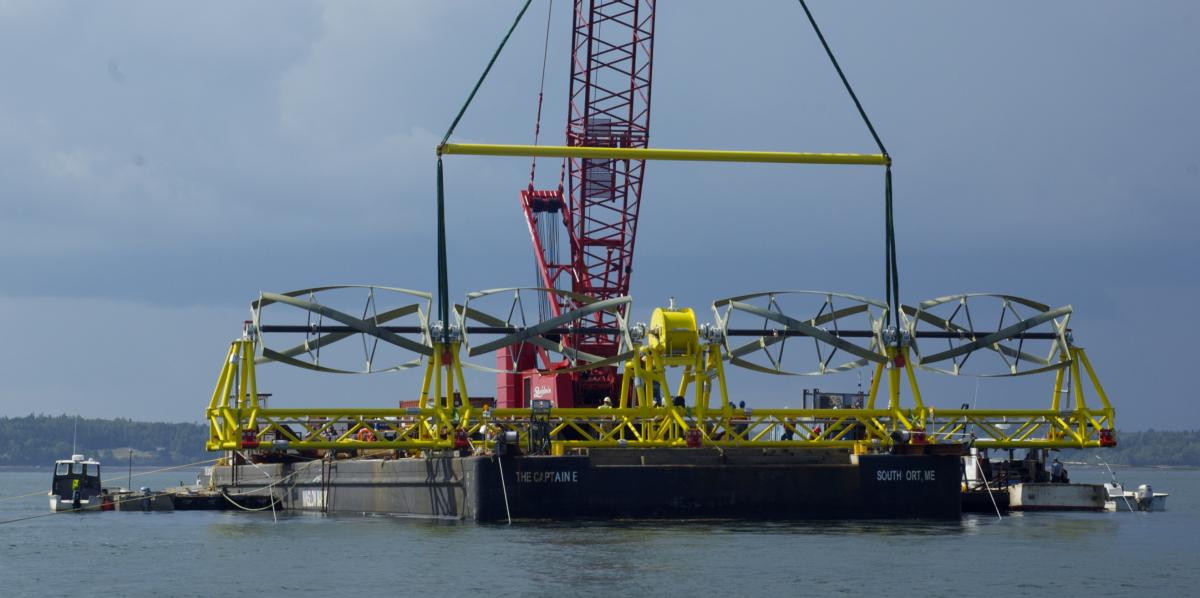
  • These turbines capture kinetic energy of moving water with spinning blades oriented perpendicular to the direction of flow. They can be mounted in either vertical or horizontal orientations. When mounted vertically, these devices can operate regardless of the direction of flow. They typically have cylindrical cross-sections amenable to placement in confined channels or allowing tight array spacing. Turbines can be open or ducted (shrouded) and placed anywhere in the water column, though bottom-mounted is the most common. The electricity production mechanism is similar to axial-flow turbines.
  • There is typically less environmental concern for collision between turbine blades and marine organisms because, depending on the design, blades are spinning in the same direction to the flow of water. Concerns about noise, electromagnetic fields, changes in flow, and impacts on water quality are similar to that of axial flow turbines.

Photo Credit: Ocean Renewable Power Company (ORPC)

ORPC TidGen Cross Flow Tidal Turbine
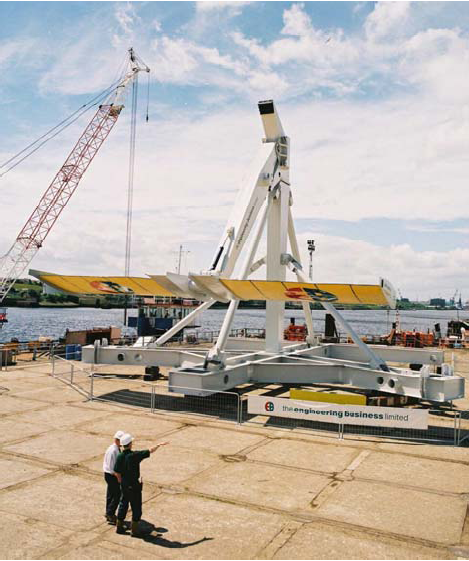
Reciprocating Tidal Device

Reciprocating Device

  • Reciprocating devices do not have rotating components and instead have a hydrofoil that is pushed back and forth transverse to the flow direction by lift or drag. Oscillating devices are the most common form of reciprocating devices. Oscillating hydrofoils operate via passive or active manipulation of one or more foils to induce hydrodynamic lift and drag forces due to pressure differences on the foils. They may be oriented horizontally or vertically, though like axial-flow turbines, they must face the direction of flow for maximum energy extraction. Linear motion of the foils may be converted to rotary motion for electricity generation, or linear generators may be used.
  • Reciprocating devices often move slower than turbines, but move more freely in the water, resulting in some concern for collision. Depending on the design and generator, reciprocating devices often produce little noise. Concerns about electromagnetic fields, impacts on water quality, and changes in flow are similar to that of other tidal devices.

Tidal Kite

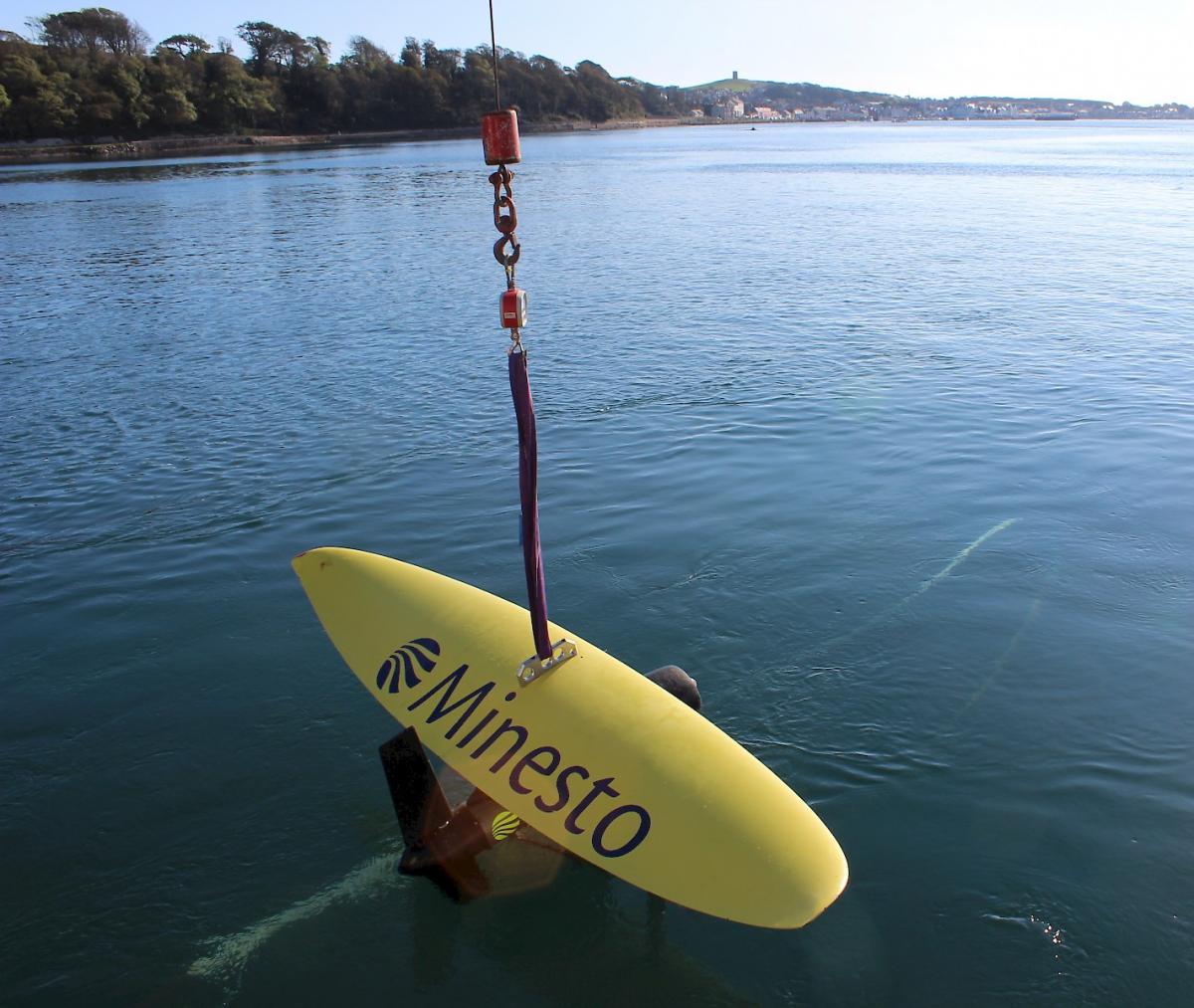
  • A tidal kite is comprised of a hydrodynamic wing, with a turbine attached, tethered by a cable to a fixed point that leverages flow to lift the wing. As the kite 'flies' loops through the water, the speed increases around the turbine, allowing more energy extraction for slower currents. The kite is neutrally buoyant so as not to fall as the tide changes direction. Electricity production is by means of a generator coupled to the turbine. Power is transferred through a cable coupled to or as part of the tether.
  • Collision risk may be of some concern with tidal kites. Although animals are more likely to collide with the tether than the kite itself, little is known about the ability of animals to detect the free movement of some tidal kites. Tidal kites can emit noise over a larger frequency than horizontal axis turbines depending on the design and generator. Concerns about electromagnetic fields, impacts on water quality, and changes in flow are similar to that of other tidal devices.
Minesto DG500 Tidal Kite
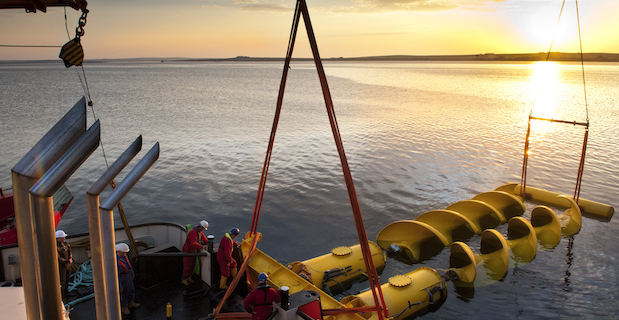
Archimedes Screw Tidal Energy Device

Archimedes' Screw

  • Historically designed to efficiently transfer water up a tube, an Archimedes screw is a helical surface surrounding a ventral cylindrical shaft. Energy is generated as water flow moves up the spiral and rotates the device. The slow rotation implies coupling to a generator through a gearbox.
  • The helical turbine moves very slowly relative to other tidal technologies and is likely to have little collision risk. Archimedes screws often produce little noise, though this depends on the design and generator. Concerns about electromagnetic fields, impacts on water quality, and changes in flow are similar to that of other tidal devices.

Tidal Lagoon

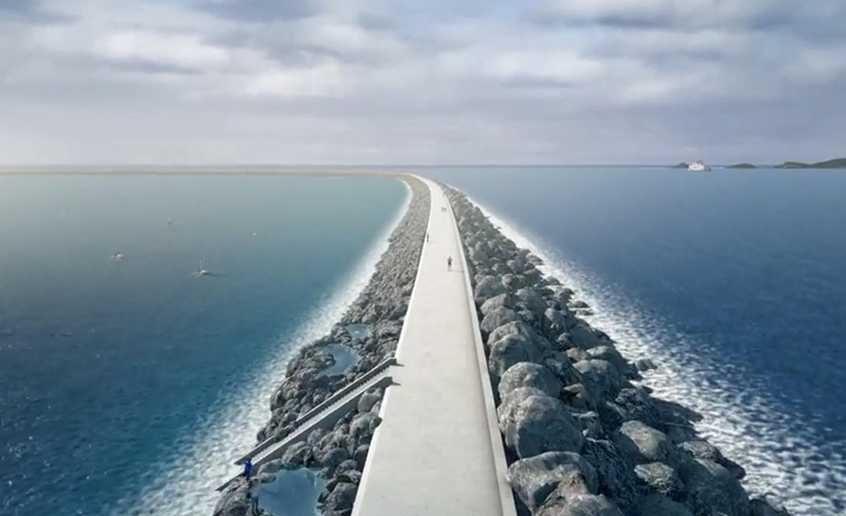
  • Tidal lagoons are comprised of retaining walls embedded with low-head turbines that surround a large reservoir of water. Functioning similar to a hydroelectric dam, tides cause a difference in the water height inside and outside the walls of tidal lagoons. The ecosystem within the reservoir undergoes significant transformation, potentially yielding positive impacts with a more diverse seabed, depending on site selection.
  • Changes to the physical environment are expected to be similar to conventional marine engineering projects and can include changes in flow and ecosystem processes. Decreased flushing of the reservoir may cause some problems for water quality. There are some collision concerns that arise if fish and invertebrates try to traverse the retaining wall through the turbines. Impacts from noise depend on turbine selection. There is little concern for electromagnetic fields because cables are embedded in the retaining wall and are not openly exposed to water. The new reservoir may also create calmer waters that allow for new recreation and tourism opportunities.
Swansea Bay Tidal Lagoon
La Rance Tidal Barrage

Tidal Barrage

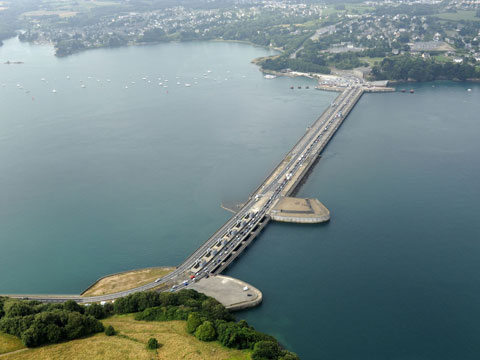
  • Tidal barrages capture water in a holding area, making use of the difference in water height from one side of the barrage to the other. Water is then released through a large turbine or turbines as it flows out with the ebb of the tide. They are typically built across the entrance to a bay or estuary and generate electricity using the difference in water height inside and outside of the structure. A minimum height fluctuation of 5 meters (16.4 feet) is typically required to justify the construction of tidal barrages, so only 40 locations worldwide have been identified as feasible.
  • Installing a tidal barrage impacts bay or estuary ecosystems due to changes in flow and can have negative effects such as changing the shoreline and important tidal flats. Inhibiting the flow of water in and out of the bay, may also lead to less flushing of the bay or estuary, altering the water quality, and potentially causing additional turbidity (suspended solids) and less saltwater, which may result in the death of fish that act as a vital food source to birds and marine mammals. Migrating fish may also be unable to access breeding streams, and may attempt to pass through the turbines and risk collision. Impacts from noise depend on turbine selection, similar to tidal lagoons. Decreasing shipping accessibility can become a major socio-economic issue, though locks can be added to allow slow passage. However, the barrage may improve the local economy by increasing land access when used as a bridge and allowing for more recreation and tourism opportunities due to calmer waters.

Marine and Wind Energy Environmental Documents

Tethys is a knowledge hub that contains documents on the environmental effects of wind and marine energy. The table below contains all of the documents in the Tethys Knowledge Base associated with Tidal.

Total: 1291

Title Author Date Content Type Technology Stressor Receptor
Attitudes towards Marine Energy: Understanding the Values de Groot, J. Thesis Marine Energy, Tidal, Wave, Wind Energy, Fixed Offshore Wind Human Dimensions, Social & Economic Data
Public Perceptions and Externalities in Tidal Stream Energy: A Valuation for Policy Making Vazquez, A., Iglesias, G. Journal Article Tidal, Marine Energy Social & Economic Data, Human Dimensions
Evaluation of Behavior and Survival of Fish Exposed to an Axial-Flow Hydrokinetic Turbine Amaral, S., Bevelhimer, M., Cada, G. Journal Article Tidal, Marine Energy Collision, Avoidance Pelagic Fish, Fish, Demersal Fish
The Maine Tidal Power Initiative: Transdisciplinary Sustainability Science Research for the Responsible Development of Tidal Power Jansujwicz, J., Johnson, T. Journal Article Tidal, Marine Energy Social & Economic Data, Human Dimensions
Environmental Risk Evaluation System - An Approach to Ranking Risk of Ocean Energy Development on Coastal and Estuarine Environments Copping, A., Hanna, L., Van Cleve, B. Journal Article Wind Energy, Wave, Tidal, Fixed Offshore Wind, Marine Energy Habitat Change, Displacement, Collision, Chemicals, Changes in Flow, Avoidance, Attraction Marine Mammals, Fish, Birds
Understanding and Informing Permitting Decisions for Tidal Energy Development Using an Adaptive Management Framework Jansujwicz, J., Johnson, T. Journal Article Tidal, Marine Energy Legal & Policy, Human Dimensions
Churchill Barriers - Wave Overtopping and Tidal Flow Energy Capture: Screening Request Harrison, J., Tobin, F., Revill, D. Report Marine Energy, Tidal
Deep Green Project Holyhead Deep: Benthic Technical Report Centre for Marine and Coastal Studies Ltd (CMACS) Report Marine Energy, Tidal Habitat Change Human Dimensions, Environmental Impact Assessment
Tidal Power Development in Maine: Stakeholder Identification and Perceptions of Engagement Johnson, T., Jansujwicz, J., Zydlewski, G. Journal Article Tidal, Marine Energy Stakeholder Engagement, Human Dimensions
Adaptable Monitoring Package (AMP) Polagye, B., Stewart, A., Joslin, J. Research Study Marine Energy, Tidal, Wave Attraction, Avoidance, Collision, Displacement, Noise Birds, Fish, Invertebrates, Marine Mammals, Physical Environment
RiCORE Project Gray, D., O'Hagan, A., Bald, J. Research Study Wave, Tidal, Marine Energy Human Dimensions
Consenting Guidance for Developers at the EMEC Fall of Warness Test Site European Marine Energy Centre (EMEC) Report Marine Energy, Tidal Human Dimensions, Legal & Policy
Evaluating biological characteristics of marine renewable energy sites for environmental monitoring Wiesebron, L. Thesis Tidal, Marine Energy
A Modeling Study of the Potential Water Quality Impacts from In-Stream Tidal Energy Extraction Wang, T., Yang, Z., Copping, A. Journal Article Tidal, Marine Energy Changes in Flow Water Quality, Physical Environment
Assessing Marine Mammal Presence in and Near the FORCE Lease Area During Winter and Early Spring - Addressing Baseline Data Gaps and Sensor Performance Redden, A., Porskamp, P. Report Marine Energy, Tidal Marine Mammals
Fish Interactions with a Commercial-Scale Tidal Energy Device in the Natural Environment Viehman, H., Zydlewski, G. Journal Article Tidal, Marine Energy Pelagic Fish, Fish
TeraWatt Position Papers TeraWatt Report Marine Energy, Tidal, Wave Changes in Flow
Examining the Impacts of Tidal Energy Capture from an Ecosystem Services Perspective Leslie, H., Palmer, M. Journal Article Tidal, Marine Energy Social & Economic Data, Human Dimensions
Using Hydroacoustics to Understand Fish Presence and Vertical Distribution in a Tidally Dynamic Region Targeted for Energy Extraction Viehman, H., Zydlewski, G., McCleave, J. Journal Article Tidal, Marine Energy Pelagic Fish, Fish
Application of Tidal Energy for Purification in Fresh Water Lake Jung, R., Isshiki, H. Journal Article Tidal, Marine Energy
Data collection, analysis and provision for the FaBTest site Ashton, I., Blundy, R. , Harnois, V. Report Marine Energy, Tidal Human Dimensions
Depth use and movements of homing Atlantic salmon (Salmo salar) in Scottish coastal waters in relation to marine renewable energy development Godfrey, J., Stewart, D., Middlemas, S. Report Marine Energy, Tidal, Wave, Wind Energy, Fixed Offshore Wind Fish, Pelagic Fish
Impact of Tidal-Stream Arrays in Relation to the Natural Variability of Sedimentary Processes Robins, P., Neill, S., Lewis, M. Journal Article Marine Energy, Tidal Changes in Flow Physical Environment, Sediment Transport
Developing regional locational guidance for wave and tidal energy in the Shetland Islands Tweddle, J., Marengo, I., Gray, L. Journal Article Marine Energy, Tidal, Wave Human Dimensions, Marine Spatial Planning, Stakeholder Engagement
An Evaluation of the Use of Shore-Based Surveys for Estimating Spatial Overlap between Deep-Diving Seabirds and Tidal Stream Turbines Waggitt, J., Bell, P., Scott, B. Journal Article Tidal, Marine Energy Birds
Environmental and ecological effects of Lake Shihwa reclamation project in South Korea: A review Lee, C., Lee, B. , Chang, W. Journal Article Marine Energy, Riverine, Tidal Human Dimensions
Environmental impact assessment for tidal energy schemes: an exemplar case study of the Strait of Messina El-Geziry, T. , Bryden, G. , Couch, S. Journal Article Marine Energy, Tidal Human Dimensions, Environmental Impact Assessment
Perpetuus Tidal Energy Centre: Environmental Statement Non-Technical Summary Royal Haskoning DHV Report Marine Energy, Tidal
Swansea Bay Tidal Lagoon Adaptive Environmental Management Plan Tidal Lagoon Swansea Bay Plc Report Marine Energy, Tidal Human Dimensions, Environmental Impact Assessment
Tidal Generation Limited Appropriate Assessment Holland, G. Report Marine Energy, Tidal Human Dimensions
Detecting Potential and Actual Turbine-Marine Life Interactions: A Call for the Development of Best Practices Redden, A. Presentation Marine Energy, Tidal
Estimates of Collision Risk of Harbour Porpoises and Marine Renewable Energy Devices at Sites of High Tidal-Stream Energy Wilson, B., Benjamins, S., Elliot, J. Report Tidal, Marine Energy Collision, Avoidance Marine Mammals, Cetaceans
GHYDRO: Methodology Guide for Assessment of Environmental Impacts of Tidal Stream Energy Technologies at Sea Lejart, M. Presentation Marine Energy, Tidal Human Dimensions, Legal & Policy
Simulating Blade-Strike on Fish Passing Through Marine Hydrokinetic Turbines Romero-Gomez, P., Richmond, M. Journal Article Tidal, Riverine, Marine Energy Collision Pelagic Fish, Fish, Demersal Fish
Assessing the Influence of Inflow Turbulence on Noise and Performance of a Tidal Turbine using Large Eddy Simulations Lloyd, T., Turnock, S., Humphrey, V. Journal Article Marine Energy, Tidal Noise
Outer Bay of Fundy Tidal Energy Development: Where the Leviathans Live Trowse, G., Malinka, C. Presentation Tidal, Marine Energy
Modeling of In-Stream Tidal Energy Development and its Potential Effects in Tacoma Narrows Washington USA Yang, Z., Wang, T., Copping, A. Journal Article Marine Energy, Tidal Changes in Flow Physical Environment, Water Quality
Comparison of hydro-environmental impacts for ebb-only and two-way generation for a Severn Barrage Ahmadian, R., Falconer, R., Bockelmann-Evans, B. Journal Article Tidal, Marine Energy Changes in Flow Sediment Transport, Physical Environment
Modelling the Far Field Hydro-Environmental Impacts of Tidal Farms - A Focus on Tidal Regime, Intertidal Zones and Flushing Nash, S., O'Brien, N., Olbert, A. Journal Article Tidal, Marine Energy Physical Environment
In-Situ Ecological Interactions with a Deployed Tidal Energy Device; An Observational Pilot Study Broadhurst, M., Barr, S., Orme, D. Journal Article Marine Energy, Tidal Fish, Demersal Fish, Pelagic Fish

Displaying 761 - 800 of 1291 results