



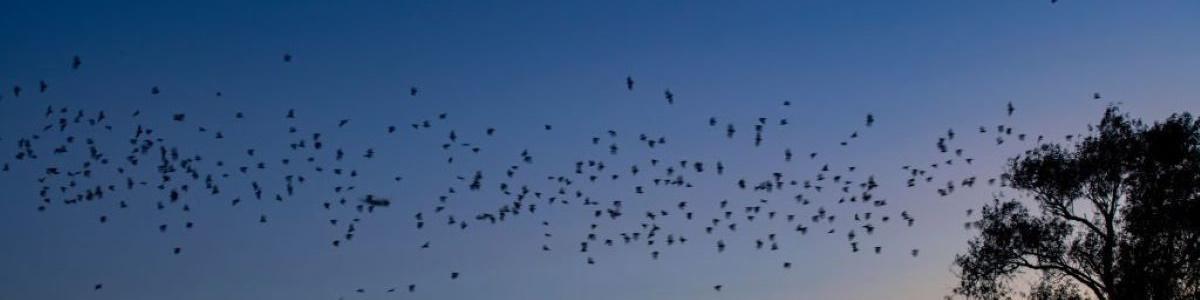
In North America, several bat species commonly collide with operating turbines. Although the ultimate cause of collisions is unknown, studies suggest bats may be attracted to turbines because they often approach turbine structures and spend extended periods of time (seconds to minutes) near them. To reduce bat mortality at wind farms, operators seek to reduce the amount of time bats spend near spinning turbine blades (known as exposure). Current approaches to reduce exposure include both curtailment, in which turbine operators stop turbine rotors from spinning during periods when bats are expected to be at the highest risk of collision, and deterrent technologies that seek to discourage bats from entering the rotor-swept area or at least limit the amount of time spent there.
The use of ultrasonic deterrent devices that emit one or more high-frequency sounds has been the most tested technique. The idea behind using ultrasound as a deterrent is it disrupts the ability of bats to effectively echolocate (sometimes referred to as signal jamming). According to this idea, introducing ultrasonic noise in the environment in the same frequency ranges that bats use to echolocate makes it difficult for bats to reliably interpret their own ultrasonic vocalizations. Bats are expected to vacate environments where echolocation is required but becomes unreliable. To test this hypothesis, researchers have investigated the behavioral responses of bats in laboratory (Spanjer 2006) and natural settings (Szewczak and Arnett 2007; Gilmour et al. 2020; Fritts et al. 2024).
In one of the earliest studies on the topic, Szewczak and Arnett (2007) used ultrasonic deterrents at a natural pond that bats frequented for drinking and foraging. Szewczak and Arnett demonstrated that ultrasonic deterrents greatly reduced the overall bat activity rates within a distance of approximately 20 meters (m). Despite relatively consistent results using ultrasound deterrents in natural settings (Szewczak and Arnett 2007; Gilmour et al. 2020) and as a tool to discourage bats (at least temporarily) from approaching buildings and bridges (Zeale et al. 2016; Aldemir Bektas et al. 2022), researchers’ ability to reduce bat mortality rates around wind turbines has been inconsistent (Table 1). For example, Weaver et al. (2020) found that ultrasonic deterrents reduced hoary bat (Lasiurus cinereus) and Brazilian free-tailed bat (Tadarida brasiliensis) fatalities but found no difference in the number of northern yellow bat (Lasiurus intermedius) carcasses between turbines with and without ultrasonic deterrents. Despite overall reductions in bat fatalities, several studies reported increased fatalities when considering species-specific effects.
View Ultrasonic Deterrents To Reduce Bat Mortality at Wind Turbines—Short Science Summary here.
The table below contains the literature relevant to this summary document and will continue to be updated as new literature is added to Tethys.
| Title | Author | Date Sort ascending | Content Type | Technology | Stressor | Receptor |
|---|---|---|---|---|---|---|
| Mitigating wildlife collisions with wind turbines: A review of techniques, evidence, knowledge gaps and avenues for future research | Kuzovnikova, E., Whale, J., Shephard, J., Fleming, P. | Journal Article | Wind Energy, Land-Based Wind, Fixed Offshore Wind | Collision | Bats, Birds | |
| Hoary Bat (Lasiurus cinereus) ecology and conservation through the lens of the full annual cycle | Felton, S., Weller, T., Hale, A., Frick, W., Jonasson, K., Clerc, J., Hein, C., Baerwald, E., Schauber, E. | Journal Article | Wind Energy, Land-Based Wind | Collision | Bats | |
| Optimising bat-friendly curtailment algorithms for wind turbines | Barre, K., Kravchenko, K., Chambert, T., Comau, A.C, Pessato, A., Ravache, A., Sivault, E., Treyvaud, C., Verniest, F., Kerbiriou, C., Vincenot, C. | Journal Article | Wind Energy, Land-Based Wind | Collision | Bats | |
| Synergies and trade-offs between biodiversity and distance to settlements in the spatial allocation of wind power | Luukkonen, S., Räsänen, A., Koivula, M., Tolvanen, A. | Journal Article | Wind Energy, Land-Based Wind | Collision, Displacement, Habitat Change | Bats, Birds, Ecosystem Processes, Terrestrial Mammals, Human Dimensions, Legal & Policy, Social & Economic Data, Stakeholder Engagement, Visual Impacts | |
| 3rd Edition: Summary of Bat Fatality Monitoring Data Contained in AWWIC Land-based Wind Energy Monitoring Database | Schauber, E., Butryn, R., Felton, S. | Report | Wind Energy, Land-Based Wind | Collision | Bats | |
| Species-specific acoustic responses by bats to ultrasonic stimuli used for reducing bat-wind turbine interactions | Guest, E., Weaver, S., Hale, A., Morton, B., Hein, C., Fritts, S. | Journal Article | Wind Energy, Land-Based Wind | Collision | Bats | |
| Airflow Dynamics and Bat Behavior Near Wind Energy Turbines and Trees | Electric Power Research Institute (EPRI) | Report | Wind Energy, Land-Based Wind | Attraction, Avoidance, Collision | Bats | |
| Pooling information across sites and years to estimate bat fatalities at wind farms | Berberian, N., Dixon, P. | Journal Article | Wind Energy, Land-Based Wind | Collision | Bats | |
| Impacts of Renewable Energy Sources on Biological Diversity and Conservation: An Overview | Saad, S., Mohamed Abou El Leil, I. | Journal Article | Wind Energy, Land-Based Wind | Collision | Bats, Birds, Raptors | |
| Song flight and 3D thermal detection provide evidence for bat attraction to wind turbines in Central Europe | Nagy, M., Hochradel, K., Haushalter, C., Simon, R., Weber, N., Behr, O., Knörnschild, M. | Journal Article | Wind Energy, Land-Based Wind | Collision | Bats | |
| A Structured Techno-Economic and Socio-Regulatory Comparison of Onshore, Fixed-Bottom Offshore, and Floating Offshore Wind Energy Systems | Koondhar, M. A., Afridi, S. K., Alsenani, T., Mahariq, I., Zeinoddini-Meymand, H., Shahnia, F., Touti, E. | Journal Article | Wind Energy, Land-Based Wind, Fixed Offshore Wind, Floating Offshore Wind | Collision, Habitat Change, Noise | Bats, Birds, Fish, Demersal Fish, Invertebrates, Marine Mammals, Legal & Policy, Social & Economic Data, Visual Impacts | |
| Assessing vertical stratification of bats and nocturnal insects to infer potential collision risk at wind turbines in central Thailand | Srilopan, S., Krauel, J., Srilopan, K., Voigt, C., Bumrungsri, S. | Journal Article | Wind Energy, Land-Based Wind | Collision | Bats, Birds | |
| Establishing baselines for echolocating bat activity at wind farms in mainland Southeast Asia | Furey, N., Tu, V., Hitch, A., Pilgrim, J., Kunzer, M. | Journal Article | Wind Energy, Land-Based Wind | Collision | Bats | |
| Evaluation of the Impact of Environmentally Driven Curtailment Regulations on Wind Farm Energy Production | Gonzalez, J., Rodríguez, A., Expósito, A., Santos, J. | Journal Article | Wind Energy, Land-Based Wind | Collision | Bats | |
| Hierarchical mixture models and high-resolution monitoring data can inform siting and operational strategies to mitigate bat fatalities at wind turbines | Labuzzetta, C., Johnson, A., Andress, A., Bohner, T., Grajal-Puche, A., Seymour, M., Straw, B., Thogmartin, W., Udell, B., Wiens, A., Diffendorfer, J. | Journal Article | Wind Energy, Land-Based Wind | Collision | Bats | |
| Bird and bat mortality at wind farms in South America: Lessons from monitoring and mitigation practices in Chile | Santander, F., Morant, J., Perez-Garcia, J. | Journal Article | Wind Energy, Land-Based Wind | Collision | Bats, Birds | |
| Minimizing aviation lighting duration reduces bat attraction to wind turbines | Larnoy, G., Verniest, F., Kerbiriou, C., Le Viol, I., Lefebvre, P., Valet, N., Barre, K., Leroux, C. | Journal Article | Wind Energy, Land-Based Wind | Collision, Lighting | Bats | |
| Testing a bat fatality detection system at wind turbines | Weaver, S., Ritter, J., Commiskey, A., Garcia, J., Morton, B. | Journal Article | Wind Energy, Land-Based Wind | Collision | Bats | |
| Impacts on birds and bats from onshore wind farms in Australia | Reid, K., Baker, G.B. | Report | Wind Energy, Land-Based Wind | Collision, Displacement, Habitat Change | Bats, Birds | |
| New frontiers in wind-wildlife monitoring systems | Dempsey, L., Clerc, J., Hein, C. | Journal Article | Wind Energy, Land-Based Wind | Collision, Displacement | Bats, Birds | |
| Harnessing AI for Bat Videography Research and Conservation | Corcoran, A. | Presentation | Wind Energy, Land-Based Wind | Collision | Bats | |
| Wind Energy Interactions with Wildlife Answers to Frequently Asked Questions Based on the State of the Science | Renewable Energy Wildlife Institute (REWI) | Report | Wind Energy, Land-Based Wind | Attraction, Avoidance, Collision, Noise | Bats, Birds | |
| Accelerating technology development to monitor and minimize effects from land-based wind energy on birds and bats | Gottlieb, I., Hein, C., Field, P., Allison, T. | Journal Article | Wind Energy, Land-Based Wind | Collision | Bats, Birds | |
| Migratory Strategy is a Key Factor Driving Interactions at Wind Energy Facilities in At-Risk North American Bats | Campbell, C., Nelson, D., Nagel, J., Clerc, J., Weller, T., Wieringa, J., Fraser, E., Longstaffe, F., Hale, A., Lout, M., Pruitt, L., Guralnick, R., Vander Zanden, H. | Journal Article | Wind Energy, Land-Based Wind | Collision | Bats | |
| Unravelling the relationship between digitalisation and sustainable energy transitions using socio-technical-ecological scripts | Schmidt-Scheele, R., Mattes, J. | Journal Article | Wind Energy, Land-Based Wind | Collision | Bats, Birds | |
| Southern bent-wing bat: a review of current knowledge, and remaining knowledge gaps, relevant to wind farms | Bush, A., Lumsden, L. | Report | Wind Energy, Land-Based Wind | Collision | Bats | |
| Systematic Review of Crop Pests in the Diets of Four Bat Species Found as Wind Turbine Fatalities | Hale, A., Foo, C., Lloyd, J., Stucker, J. | Journal Article | Wind Energy, Land-Based Wind | Attraction, Collision | Bats | |
| Spatiotemporal patterns in sex ratios of bat fatalities at wind energy facilities in the United States | Weaver, S., Hale, A., Nelson, D., Fritts, S., Katzner, T., Chipps, A., Korstian, J., LiCari, S., Nagel, J., Williams, D. | Journal Article | Wind Energy, Land-Based Wind | Collision | Bats | |
| Integrating Biodiversity Impacts into Life Cycle Assessment: Applied to a case study of onshore wind power production | Demyanenko, S. | Thesis | Wind Energy, Land-Based Wind | Collision, Displacement, Habitat Change, Noise | Bats, Birds, Terrestrial Mammals, Human Dimensions, Life Cycle Assessment | |
| Acoustic exposure reveals variation in curtailment effectiveness at reducing bat fatality at wind turbines | Peterson, T., Rusk, A., Byrne, C., Aghababian, S., Edwards, S. | Journal Article | Wind Energy, Land-Based Wind | Collision | Bats | |
| Proceedings of the 15th Wind Wildlife Research Meeting | Gottlieb, I. | Workshop Article | Wind Energy, Land-Based Wind | Collision, Displacement | Bats, Birds | |
| Ultrasonic deterrents provide no additional benefit over curtailment in reducing bat fatalities at an Ohio wind energy facility | Clerc, J., Huso, M., Schirmacher, M., Whitby, M., Hein, C. | Journal Article | Wind Energy, Land-Based Wind | Collision | Bats | |
| Mapping bird and bat assemblage vulnerability for predicting wind energy impact | Morant, J., Naves-Alegre, L., Garcia, H., Tena, E., Sanchez-Navarro, S., Nogueras, J., Ibanez, C., Sebastian-Gonzalez, E., Perez-Garcia, J. | Journal Article | Wind Energy, Land-Based Wind | Collision | Bats | |
| Predicting risk to bat species from wind turbine collision in Southeast Asia | Crane, M., Silvia, I., Grainger, M., Gale, G. | Journal Article | Wind Energy, Land-Based Wind | Collision | Bats | |
| Assessment, mitigation and monitoring of onshore wind turbine collision impacts on wildlife: a systematic review of the international peer-reviewed literature. | Lentini, P., Lumsden, L., van Harten, E. | Report | Wind Energy, Land-Based Wind | Collision | Bats, Birds | |
| Advancing bat monitoring: Assessing the impact of unmanned aerial systems on bat activity | Roswag, M., Roswag, A., Fietz, J., Taefi, T. | Journal Article | Wind Energy, Land-Based Wind | Collision | Bats | |
| Activity-based Informed Curtailment: Using Acoustics to Design and Validate Smart Curtailment to Reduce Risk to Bats at Wind Farms | Peterson, T., Aghababian, S., Byrne, C. | Report | Wind Energy, Land-Based Wind | Collision | Bats | |
| Bats and Wind Turbines: Adding Ecological Context to the Olfaction Hypothesis | Clerc, J., Rogers, E., Fuller, N., Jonasson, K., Dempsey, L., Brokaw, A., Weller, T. | Journal Article | Wind Energy, Land-Based Wind | Collision | Bats | |
| Environmental Impact of Wind Farms | Bošnjaković, M., Hrkac, F., Stoić, M., Hradovi, I. | Journal Article | Wind Energy, Land-Based Wind | Collision, Habitat Change, Noise | Bats, Birds, Human Dimensions, Health & Safety | |
| Guidance on biodiversity cumulative impact assessment for wind and solar developments and associated infrastructure | Bennun, L., Fletcher, C., Cook, A., Wilson, D., Jobson, B., Asante-Owusu, R., Dakmejian, A., Liu, Q. | Guidance | Wind Energy, Land-Based Wind, Fixed Offshore Wind | Avoidance, Collision, Displacement, Habitat Change, Noise, Vessel Strike | Bats, Birds, Fish, Marine Mammals, Human Dimensions, Environmental Impact Assessment, Fisheries, Legal & Policy, Stakeholder Engagement |