
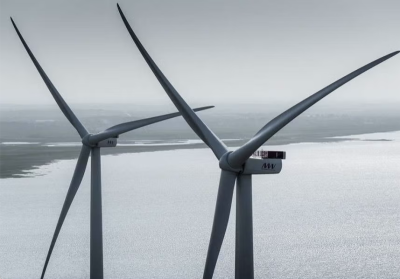
Description
The Horns Rev 3 Offshore Wind Farm consists of 49 wind turbines with a power output of 8.3 MW each, resulting in a total power output of approximately 400 MW. Horns Rev 3 was Denmark’s largest offshore wind farm at the time of construction, is capable of powering around 425,000 households, and will provide some of the cheapest offshore wind electricity in Europe. Vattenfall won the right to construct Horns Rev 3 with a historically low bid in 2015.
The Horns Rev wind farm was built in three phases, the first coming online in 2002, the second in 2009, and the third, Horns Rev 3, in 2019. Horns Rev 1, the first phase, was the first large-scale offshore wind farm in the world, with a capacity of 160 MW.
Location
Horns Rev 3 is located in the North Sea 25-40 km off the Danish West Coast. The wind farm occupies an optimal wind area of 88 km², with the distance between turbines ranging between 1.1 km and 1.5 km. The turbines are installed in 11-19 m water depth on monopile foundations with separately installed transition pieces. The wind turbines are connected to an offshore substation (OSS) by 49 inter-array cables in 12 strings. In total approximately 100 km of infield array cable was installed in order to connect each of the 49 wind turbines to the OSS. The electricity generated by the turbines is transferred through 105 km of array cables to the transformer platform installed with three 33/220kV transformers. It is evacuated onshore via 34 km-long 220 kV export cables, before being transmitted through onshore cables to the existing substation at Endrup. Installation Base ports include Esbjerg (DK) and Thyboron (DK), whereas the Operations and Maintenance port is Hvide Sande (DK).
Project Timeline
- 22 August 2019: Horns Rev 3 was commissioned
- January 2019: Final turbine installation completed
- December 2018: First turbines begin delivering electricity to grid
- July 2018: First turbine installed
- October 2017: First foundation placed on seabed
- May 2017: Construction begins
- July 2016: Installation of three transformers
- April 2015: Vattenfall awarded concession to build and operate Horns Rev 3
Licensing Information
Regulatory oversight for Horns Rev 3 includes certification under Danish regulations. On February 10, 2021, DNV GL awarded a project certificate to Vattenfall’s Horns Rev 3 offshore wind farm in compliance with Danish Executive Order No. 73 (BEK 73). This certification verifies that the project meets all applicable national requirements for safety, environmental protection, and operational standards during wind farm deployment and operation.
Key Environmental Issues
Noise impacts during construction, operation, and decommissioning have been quantified and are considered negligible due to the use of noise-reducing technology and adherence to mitigation protocols. Subsurface investigations identified complex Holocene sediment structures and regional variations in clay thickness, and informed geotechnical assessments. Marine monitoring has documented the role of Asterias rubens in regulating species composition and observed mobile species utilizing interstitial habitats near turbines. Mobile species such as gobies, blennies, and crabs have been observed foraging in seabeds between scour protections, contributing to ecosystem dynamics near the turbines. Atmospheric studies have recorded wind speed reductions upstream and wake effects, with no significant interference with radar or SAR systems, supported by low probabilities of failure in protection measures.
Environmental Papers and Reports
- Changes in the distribution and abundance of common scoter and diver species in the Horns Rev I, II and III offshore windfarm areas, Denmark, 2025 (Scott-Hayward et al. 2025)
- Wind Farm Blockage Revealed by Fog: The 2018 Horns Rev Photo Case (Hasager et al. 2023)
- Assessment of environmental pressures and state in relation to three Danish offshore wind farms (Dahl et al. 2023)
- Probabilistic Assessment and Comparison of Scour Protections at Horns Rev 3 and Egmond aan Zee Offshore Wind Farms (Chambel et al. 2022)
- The Long distance wake behind Horns Rev I studied using large eddy simulations and a wind turbine parameterization in WRF (Eriksson et al. 2017)
- Low Frequency Alternating Current (LFAC) Transmission Systems for Offshore Wind Farms: Case Studies on the Use of LFAC, Based on Horns Rev 3 Offshore Wind Farm (Allgot 2016)
- Offshore wind climatology based on synergetic use of Envisat ASAR, ASCAT and QuikSCAT (Hasager et al. 2015)
- Integrated Geomodel – Horns Rev 3 Case Study (Medhus et al. 2014)
- Horns Rev 3 Offshore Wind Farm: Offshore Noise Emission (Wigham 2014)
- Horns Rev 3 offshore wind farm: hydrography, sediment spill, water quality, geomorphology and coastal morphology (Brew et al. 2014)
- Horns Rev 3 Offshore Wind Farm: Air Traffic (Beeden et al. 2013)
- Responses of Harbour Porpoises to Pile Driving at the Horns Rev II Offshore Wind Farm in the Danish North Sea (Brandt et al. 2011)
- Measurement of Wind Turbine Construction Noise at Horns Rev II (Betke 2008)
- Investigations of the Bird Collision Risk and the Responses of Harbour Porpoises in the Offshore Wind Farms Horns Rev, North Sea, and Nysted, Baltic Sea, in Denmark - Part I: Birds (Blew et al. 2008)
- Investigations of the Bird Collision Risk and the Responses of Harbour Porpoises in the Offshore Wind Farms Horns Rev, North Sea, and Nysted, Baltic Sea, in Denmark - Part II: Harbour porpoises (Diederichs et al. 2008)
- Changes in Bird Habitat Utilisation around the Horns Rev 1 Offshore Wind Farm, with Particular Emphasis on Common Scoter (Petersen and Fox 2007)
- Hydro-Acoustic Monitoring of Fish Communities at Offshore Wind Farms (Hvidt et al. 2006)
- Bird Numbers and Distributions in the Horns Rev Offshore Wind Farm Area (Petersen 2005)
- Investigations of migratory birds during operation of Horns Rev offshore wind farm. Annual status report 2004 (Christensen and Hounisen 2005)
Environmental Monitoring: Horns Rev 3
| Phase | Stressor & Receptor | Design and Methods | Results | Publications | Data |
|---|---|---|---|---|---|
| Baseline | Habitat Change Birds |
Collision Risk and Avoidance Behavior Study Vertical and horizontal radar were used alongside visual monitoring from anchored vessels positioned near offshore wind farms. Observation points were placed strategically along expected bird migration paths. | Complete Most migrating pelagic waterbirds avoided wind farms on a large scale, reducing collision risk, while resident species such as gulls and cormorants regularly entered wind farm areas and faced potential collision risks. Songbirds showed avoidance during daytime but entered wind farms at night and during inclement weather, increasing collision risk. Habitat loss and barrier effects were noted for some species. | Blew et al. 2008 | No data publicly available. |
| Baseline | Avoidance Birds |
Habitat Utilization and Distribution Analysis Aerial surveys of waterbird distributions were conducted in grid cells within and around the Horns Rev 1 wind farm site. Historical data from 1999–2005 were compared with data collected in 2007 to assess changes in habitat use by Common Scoters and other species. | Complete Common Scoters initially avoided the wind farm but were observed in higher densities within the wind farm footprint by 2007, suggesting a gradual change in habitat use years after construction. Distribution results indicated cumulative increases in the proportion of birds close to the wind farm, potentially linked to food supply changes rather than direct behavioral responses to turbines. No changes in diver distributions relative to the wind farm were observed. | Petersen and Fox 2007 | No data publicly available. |
| Baseline | Birds | Aerial Survey Aerial surveys were conducted in February, March, May, and September of 2004 to document bird distribution. | Complete Pre-construction data showed high diversity of bird species in the study area. Common Scoter was the most abundant species, followed by Herring Gull. Shallow offshore areas were key habitats. | Petersen 2005 | No data publicly available. |
| Baseline | Avoidance Birds |
Collision Risk and Behavioral Response Analysis Bird movements were observed using radar and visual surveys, performed from a transformer station and along transects positioned inside and around the Horns Rev wind farm. Observations were conducted during spring migration periods in March, April, and May 2004 to assess flight paths, avoidance behaviors, and flight altitude. | Complete During spring 2004, 29% of bird tracks entered the eastern side of the wind farm, consistent with patterns observed in autumn 2003. Most birds showed avoidance behaviors, altering their flight orientation at distances of 400–500 m from turbines, though some made perpendicular passages between turbine rows. Risk of collision appeared higher during periods of low visibility. Radar data confirmed behavioral responses, with tracks disappearing near the wind farm due to birds changing flight direction or landing. No collisions were observed. | Christensen and Hounisen 2005 | No data publicly available. |
| Baseline | Habitat Change Fish |
Hydroacoustic and Fishing Surveys Dynamic hydroacoustic surveys were conducted along transects inside and outside the wind farm area, supplemented by fishing using gill nets and pelagic trawls to calibrate acoustic signals and identify species composition. | Complete Surveys revealed 21 fish species, including sandeels and gobies dominating benthic and semi-pelagic habitats. No statistically significant regional or local effects from wind farm structures associated with an earlier project in the region, Horns Rev 1, on fish densities or biomass were identified due to variability. | Hvidt et al. 2006 | No data publicly available. |
| Baseline | Human Dimensions, Navigation | Impact Assessment & Stakeholder consultations with DTA, Naviair, Military A 2013 desk-based assessment analyzed air traffic interests within the Horns Rev 3 study area. The review included Danish Aeronautical Information Publications, military AIP, and aeronautical charts, alongside consultations with the Danish Transport Authority, Royal Danish Air Force, and Naviair. The focus was on potential impacts to flight paths, radar systems, and search and rescue operations within 20 km of the mainland. | Complete The assessment identified potential impacts on civilian radar systems, search and rescue activities, and military training areas. However, there is a low probability of adverse effects, with effective mitigation strategies minimizing radar interference and maintaining SAR capabilities. | Beeden et al. 2013 | No data publicly available. |
| Baseline | Noise Marine Mammals |
Acoustic Monitoring Porpoise echolocation activity was monitored using passive acoustic devices (T-PODs) placed at varying distances from the construction site to record acoustic activity before, during, and after pile driving events for Horns Rev II in summer 2008. | Complete Porpoises avoided areas near pile driving, leaving for an average of 16.6 hours, with recovery times reaching 22.7 hours. Effects at ~10 km distances were limited to the duration of pile driving, likely due to sound attenuation. No porpoises were observed within 3 km during pile driving, indicating that mitigation measures effectively reduced injury risk. Porpoise density recovered within 1–2 days post-construction. | Brandt et al. 2011 | No data publicly available. |
| Baseline | Noise Marine Mammals |
Acoustic Monitoring Measurements of underwater noise during pile driving, including peak and SEL values, with consideration of M-weighting curves (adjusting for species-specific hearing sensitivity). | Complete Peak noise levels reached 195 dB (unweighted) at 720 m and 180 dB at 2300 m, with spectral peaks at 80–200 Hz. When MHF cetaceans weighting is applied, sound levels were reduced by 5–7 dB, suggesting that noise impacts on marine mammals may vary by species sensitivity. | Betke 2008 | No data publicly available. |
| Baseline | Noise Marine Mammals |
Acoustic Monitoring Harbor porpoise echolocation activity was monitored using T-PODs deployed inside and outside wind farms at varying distances from turbines across multiple experiments at Horns Rev 1 and Nysted. | Complete No difference in porpoise presence was found at Horns Rev. Diurnal rhythms in activity were observed near turbines in 2005 but were less pronounced in 2006, possibly linked to fish communities. Offshore wind farms were incorporated into porpoise habitats without significant avoidance behavior. | Diederichs et al. 2008 | No data publicly available. |
| Baseline | Changes in Flow Physical Environment |
Wake Modeling Analysis Microscale Large Eddy Simulations (LES) and mesoscale Weather Research and Forecasting (WRF) simulations were used to model wake recovery and expansion for the Horns Rev 1 wind farm. Simulations were compared to site data on wind speed and relative production, with WRF profiles incorporated into LES models for simplified meso/microscale coupling. | Complete Findings suggest potential future refinements to coupling methods for analyzing farm-to-farm interactions. While primarily technical, insights gained could inform environmental assessments of wake effects, such as impacts on local ecosystems or neighboring wind farms. | Eriksson et al. 2017 | No data publicly available. |
| Baseline | Physical Environment | Site Characterization An integrated analysis was conducted between 2012 and 2013, combining geophysical surveys, borehole data, Cone Penetration Tests (CPTs), and sediment sample C14 age dating. Initial interpretations were developed through a literature review and validated with field data. | Complete The study revealed complex Holocene sediments extending to 40m depth, surpassing initial predictions of 10–15m. Regional variations in clay thickness were observed, and integrating multiple data sources showed a more intricate subsurface geology than inferred from geophysical data alone. | Medhus et al. 2014 | No data publicly available. |
| Construction, Operations | Displacement, Habitat Change Birds, Ecosystem Processes, Fish, Marine Mammals |
Aggregated Environmental Status and Pressure Assessment Information was aggregated from national (NOVANA) and international (OSPAR, HELCOM) frameworks under the MSFD, Habitats Directive, and Birds Directive to evaluate marine ecosystem status and pressures. | Complete The environmental status near Horns Rev 3 was assessed as moderate to poor. Renewable energy, including offshore wind farms, was identified as a significant pressure factor. Area-specific monitoring is needed to address uncertainties in regional data. | Dahl et al. 2023 | No data publicly available. |
| Construction, Operations | Physical Environment, Sediment Transport, Water Quality | Numerical Modeling and Sediment Transport Simulation Numerical modeling and expert assessment were used to evaluate worst-case scenarios during construction, operation, and decommissioning phases. The effects of infrastructure (e.g., foundations, cables, landfall trenching) on sediment transport, tidal currents, waves, and water quality were analyzed over simulated periods. | Complete Construction caused temporary sediment plumes, with concentrations exceeding 200mg/l in small patches near foundations and cables. Changes to tidal currents (+/- 0.008m/s) and wave heights (+/- 0.007m) during operation were negligible, with no impact on sediment transport or morphology. Coastal construction effects were short-term, with no long-term impacts or changes to water quality. No significant interaction effects with Horns Rev 1 or Horns Rev 2 were expected. | Brew et al. 2014 | No data publicly available. |
| Construction, Operations, Decommissioning | Habitat Change Fish, Invertebrates, Physical Environment |
Probabilistic Assessment & Reliability Analysis A probabilistic assessment was conducted at Horns Rev 3 to evaluate the reliability of scour protection designs. Monte Carlo simulations with 1,000,000 wave condition pairs were used alongside conditional modeling to analyze probabilities of failure. The analysis utilized a 10-year dataset of wave conditions (2003–2013) and applied statistical models, including a Weibull distribution for wave heights and a lognormal distribution for peak wave periods. | Complete The study found that the probability of failure for scour protection varied significantly depending on site conditions, ranging from 10⁻⁴ to 10⁻⁶. These low probabilities of failure indicate that the scour protection designs are reliable and perform effectively across different site-specific scenarios. | Chambel et al. 2022 | No data publicly available. |
| Construction, Operations, Decommissioning | Noise Fish, Marine Mammals |
Noise impact assessment A 2014 noise impact assessment evaluated three areas: wind farm site, export cable route, and landfall site. Using SoundPLAN software and Nord2000 acoustic modeling standards, noise levels were assessed at six turbine foundations across different wind speeds (6 m/s and 8 m/s). Data from vessel operations at the Anholt wind farm were used for comparison. | Complete Noise impacts during construction, including monopile installation, were assessed as negligible, with similar effects expected during decommissioning subject to a future EIA. Operational noise impacts from the converter station were also found to be negligible. | Wigham 2014 | No data publicly available. |
| Operations | Changes in Flow Physical Environment |
Field Observations A 2018 study examined wind farm blockage effects during a fog event at Horns Rev 2 using data from satellites, meteorological masts, lidar, SCADA turbine data, and wake models across multiple locations, including FINO3 and coastal stations. | Complete Blockage effects extended 10–20 turbine diameters upstream, reducing wind speeds and contributing to cold sea fog formation. Stable atmospheric stratification was observed, with strong vertical wind shear and fog patterns reflecting wake effects downstream. | Hasager et al. 2023 | No data publicly available. |