
Description
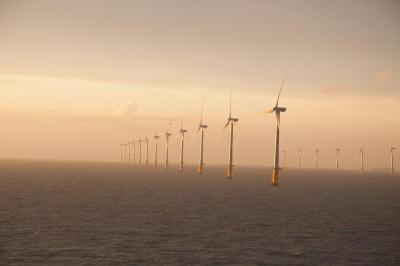
The Thanet Offshore Wind Farm is located 7 mi (11 km) off the coast of the Thanet district in Kent, England. On commissioning it was the world's largest offshore wind farm with a nameplate capacity of 300 MW. Thanet is one of fifteen Round 2 wind projects announced by the Crown Estate in January 2004 and was the first to be developed. It was officially opened on 23 September 2010, when it overtook Horns Rev 2 as the biggest offshore wind farm in the world. Thanet consists of 100 Vestas V90 wind turbines and cost roughly £780-900 million (US$1.2–1.4 billion). This is a one-phase project; all turbines were installed in rapid succession, about one every 18 hours.
Vattenfall planned to extend the Thanet Offshore Wind Farm, following 18-months of consultation with residents and businesses by Vattenfall, and submitted a development consent order in 2018 to the UK’s government agency, The Planning Inspectorate (PINS). This agency accepted the proposed project for examination in 2018, but in June 2020, the Secretary of State refused development consent for the application due to the concern of navigational safety and impact on future ports and shipping traffic.
Location
Thanet’s 100 wind turbines are spread over an area of 35 km² in the Thames Estuary. The distance between each turbine is 500 m along the rows and 800 m between the columns.
Project Timeline
- June 2020: The UK Secretary of State for Business, Energy and Industrial Strategy (BEIS) refused Vattenfall’s development consent order application for the Thanet Extension.
- November 2022: Vattenfall and Shell entered into a 5-year power purchase agreement for 300,000 MWh.
- June 2018: Vattenfall applied for the development consent order for the Thanet Extension.
- December 2014: The UK’s Office of Gas and Electricity Markets (Ofgem) granted license for Thanet offshore wind farm’s transmission assets.
- 2014: The cables, substations, and transmission infrastructure assets were sold by Vattenfall to Thanet OFTO.
- September 2010: Construction completed (world’s largest offshore wind farm at the time).
- November 2008: Vattenfall acquired CRC and the project.
- January 2008: Construction on Thanet Offshore Wind Farm began.
- 2007: License obtained under the Marine and Coastal Access Act (Marine License).
- 2007: Christofferson, Robb & Co (CRC) purchased the project and Warwick Energy continued to manage the project until October 2008 (when the buyer backed out).
- July 2006: Vestas chosen as preferred turbine supplier.
- September 2006: SLP were chosen as the preferred supplier for the foundations.
- 2004: The Crown Estate awarded Thanet in round 2 offshore licensing to Thanet Offshore Wind Ltd in the Thames Estuary Strategic Environmental Assessment (SEA).
- 2003: Thanet Offshore Wind Ltd was originally conceived in 2003 by Warwick Energy under the Round 2 offshore wind farm license applications.
Licensing Information
At the national level, the Crown Estate, responsible for managing the seabed around England, Wales and Northern Ireland, awarded development rights in 2004. At the time, the Department of Trade and Industry’s (DTI) Offshore Renewable Consents Unit (ORCU) led the consent process. Some of the key consents were included under the Food and Environment Protection Act (FEPA) 1985, Coast Protection Act 1949, Electricity Act 1989, Town and Country Planning Act 1990, etc.
In 2018 Vattenfall applied for a 340MW extension to Thanet, however in 2020 this development consent was denied by the Department for Business, Energy and Industrial Strategy.
Key Environmental Issues
The Thanet Offshore Wind Farm faced several environmental challenges, including potential impacts on marine habitats, marine mammals, seabirds, and local fisheries. The construction and operation of the wind farm raised concerns about habitat disturbances, particularly to benthic ecosystems and sandbanks. Royal Haskoning was commissioned by Thanet Offshore Wind project to undertake an Environmental Impact Assessment (EIA) of the proposed development, including both offshore and onshore elements. A scoping report was produced in July 2004 and provided an initial overview of the environmental issues associated with the Thanet project (Royal Haskoning, 2005). In the early stages of development of the wind farm, research was conducted to fulfill Thanet’s commitment to ensure that a minimum of two years of ornithological data was used to assess the likely impacts of the Thanet Offshore Wind Farm project (Royal Haskoning, 2005). This was just one example of research conducted to assess the potential impact of the project.
When Vattenfall was looking to expand their wind farm, around 2016, they proposed various ways they would approach considerations for environmental effects of the expansion including aspects such as developing a marine mammal mitigation protocol (MMMP) to mitigate effects on marine mammals (e.g., harbour porpoise from pile-driving noise (SMRU Consulting, 2018). However, the Secretary of State for Business, Energy, and Industrial Strategy refused development consent for Thanet’s expansion application in 2020. The secretary of state stated that the rejection of the application was on the grounds that it could affect navigational safety. The secretary of state also cited concerns over the effect on certain environmentally sensitive areas.
Environmental Papers and Reports
- Monopile-induced turbulence and sediment redistribution form visible wakes in offshore wind farms (Bailey et al. 2024)
- The effect of monopile-induced turbulence on local suspended sediment pattern around UK wind farms (Forster 2018)
- Thanet Extension Offshore Wind Farm, Environmental Statement Volume 2, Chapter 5: Benthic Subtidal and Intertidal Ecology (GoBe Consultants 2018)
- Thanet Extension Offshore Wind Farm, Environmental Statement Volume 2, Chapter 7: Marine Mammals (SMRU Consulting 2018)
- Thanet Extension Offshore Wind Farm, Environmental Statement Volume 2, Chapter 15: Offshore Conclusions (GoBe Consultants 2018)
- ORJIP Bird Collision and Avoidance Study (Skov et al. 2018)
- Thanet Extension Offshore Wind Farm Environmental Impact Assessment Report to Inform Scoping (Royal Haskoning 2016)
- Repeated Mapping of Reefs Constructed by Sabellaria spinulosa Leuckart 1849 at an Offshore Wind Farm Site (Pearce et al. 2014)
- Turbid Wakes Associated with Offshore Wind Turbines Observed with Landsat 8 (Vanhellemont and Ruddick 2014)
- 2010-2013, RHDHV, Thanet, Ornithological Monitoring (Royal Haskoning DHV et al. 2013)
- Strategic Review of Offshore Wind Farm Monitoring Data Associated with FEPA Licence Conditions: Birds (Budgey and Ormston 2009)
- Strategic Review of Offshore Wind Farm Monitoring Data Associated with FEPA Licence Conditions: Fish (Walker et al. 2009)
- 2005, Royal Haskoning Ltd, Thanet Offshore Windfarm, Environmental Statement (Royal Haskoning 2005)
For additional data and information on Thanet, visit the Marine Data Exchange.
Environmental Monitoring: Thanet
| Phase | Stressor & Receptor | Design and Methods | Results | Publications | Data |
|---|---|---|---|---|---|
| Baseline | Birds | Boat-based Bird Surveys Monthly boat-based surveys were undertaken between November 2004 and October 2005, with an additional round of surveys between November 2005 and April 2006 over the winter period. Aerial surveys of the whole Thames Estuary SEA area, including the Thanet site, were undertaken between October 2004 and June 2005, with an additional round of surveys between November 2005 and April 2006. | Complete Overall, a negligible to minor adverse impact is anticipated on the ornithological interest of the Thanet site. The most sensitive species to the Thanet project is considered to be the red-throated diver, because of its conservation status and susceptibility to anthropogenic disturbance. | Royal Haskoning 2005 | No data publicly available |
| Baseline | Ecosystem Processes | Intertidal, Subtidal benthic grab, and Subtidal epibenthic Surveys Surveys of the proposed export cable route across the intertidal flats of Pegwell Bay were carried out May 2005. This also included grab samples to assess particle size composition of substrate and associated benthic infauna between May and June 2005. Subtidal epibenthic surveys were also conducted July 2005 and were collected using a beam trawl. | Complete The report proposes further monitoring on a species, a part of the epifaunal assemblage, S. spinulosa. Overall, the assessment found the biological communities recorded in the survey area are typical of coarse deposits of the southern North Sea and eastern English Channel and no significant adverse effects on the marine ecology due to construction, operation or decommissioning are anticipated. | Royal Haskoning 2005 | No data publicly available |
| Baseline | Fish | Demersal Otter Trawl and Beam Trawl Surveys In spring and summer 2005 adult fish surveys of the Thanet site, export cable routes, inshore area and two control areas were carried out using a demersal otter trawl. Observer trips were also undertaken August 2005 and September 20025. | Complete The baseline study found that potential impacts during operation of the wind farm include underwater noise and vibration, the fish aggregating effect of the structures and the influence of EMF. The assessment showed that, overall, the significance of such impacts is considered to be negligible. | Royal Haskoning 2005 | No data publicly available |
| Baseline | Invertebrates | Benthic and Bathymetric Surveys Sabellaria spinulosa reefs were mapped in 2012 and compared to pre-construction maps. | Complete It was found over a large proportion of the wind farm site and the 2012 data illustrated a wider distribution with less signs of damage; possibly due to a reduction in bottom fishing in the wind farm area. The benthic invertebrate fauna within the wind farm site and along the export cable route have been sampled before and after the main construction period and on an annual basis. | Royal Haskoning 2005 | No data publicly available |
| Baseline, Construction, Operations | Habitat Change Invertebrates |
Benthic Assessment Sabellaria spinulosa reef habitats associated with the Thanet Offshore Windfarm site were mapped using high resolution sidescan sonar and multibeam echo sounder. Data was collected in 2005 (baseline), 2007 (pre-construction baseline), and 2012 (post-construction). | Complete The extent of Sabellaria spinulosa reefs identified increased between the pre-construction survey in 2007 and the post-construction survey in 2012, indicating that the wind farm may be providing some protection to this habitat. The diversity of macrofauna associated with the Sabellaria spinulosa reefs at the site was greater than that observed in adjacent sedimentary habitats. | Pearce et al. 2014 | No data publicly available |
| Baseline, Construction, Operations | Marine Mammals | Marine Mammal Incidental Surveys Thanet Offshore Wind Farm agreed with the Licensing Authority that post-construction marine mammal surveys were not required and instead committed to presenting incidental sightings recorded during the ornithological surveys, making comparisons to all pre- and during-construction data. | Complete There was evidence for a statistically significant decline in harbour porpoise abundance within the wind farm during the construction phase. That reduction persisted in the first post-construction monitoring year, though that effect appeared short-term and was not apparent by the second year of operation. | Royal Haskoning and Royal Haskoning DHV 2013 | No data publicly available |
| Baseline, Operations | Fish | Elasmobranch Surveys Pre-construction elasmobranch surveys were undertaken in September 2007 and July 2008. Seven combination fleets were used to target elasmobranchs, skates and rays at seven sampling locations. Post-construction surveys were undertaken in August and September 2012 replicating the methodology and sampling stations used during pre-construction. | Complete The conclusions were drawn that the abundance and diversity of elasmobranch species in the wind and cable corridor has not significantly altered due to the presence of the infrastructure. | Royal Haskoning and Royal Haskoning DHV 2013 | No data publicly available |
| Operations | Avoidance Birds |
Boat-based Bird Surveys The surveys consisted of boat-based line transects over a two-year post-construction monitoring period. They were conducted, twice-monthly during the October – March period following a standardized protocol. | Complete Preliminary findings indicated a decline in observed numbers of divers, gannets and guillemots, though these trends were based on limited sample sizes. Post-construction surveys suggested a partial recovery of some species to pre-construction levels within the wind farm area. | Royal Haskoning DHV et al. 2013 | No data publicly available |
| Operations | Avoidance, Collision Birds |
Bird Surveys A combination of observer-based tracking with a system that automatically recorded seabird movements was used over a two-year period. | Complete The analysis of the video footage showed a collision risk of seabirds that is less than half of what was expected, with seabirds exhibiting avoidance behavior and changing their flight path to avoid the turbines. | Skov et al. 2018 | |
| Operations | Habitat Change Ecosystem Processes, Physical Environment |
Suspended Sediment Surveys Suspended particulate matter concentration (SPM) were derived from Landsat 8 imagery in Thames estuary and specifically for one of five wind farms-Thanet Offshore Wind Farm and compared with other sensors. | Complete A significant increase in suspended sediments was observed in the wakes of individual turbine monopiles in offshore wind farms. The spatial extent was considerable, and the turbidity change may be persistent (repeating each current reversal). | Vanhellemont and Ruddick 2014 | |
| Operations | Fish | Demersal Otter Trawl and Beam Trawl Surveys In 2010 a single year of post-construction adult fish surveys i.e. a spring (April) and summer (July) and a concurrent juvenile fish survey was undertaken. | Complete The results found that there was little evidence that Thanet Offshore Wind Farm has had a significant impact on either adult fish species abundance or diversity. The general conclusion based on the evidence provided indicates that there will be little effect on the juvenile population in relation to habitat disturbance. | Royal Haskoning and Royal Haskoning DHV 2013 | No data publicly available |
| Operations | Changes in Flow Physical Environment, Sediment Transport |
Plume Surveys and Sampling Research cruises investigated plume formation and content. Optical and acoustic profiling of the water column from surface to seabed was done at locations in and out of distinct plumes. | Complete Results showed that wakes were present and longer than the range of length scales predicted from scale models and numerical models, where estimates suggesting that the downstream effects have a length scale of approximately 8 to 10 multiples of the monopile diameter. | Forster 2018 | No data publicly available |