



Contents
MRE Project Site
(login for email address)
Details
Description
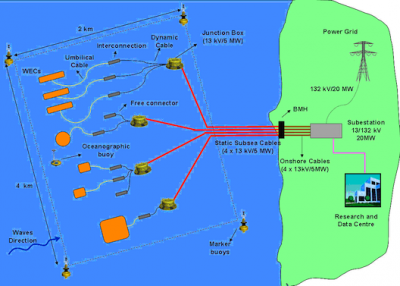
The Biscay Marine Energy Platform (BiMEP) is an open-sea facility to support research, technical testing and commercial demonstration of pre-commercial prototype utility-scale floating Marine Renewable Energy Devices or MREDs. BiMEP provides manufacturers of such devices with ready-to-use facilities to validate their designs and to test their technical and economic feasibility.
BiMEP occupies a 5.3 km2 marked area excluded for navigation and maritime traffic and located at a minimum distance of 1,700 m from shore, close enough for fast access. The water depth in this area ranges from 50 to 90 m. The total power of 20 MW is distributed over four offshore connection points of 5 MW each.
Each berth is connected to the onshore substation via a dedicated three-phase submarine cable in series with a land three-phase line, both at 13.2 kV. The onshore electricity substation houses electrical protection systems, measurement systems and transformer, allowing the berths to be connected up to the national power grid. The berths are fitted with commercial power and fibre optic connectors to enable swift connection and disconnection of MREDs.
Location
Located off the coast of Armintza, in the Basque Country, northern Spain
Licensing Information
The technological development and the geographical characteristics of the Basque Country provide suitable preconditions for the production of marine energy, including wave and offshore wind. Furthermore, the presence and level of development of the naval industry in the Basque Country are determinants for the wave energy sector to be considered as a strategic and promising sector in the Basque Country. In this context, in 2008 the Basque Energy Board (Ente Vasco de la Energía-EVE) set the BiMEP project in motion.
The installation of BiMEP was administratively complex; it involved the participation of both national and local administrations. Several ministries and departments participate in different sections/steps of the administrative process. Such administrative process generally shares the following common structure:
- Step 1: Consult with the Spanish Ministry for Environment, Rural and Marine Affairs (the Spanish environmental agency) about the need for conducting an Environmental Impact Assessment
- Step 2: Apply for the administrative authorisation from the Spanish Ministry of Industry, Tourism and Trade to conducting the works and for the declaration of Public Use from the Provincial Industry and Energy Dependency of the Spanish Government Delegation in Bizkaia
- Step 3: Apply for the concession of marine-terrestrial public domain, which is a two-step process and involves the Spanish Ministry of Public Works and the Ministry for Environment, Rural and Marine Affairs.
Step 1: In accordance with Article 16 of Royal Decree 1/2008, the Promoter (EVE) initiated the environmental procedure in 2008. In order for the Ministry to make an informed decision on whether or not an Environmental Impact Assessment was needed, three documents/steps were required:
- 1A. Project submission, including the objective, description and location of the project
- 1B. Submission of an environmental analysis document, covering the following aspects: a) actions that may cause environmental impacts throughout the different stages of the project (i.e. planning, construction, operation and abandonment), b) potential environmental impacts of the project, c) mitigation and corrective measures/strategies to offset the potential negative environmental impacts, and d) an Environmental Monitoring Plan of the project.
- 1C. Consultation with stakeholders, which is to be carried out by General Directorate for Environmental Quality and Evaluation of the Spanish Ministry for Environment, Rural and Marine Affairs. In this case, the consultation process included key stakeholders, such as fishermen guilds (cofradias [1]) and environmental NGOs, amongst others.
A preliminary Environmental Impact Study (EIS) of the BiMEP Project was undertaken in July 2008 by AZTI-Tecnalia. The full EIS was commissioned by EVE and carried out by AZTI-Tecnalia in December 2008.
In April 2009, the General Directory of Quality and Environmental Evaluation of the Spanish Ministry of Environment, Rural and Marine Affairs requested additional information about the project and its impacts. In order to respond to this request, in April 2009 the complete EIS was sent to the above mentioned General Directory and, in parallel, a personal meeting was held with their representatives.
Based on a detailed analysis of these three documents/steps, the Spanish Ministry for Environment, Rural and Marine Affairs made the decision for BiMEP not to be subject to the full Environmental Impact Assessment process in June 2009. The analysis of the EIS had concluded that no significant environmental impacts were expected as a result of the implementation of the BiMEP project. Furthermore, most stakeholders consulted about the potential affection of the BiMEP did not envisage significant impacts on habitats, protected species or environment as a result of the implementation of the BiMEP.
Due to the uncertainties around environmental impacts and the lack of reference data, the Environmental Statement recommended the implementation of the environmental monitoring program suggested in the Environmental Impact Study.
Step 2: For obtaining the administrative authorisation and public use declaration of the installation of the BiMEP infrastructure, the Promoter (EVE) submitted to Spanish Ministry of Industry, Tourism and Trade and the Provincial Industry and Energy Dependency of the Spanish Government Delegation in Bizkaia several documents, which included, a) the preliminary draft of the project, b) an environmental analysis document, and c) an economic evaluation analysis document.
In accordance with the provisions of Articles 125 and 144 of Royal Decree 1955/2000 and Article 27 of Royal Decree 1028/2007, the preliminary draft was submitted for public consultation and reprints were sent to key administrations and stakeholders:
- The City Council of Lemoiz, the General Directorate for Planning, the General Directorate of Ports and Maritime Affairs, and the General Directorate for Fisheries and Agriculture of the Basque Government, as well as the Basque Water Agency did not provide any feedback.
- On the other hand, the Department of Public Works of the Provincial Council of Bizkaia, the Bilbao Bizkaia Water Consortium, the General Directorate for Fisheries and Aquaculture of the Spanish Ministry for Environment, Rural and Marine Affairs, Iberdrola (Spanish energy company) and one local citizen did provide feedback, indicating interest mainly on technical aspects, to be considered in drafting the execution project. All requests for additional information were duly addressed by EVE at this stage.
Based on the outcome of the consultation process, the Spanish Ministry for Industry, Tourism and Trade (of the General Directorate for Energy Policy and Mining) authorized, in 2011, the installation of BiMEP, and stated its declaration of public use.
Step 3: In 2011, the Promoter (EVE) proceeded to tackle the final step and obtain the concession of marine-terrestrial public domain which was granted on the 6th of February 2012.
Once authorisation for the project execution was granted, contracts were awarded for the supply and installation of submarine power lines and ground cables, in November 2012 the first works started with the horizontal drilling for the installation of the submarine power cables. In September 2013 the works for the installation of submarine cables started.
The environmental monitoring program started in August 2011 in its preoperational phase and was undertaken by AZTI-Tecnalia. During construction works, the environmental monitoring for the construction phase was carried out.
BiMEP was officially inaugurated in July 2015.
During the public consultation process of the EIS in the framework of the EIA process in Spain, some amendments and comments to the EIS developed in 2016 were done by different stakeholders. Thus, in 2018 a new EIS was developed by AZTI in order to correct, respond and improve those aspects and amendments indicated during this public process. This new EIS was presented in February 2018.
On the 31th of May 2018, the Ministry of Agriculture, Fisheries and Food and Environment of the Spanish Government decided to grant environmental approval to offshore wind testing and demonstration projects at the BIMEP test site.
[1] Spanish cofradias (fishing guilds) are institutions with and old tradition that in some cases dates back many centuries. Their aim is to assure collective economic exploitation of fishing resources in coastal area. The cofradias are the institutional system for more than 80% of the employment in fisheries in Spain. In addition, more than 50% of landings are under the control of cofradias. It is a clear distinction between cofradias and other organizations such as boat owners associations or producer organizations. The cofradias are related exclusively to coastal fisheries while the other organizations deal with industrial fisheries. The cofradias are organized democratically and both the crew and the boat owner have representatives in the executive bodies. These institutions are well recognized by the Spanish and regional law and can propose management rules in their area of influence such as fishing time, allowed fishing gear and area and time closures. The rights of cofradias can be considered a form of territorial use rights in fisheries (TURFs).
Project Progress
The test centre was inaugurated and fully operational in July 2015.
Activity to date:
- MARMOK-A-5: BiMEP hosted the first floating wave energy device connected to the grid in Spain, the MARMOK-A-5 device developed by Oceantec (IDOM). The transport to site operation of the WEC, so-called MARMOK-A-5, and its installation at BiMEP was completed on 12 October 2016. MARMOK-A-5 was an OWC point absorber 5 metres in diameter, 42 metres in length and 80 tonnes in weight. The generating system comprised two air turbines located in the upper part of the device with a rated capacity of 30 kW, which were previously tested at the Mutriku wave power plant. The device was connected to the grid in early December delivering the first kWhs on 13 December 2016. The technology development was supported by the Basque Energy Agency – Ente Vasco de la Energía (EVE) under a Pre-commercial Procurement Contract. A second phase of testing activities of the WEC were also carried out as part of the European project OPERA, that ended in July 2019.
- Arrecife: Arrecife Energy Systems' 75 kW prototype was tested in BiMEP for a one-month period, between September and October 2019.
- Penguin (WELLO): In August 2021 Finnish company WELLO completed the installation of its Penguin device in BiMEP. It is a direct drive, 44m long, 600kW rated power device. Grid connected testing of the Penguin device will start in September 2021.
- DemoSATH (SAITEC): The first floating wind energy device to be installed in BiMEP is a 2MW wind turbine with rotor height 79 m and mounted on a 65 m x 30 m concrete platform developed by Saitec. Moorings and mooring lines were installed in September 2022 and installation of the device was completed in August 2023.
Regarding ancillary equipment testing, there are several prototypes being tested in the area:
- HarshLab 2.0 by Tecnalia, an offshore laboratory that enables testing of new materials and solutions against corrosion, ageing and fouling in the marine environment, was installed in summer 2022. The installation of Harshlab 2.0 follows the successful testing of Harshlab, installed in summer 2018 and decommissioned in August 2021.
- Basque company ZUNIBAL tested metocean buoys under the ANTEIA project. Subsequently Anteia buoys have been used in the BiMEP area as wave data suppliers.
- In 2017, company DITREL tested their submarine connector KONEKTA2.
Key Environmental Issues
The environmental factors that the EIS developed by AZTI in 2008 considered key were hydrodynamics, landscape, benthic communities, ichthyofauna, marine mammals, fishing activity and archaeological and cultural resources.
The EIS developed by AZTI in 2018 for the use of BiMEP as a floating wind turbine testing facility considered that the main environmental factor that could be affected by the testing of offshore wind devices in BiMEP would be the marine birds communities protected under the ES0000490 Mundaka-Cabo de Ogoño Special Bird Protection Area. Consequently, an ambitious environmental monitoring plan over marine birds was suggested to be undertaken during the pre-operational, construction, operational and decommissioning phases.
Environmental reports and data resources:
Environmental Datasets
Relevant environmental datasets for this project are available on MARENDATA.