



Contents
MRE Project Site
(login for email address)
Details
Description
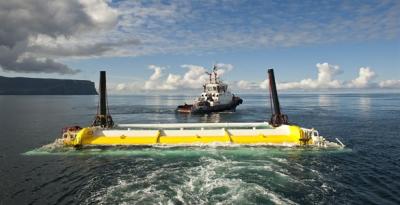
Oyster is a near-shore wave energy device, typically deployed in 10 to 15 metre (m) water depth. The oscillating action of the waves against the wave energy converter (WEC) (or ‘flap’) drives hydraulic pistons which pump pressurised freshwater back to shore through a closed loop pipeline system. Oyster 800 is 250% more powerful than Oyster 1, simpler to install, easier to maintain and more efficient. The Oyster 801 and Oyster 802 devices will further refine the design of Oyster 800.
Location
The device was installed at European Marine Energy Centre (EMEC) wave device test area in Billia Croo, Orkney, UK.
Licensing Information
Onshore planning permission: Granted by Orkney Islands Council, September 2010. Offshore consents: Granted for first of three Oyster devices by Marine Scotland, December 2011 and for the further 2 devices in February 2012. Environmental Impact Assessment: Completed by Xodus Environment, June 2011.
Project Progress
Det Norske Veritas (DNV), the world's leading international provider of services for managing risk, awarded a Statement of Feasibility for the design of Oyster 800 in 2010, based on a 20 year life span. This was the first time DNV awarded this accreditation to a wave power device.
Fabrication of Oyster 800 was completed and unveiled by Scotland's First Minister in July 2011. The Offshore installation was completed in August 2011. Operational testing of Oyster 800 commenced in June 2012, producing first electrical power to the grid the same month.
Aquamarine Power subsequently went into administration in October 2015 and was unable to secure a buyer for the business by November 2015 and therefore had to cease trading.
Key Environmental Issues
Baseline studies for the Billia Croo test site were performed by EMEC and can be found here.
No issues were identified as being of major or severe significance.