



Contents
Wind Project Site
(login for email address)
Details
Description
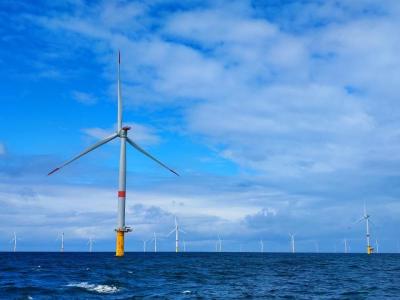
The Saint-Nazaire Offshore Wind Farm is the first offshore wind farm in France, developed by EDF Renewables, Enbridge, and GE. The project is the first of three awarded by the French government, with the next wind farms to be developed near Fécamp and Courseulles-sur-Mer. These projects are planned to include a total of 238 wind turbines with a capacity to provide power to 2 million people. These developments are part of France’s goal to reach a target of 32% renewable energy consumption by 2030.
The site on the Banc de Guérande was chosen for its combination of strong winds and relatively shallow depth as well as its relative freedom from maritime constraints and compatibility with environmental issues. The wind farm is also open to navigation if vessels are less than 25 meters in length and follow certain speed, activity, and navigation rules.
The GE Haliade turbines used for the project were first tested at a land-based wind energy installation along the Loire River. After the successful test, a second turbine was deployed off the coast of Belgium for marine testing of the deployment method.
Location
The Saint-Nazaire Offshore Wind Farm covers a 78 km2 area of the Banc de Guérande, 12 km to 20 km off the Loire-Atlantique coast. The wind farm is operated and maintained from the port of La Turballe where a 1,250-m2 maintenance building is located. There are three maintenance vessels located at La Turballe for daily operations on the wind farm. Cable landfall occurs near Saint-Nazaire and then travels overland through Trignac, Montoir-de-Bretagne, Donges, and ends at Prinquiau.
Project Timeline
- November 2022: Fully operational and commissioned
- June 2022: First electrical production
- April 2022: First turbine installed
- August 2021: Offshore substation and 19 wind turbine foundations installed
- June 2021: 73 monopile foundations excavated
- May 2021: First foundation installed
- September 2020: First turbine nacelle manufactured
- September 2019: Construction started
- June 2019: Final decision from the Conseil d’État awarded
- 2017: Construction and operating permits issued
- 2012: Government of France names Éolien Maritime France (EMF) as winning bidder for project
- 2008: Start of technical and environmental studies
Licensing Information
In 2017, French local authorities issued construction and operating permits. In June 2019, the Conseil d’État delivered a final decision upholding these authorizations.
Key Environmental Issues
Beginning in 2008, several studies provided background environmental information about the proposed installation areas, identified potential environmental issues, and proposed monitoring plans for the site. The project then performed baseline or reference studies in 2019 prior to the beginning of marine operations and construction. The baseline studies were used for during- and post-construction comparisons but also provided comparisons to data from the earlier studies. Following the baseline studies, monitoring has continued each year and is posted in an annual summary report.
Several key environmental issues have required the implementation of monitoring measures: changes in water quality; effects on benthic communities and fisheries (including large crustaceans and fish larvae); impacts to marine mammals, birds, and bats; and potential noise effects on shorelines.
In addition, the wind farm area is used by sensitive species of marine mammals and seabirds; therefore, several mitigation measures were put in place during construction activities, as well as for the whole duration of the project:
- During construction activities, pingers and seal-scarers were used before any pile driving started to ward off marine mammals potentially in the vicinity. Hydrophones mounted on buoys around the construction zone allowed to verify in real time the absence of cetaceans before and during pile driving. Once all clear, pile driving started, following a gradual increase in intensity, ready to stop immediately if any marine mammal were detected in proximity to the construction zone. In addition, a bubble curtain was used to limit in-water propagation of pile-driving noise.
- To protect and improve the quality of nearby breeding grounds of the Great black-backed gull (Larus marinus), specific measures were implemented to remove rats, that prey on eggs, from islets in the vicinity of the wind farm. In addition, to protect the critically endangered Balearic shearwater (Puffinus mauretanicus) if any were observed in the wind farm area at any time, specific navigation rules were established, as well as outreach to recreational boaters to educate on this very sensitive species.
- During the construction phase, it was required that vessels related to the construction activities limit their night-time lighting, as long as it was safe to do so, to decrease the potential attraction effects to birds, bats, and other animals attracted by anthropogenic lights. In addition, safety markers for the wind farm during its operation phase are designed as to decrease night-time light attraction.
Environmental Papers and Reports
- Bilan annuel 2024 des études environnementales sur le parc éolien en mer de Saint-Nazaire Parc éolien en mer de Saint-Nazaire 2025
- Bilan annuel 2023 des études environnementales sur le parc éolien en mer de Saint-Nazaire Parc éolien en mer de Saint-Nazaire 2024
- Parc éolien en mer de Saint Nazaire _ Suivi de l'avifaune et de la mégafaune marine.: Rapport final de la mesure MSU10 en phase de construction (Octobre 2021- Septembre 2022) Biotope 2023
- Suivi écologique le long du fuseau: Suivi substrats rocheux et enrochements en 2021: Suivi substrats meubles en 2022 TBM Environnement 2023
- Parc Éolien en Mer de Saint-Nazaire Banc de Guérande: Suivi halieutique en phase de construction Hacquebart and Couraud 2023
- SAINT-NAZAIRE Bilan environnemental annuel 2022 Parc éolien en mer de Saint-Nazaire 2023
- PARC EOLIEN EN MER DE SAINTNAZAIRE: Phase Construction – Rapport opérationnel Bellanger et al. 2022
- SUIVI DE LA QUALITE DE L'EAU, DES HABITATS ET PEUPLEMENTS BENTHIQUES: PARC EOLIEN EN MER DE SAINT-NAZAIRE PHASE CONSTRUCTION 2022 Tertre 2022
- RAPPORT D'ACTIVITÉ MR9 Année N+1 MAZIERE 2022
- RAPPORT D'ACTIVITÉ MR10 ANNÉE N+2 MAZIERE et al. 2022
- Suivi par acoustique passive du bruit ambiant et de la fréquentation des mammifères marins dans le cadre de la construction du parc éolien en mer de SaintNazaire: Phase de construction : Mesure de Suivi N°8 Chompret et al. 2022
- Bilan annuel 2021 des études environnementales sur le parc éolien en mer de Saint-Nazaire Parc éolien en mer de Saint-Nazaire 2021
- Document cadre de la MR9 Réduire les dérangements de la halte migratoire du Puffin des Baléares Sadoul 2021
- RAPPORT D'ACTIVITÉ MR10 ANNÉE N+1 MAZIERE et al. 2021
- Parc éolien en mer de Saint-Nazaire – Suivi de l'avifaune et de la mégafaune marine: Société Parc du Banc de Guérande Octobre 2020 Biotope 2020
- Suivi acoustique passif du bruit ambiant et des mammifères marins dans le cadre du parc éolien en mer de Saint-Nazaire Chompret et al. 2020
- SAINT-NAZAIRE Bilan environnemental annuel 2020 Parc éolien en mer de Saint-Nazaire 2020
- Parc Éolien en Mer de Saint Nazaire Banc de Guérande: Étude de l'état de référence halieutique SINAY - Maritime Data Solutions 2020
- Document cadre de la MR10 Soutien à la mise en œuvre d'actions de préservation des îlots utilisés comme site de nidification, en particulier pour le Goéland marin Le Guen and Leicher 2019
- Parc éolien en mer de St Nazaire : Analyse complémentaire des impacts sur le Goéland marin (Larus marinus) McGregor 2014
- Diagnostic environnemental 2013-2014 pour le groupe avifaune et évaluation du risque d'impact dans le cadre du projet de parc éolien en mer de Saint- Nazaire. Matthieu et al. 2014
- Projet de Parc éolien en Mer de Saint- Nazaire. Diagnostic « chauves-souris » Etienne and Matthieu 2014
- Etude d'Impact Acoustique du Parc Eolien Offshore du Banc de Guérande, Saint-Nazaire, France Clorennec and Folegot 2014
- Projet de parc éolien en mer de Saint-Nazaire -Banc de Guérande – Etat initial, effets, impacts et mesures Parc éolien en mer de Saint-Nazaire 2014
- Parc Eolien en Mer de Saint Nazaire Etude d'impact environnemental Halieutique 2014
To inform the public about the environmental monitoring studies conducted during construction of Saint-Nazaire, EDF published a series of short videos covering different themes: the seabed, fisheries resources, marine mammals, and birds.
View an additional video focused on the bio-colonization of foundations and cables here.
Environmental Monitoring: Saint-Nazaire Offshore Wind Farm
| Phase | Stressor & Receptor | Design and Methods | Results | Publications | Data |
|---|---|---|---|---|---|
| Baseline | Bats | Passive Acoustic Monitoring
Bat echolocation calls were recorded using fixed coastal monitoring stations and mobile recording units positioned along migratory pathways. Acoustic data was analyzed to identify species presence, abundance, and activity patterns in relation to construction timelines and locations. |
Complete
Species-specific vulnerability to disturbance was observed, with near-threatened migratory bat species showing heightened sensitivity. Analysis revealed varying degrees of spatial-temporal overlap between migration corridors and construction activities, identifying populations requiring targeted conservation measures. |
Etienne and Matthieu 2014 | No data available |
| Baseline | Birds | Boat Observer Study
Marine bird surveys were conducted via vessel-based observations in 2013 and 2019. Species identification, distribution patterns, and temporal activity were documented. Potential wind farm impacts were assessed through spatial analysis of species occurrence relative to planned development areas. |
Complete
Impact assessments were predominantly medium for most observed species. Two species exhibited elevated vulnerability: Balearic shearwater (Puffinus mauretanicus) and Great black-backed gulls (Larus marinus) were classified as subject to strong potential impacts. Comparative analysis between the 2013 and 2019 surveys demonstrated consistent findings regarding species distribution and projected impact levels. 2013 and 2019 surveys demonstrated consistency in findings across temporal sampling periods. |
Matthieu et al. 2014 | No data available |
| Baseline | Fish, Invertebrates | Marine Resource Assessment
Research conducted in 2013 and 2019 consisted of: (1) Literature review to identify potential species presence and vulnerability zones; (2) Field sampling of adult marine organisms using traps, nets, and longlines; (3) Collection of hydrological parameters concurrent with biological sampling; (4) Spatial and seasonal distribution analysis of captured species; (5) Development of baseline resource assessments, impact mitigation recommendations, and monitoring protocols. |
Complete
Site assessment determined the area does not function as a significant nursery or spawning ground, though it serves as juvenile development habitat. Impact analysis identified foundation construction and cable installation as activities with highest potential ecological effects, though overall impact was classified as minor. Findings recommend implementation of a "soft start" approach to construction activities to evaluate actual ecological responses before full-scale development. |
Halieutique 2014 | No data available |
| Baseline | Invertebrates, Physical Environment | Benthic Habitat Video Survey
Baseline benthic ecosystem assessment conducted in 2013 and 2019 at proposed development and reference sites using underwater video transects, sediment/rock sampling, and diver surveys. Analysis included sediment granulometry, organic content, species metrics, and habitat classification to develop impact assessments, mitigation strategies, and monitoring protocols. |
Complete
Assessment determined permanent habitat alteration would be negligible to minimal relative to the total wind farm area. Localized substrate modifications at infrastructure points represent a small fraction of available benthic habitat, indicating limited ecological significance of anticipated changes. |
Le Guen and Leicher 2019 | No data available |
| Baseline | Marine Mammals | Passive Acoustic Monitoring
Marine mammal presence and activity patterns were assessed using a network of acoustic monitoring devices. Fixed acoustic recorders were deployed at wind farm perimeter corners, supplemented by six mobile C-PODs (Cetacean-Porpoise Detectors) that were repositioned across two designated survey zones. Acoustic data were analyzed to determine species occurrence, relative abundance, and spatial distribution patterns. |
Complete
Acoustic detections confirmed regular presence of three cetacean species: common dolphin, bottlenose dolphin, and harbour porpoise throughout the study area. Spatial analysis of detection patterns revealed no evidence of critical habitat within the wind farm footprint. Distribution appeared relatively uniform without identifiable hotspots of activity, suggesting the absence of key feeding, breeding, or transit areas for marine mammals within the development zone. |
Biotope 2020 | No data available |
| Baseline | Physical Environment | Acoustic Field Survey
Baseline benthic ecosystem assessment conducted in 2013 and 2019 at proposed development and reference sites using underwater video transects, sediment/rock sampling, and diver surveys. Analysis included sediment granulometry, organic content, species metrics, and habitat classification to develop impact assessments, mitigation strategies, and monitoring protocols. |
Complete
Assessment determined permanent habitat alteration would be negligible to minimal relative to the total wind farm area. Localized substrate modifications at infrastructure points represent a small fraction of available benthic habitat, indicating limited ecological significance of anticipated changes. |
Clorennec and Folegot 2014 | No data available |
| Construction | Displacement Bats, Birds, Marine Mammals |
Visual Survey
An opportunistic megafauna survey was conducted during and after construction to assess habitat use changes. Visual surveys from construction vessels and volunteer boaters recorded marine mammals, birds, and bats. |
Complete
Marine mammals were observed in the area at least once a week during summer 2021, and less often in the fall. |
Parc éolien en mer de Saint-Nazaire 2021 | No data available |
| Construction | Displacement, Attraction, Habitat Change, Lighting Birds, Marine Mammals |
Boat and aerial bird surveys
During the construction period, 4 boat surveys and 8 plane surveys were conducted. Boat surveys included 10 transects within the wind farm area with real-time bird observations recorded. Plane surveys covered 10 transects in the broader vicinity of the wind farm and through its center, utilizing 4 downward-facing cameras for later data processing. |
Complete
The surveys revealed that certain bird species avoided the wind farm area during construction, likely due to the absence of fishing boats as food sources, while others were attracted to the new structures for roosting. However, the majority of bird species showed no significant impacts. Regarding marine mammals, harbor porpoises were displaced from the wind farm area during construction, whereas dolphins appeared unaffected. |
Biotope 2023 | No data available |
| Construction | Displacement, Habitat Change Fish, Invertebrates |
Ichthyoplankton and Fish Diversity Survey
The ichthyoplankton survey collected eggs and larvae monthly at five stations (three within the wind farm, two outside) for five months using paired Bongo zooplankton nets. The fish and crustacean survey employed pots and gillnets for crustaceans and longlines for demersal fish across five surveys at six wind farm stations and four outside stations. |
Complete
The ichthyoplankton survey revealed no construction-related impacts on species richness, diversity, or evenness from egg data; larval data showed no impacts on diversity or evenness but differences in species richness compared to baseline. Fish and crustacean surveys detected no impacts on diversity indices or CPUE from gillnet and longline data. Changes to assemblage composition and lobster size were observed from pot data, though sampling bias may have influenced these findings. |
Hacquebart and Couraud 2023 | No data available |
| Construction | Habitat Change Invertebrates |
Benthic Surveys
Benthic surveys of soft bottom and rocky habitats were conducted post-construction along the cable route. Infauna were sampled at 8 stations along the cable route and 8 outside it using a Day grab and Rallier du Baty dredge, with 5 replicates per station. Scuba divers collected encrusting fauna and flora on rocky substrates at 2 stations using scrapers and vacuums, accompanied by quadrat photos taken before scraping. Surveys at concrete mattresses involved photographing 15 0.1-m² quadrats at 2 stations and conducting 10 scuba transects to assess large invertebrates and kelp along mattress surfaces. |
Complete
No significant changes in infauna assemblages or ecological indices were observed, except at one station. Annual variations in encrusting assemblages were detected, though they were not linked to construction activities. Eight months post-construction, colonization of the concrete mattresses was evident, with 103 different taxa observed. |
TBM Environnement 2023 | No data available |
| Construction | Habitat Change Invertebrates |
Benthic Surveys
Benthic surveys assessed sediment composition and habitats in soft-bottom areas around the wind farm using a Van Veen grab and a Ralier du Baty dredge. Samples were subsampled for various analyses after collection. |
Complete
Sediment composition down current from the wind farm showed some changes between baseline and construction, which may or not be linked to the accumulation of drill cuttings after pile driving. There were no significant differences observed in benthic assemblages. |
Tertre 2022 | No data available |
| Construction | Noise Marine Mammals |
Passive Acoustic Monitoring
Six floating hydrophone systems (Smart-PAM) were strategically positioned surrounding the construction site to detect marine mammal vocalizations. Acoustic data was transmitted and analyzed in real time to enable mitigation through work stoppages when protected species were detected in proximity to active pile driving operations. Monitoring occurred both before and during pile driving activities to establish presence of sensitive species. |
Complete
The acoustic monitoring system detected delphinid vocalizations on 11 separate occasions during construction operations. These detections occurred across 7 distinct pile-driving events, triggering 8 temporary work stoppages in accordance with mitigation protocols. Real-time detection and response demonstrated successful implementation of acoustic monitoring as a construction mitigation measure. |
Sadoul 2021 | No data available |
| Construction | Noise Marine Mammals, Physical Environment |
Acoustic Survey
Ambient noise and pile driving noise propagation were measured near the wind farm to assess impacts on marine mammals. Bottom-mounted hydrophones were deployed three times at four locations for 30 days, and floating hydrophones were used around turbines during pile driving activities. |
Complete
Results show that pile-driving noises were detectable 20-34 km away from the source, but vessel and drilling noises were perceivable at much shorter distances. Vocalizations from 4 marine mammal species were regularly recorded during the surveys; their presence and behavior in the surveyed area did not change from the baseline data. |
Chompret et al. 2022 | No data available |
| Construction | Habitat Change Physical Environment |
Water Quality Survey
Water quality changes during construction were monitored at fish survey stations using a multisensor sonde, measuring water temperature, salinity, turbidity, fluorescence, and dissolved oxygen in vertical profiles. |
Complete
None of the parameters measured show results different from the natural variability, nor differences with the baseline data. |
Hacquebart and Couraud 2023 | No data available |
| Construction | Habitat Change Physical Environment |
Water Quality Survey
A Niskin bottle was used to collect subsurface and bottom water samples at the same 7 stations, to measure physicochemical parameters, biological elements and nutrients, and toxicity of samples. |
Complete
No noticeable changes in water quality were measured, except greater oxygen concentrations and lower nitrate concentrations after construction. |
TBM Environnement 2023 | No data available |
| Construction | Habitat Change Physical Environment |
Water Quality Survey
Phytoplankton and water quality changes were measured near the wind farm using a multisensor sonde for vertical profiles of depth, temperature, turbidity, salinity, and dissolved oxygen, and a Niskin bottle for mid-depth chlorophyll and suspended matter samples. |
Complete
Results were relevant to the known seasonal variability in the area and did not show any impacts from construction activities. |
Tertre 2022 | No data available |
| Construction | Habitat Change Physical Environment |
ROV Video Survey
Rocky habitats were qualitatively monitored during construction due to safety constraints. Video observations with a remotely operated vehicle (ROV) assessed impacts around four turbine foundations, including vessel footprints, drill cuttings, and scour protection. |
Complete
The videos provided visual observations of the physical habitat right after construction. |
Parc éolien en mer de Saint-Nazaire 2021 | No data available |
| Operations | Displacement Bats |
Acoustic surveys
Bat activity was recorded using acoustic devices (Batloggers) deployed from August to October 2023. Additional devices were placed at control locations to provide comparative data. Recordings captured nightly presence and activity density to assess visitation levels across the study period. Environmental variables, including temperature, wind speed, humidity, and timing of bat detections, were considered to evaluate factors influencing bat activity at both sites. |
Complete
Activity levels were similar at both locations, with peaks primarily in September and October, dominated by the Nyctaloides group, especially Leisler's bat. Factors influencing activity included temperature (~20.5°C), low wind speeds (1–2 m/s), southerly winds, and humidity below 70%. The difference in nightly arrival times between sites suggests an influence from the proximity of Hoëdic Island. While migratory behavior remains uncertain, seasonal transit and local exploration for food or dispersal are likely contributors to bat presence. |
Parc éolien en mer de Saint-Nazaire 2024 | No data available |
| Operations | Displacement Bats |
Acoustic Sensor Bat Monitoring
Bat activity was monitored from Fall 2022 to Fall 2023 using Batloggers installed at three wind turbines, and at a control site. Monitoring focused on species diversity, activity density, and factors influencing bat behavior. |
Ongoing
Bat activity was low overall but peaked from September to October at both the G02 turbine and control site, with Leisler's bat being the most frequently detected species. Migratory behavior was uncertain, with bats potentially venturing offshore for food or dispersal. Activity was influenced by temperatures above 20.5°C, low wind speeds (1–2 m/s), southerly winds, and humidity below 70%. Earlier activity at the lighthouse was likely due to proximity to Hoëdic Island. Monitoring continued efficiently in 2024, with data analysis ongoing. |
Parc éolien en mer de Saint-Nazaire 2023 | No data available |
| Operations | Displacement, Attraction, Avoidance, Habitat Change, Lighting Birds |
Boat and Aerial Bird Surveys
Bird monitoring during the operational phase focuses on tracking distribution, densities, and spatio-temporal changes across the wind park and extended study area. Large transects are carried out via aircraft with video acquisition, while short transects are conducted via boat with onboard observers. Surveys target key biological periods, including wintering, migration, breeding, and post-breeding dispersal. |
Ongoing
Data collected during the first year of operation (October 2023–September 2024) is being processed and interpreted. Analysis methods were validated in a scientific meeting in September 2024, ensuring robust evaluation of bird distribution, impact correlations, and the effectiveness of mitigation measures. |
Parc éolien en mer de Saint-Nazaire 2024 | No data available |
| Operations | Habitat Change Fish |
Fish & Ichthyoplankton Comprehensive Assessment
Multiple survey methods targeting different fish life stages and habitats: (1) Ichthyoplankton surveys using Bongo paired zooplankton nets at five stations; (2) Fish net surveys using gillnets for demersal species; (3) Longline fishing targeting commercial species. Stations located both within and outside the wind farm area. |
Complete
Ichthyoplankton: No major difference in fish egg biodiversity between baseline and operation. Fish larvae showed lower species richness in 2023, but differences appear unrelated to wind farm presence. No apparent impact on spawning function for resident species. Fish Net Surveys: Overall abundance decreased in 2023, with species diversity and evenness showing little change. Longline Fishing: No difference in diversity indices between baseline and operation phases. Overall Assessment: Multivariate analyses across all methods indicate observed differences in fish populations primarily associated with temporal variation in environmental parameters rather than wind farm operation effects. |
Parc éolien en mer de Saint-Nazaire 2024 | No data available |
| Operations | Habitat Change Invertebrates |
Benthic Sampling and Crustacean Surveys
Benthic surveys assessed multiple habitat types using: (1) soft sediment sampling with Van Veen grab and Ralier du Baty dredge for infauna and epifauna collection, and (2) rocky habitat and structure colonization assessment via scuba diver transects along rocky areas, cables, and turbine foundations. Pot sampling targets crustaceans of commercial interest, with surveys conducted at stations within and outside the wind farm. |
Complete
Findings align with previous research indicating wind farm effects on invertebrates are temporary, localized, and primarily limited to construction phases. |
Parc éolien en mer de Saint-Nazaire 2024 | No data available |
| Operations | Habitat Change Invertebrates |
Trap Surveys
Crustacean trap surveys were conducted during the operational phase to monitor abundances and diversity indices compared to baseline data, with a focus on species composition. Sampling included targeted collection of Brown Crab and comparison across varying habitats and physicochemical conditions. Efforts included tagging and recapture efforts to study European lobster populations and fisheries, although tagging was limited in 2023 and paused in 2024. |
Complete
Trap surveys showed reduced abundances during monitoring, except for a high Brown Crab sample in July 2023. Diversity indices remained unchanged, but species composition shifted, with Spider Crab absent during monitoring and European Lobster and Brown Crab dominating. Differences were linked to physicochemical factors and sampling biases. The Lobster Program reported one recapture in 2024, prompting a redirection of objectives to address declining lobster catches and support population recovery. |
Parc éolien en mer de Saint-Nazaire 2023 | No data available |
| Operations | Noise, Displacement, Attraction, Avoidance Marine Mammals |
Combined Acoustic Monitoring & Opportunistic Observations
Comprehensive marine mammal monitoring was performed using: (1) Bottom-mounted hydrophones at multiple stations around wind farm and control sites; (2) Trained maintenance vessel crews documenting opportunistic sightings. Winter and summer monitoring periods implemented. |
Ongoing
Operational wind farm noise (10-250 Hz range) was found only audible to low-frequency cetaceans at closest monitoring station. Dolphin presence was consistent with pre-construction baseline (occasional to frequent within park, daily in Mor Braz), with 29-43% of encounters showing potential foraging behavior. Porpoise detections were limited to specific locations and classified as occasional to exceptional. No significant displacement effects were observed. Ambient noise levels were slightly lower than baseline period, with prominent benthic fauna sounds in rocky habitat areas. Overall analysis suggests marine mammal activity patterns remain consistent with pre-wind farm conditions. |
Parc éolien en mer de Saint-Nazaire 2024 | No data available |
| Operations | Displacement, Noise Marine Mammals |
Noise Monitoring
Marine mammal activity and ambient noise were monitored during the wind farm’s operational phase using passive acoustics. Data were collected at multiple stations covering the wind farm area and the nearby Mor Braz region, with seasonal monitoring conducted in summer and winter. The monitoring targeted both ambient noise sources and acoustic activity of marine mammals like dolphins and porpoises. |
Ongoing
The wind farm generated noise in the 10–250 Hz range, audible only to low-frequency cetaceans near the turbines. Dolphin acoustic activity was recorded across all stations, with presence ranging from occasional to frequent, and daily activity noted in the Mor Braz. Dolphin activity included potential foraging (29–43% of events). Porpoise clicks were rare, detected at only two stations during exceptional or occasional visits. Monitoring continued into 2024, with results under analysis. |
Parc éolien en mer de Saint-Nazaire 2023 | No data available |
| Operations | Habitat Change Physical Environment |
Water Quality Sampling
A multisensor sonde measured depth, temperature, turbidity, salinity, and dissolved oxygen along vertical profiles. Niskin bottle collected mid-depth water samples for chlorophyll and suspended matter analysis. |
Complete
Four-year monitoring (including baseline and operational phases) detected no significant differences between wind farm and control areas beyond natural environmental variability. Statistical analyses confirmed all observed variations corresponded to normal environmental fluctuations. |
Parc éolien en mer de Saint-Nazaire 2024 | No data available |
| Operations | Habitat Change Physical Environment |
Sediment Quality Survey
Post-construction sediment quality surveys were conducted along the cable route. Soft sediments were collected using a Day grab at 7 stations to analyze granulometry, physicochemical properties, and organic contaminants. |
Complete
No significant changes in granulometry, physicochemical properties, ecological indices, or contaminant status were observed, except for one station displaying minor granulometric variation. |
TBM Environnement 2023 | No data available |