



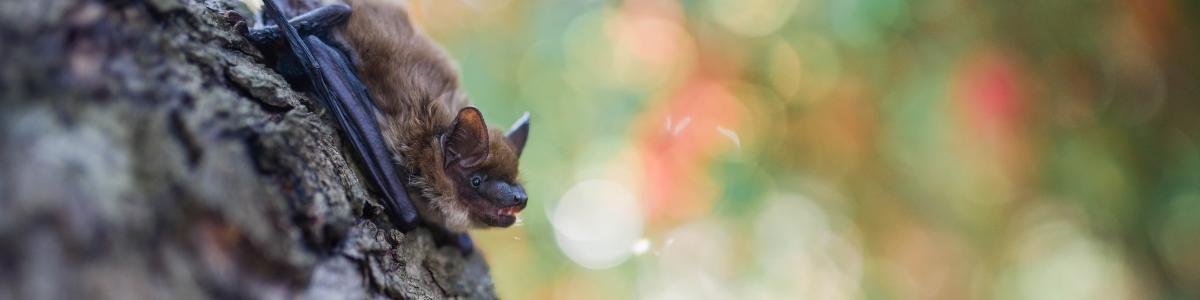
Wind turbine-related fatalities of bats were first observed over 40 years ago, but it was not until the early 2000s when unexpectedly high numbers of fatality events were discovered at wind energy facilities in the eastern U.S. that the impacts of wind turbines on bats became a concern. Fatality rates vary dramatically and can range from zero to more than 100 bats/turbine/year at individual wind energy facilities. However, certain patterns are evident across the northern hemisphere. For example, fatalities are most frequent during late summer and autumn and are often concentrated during nights with warm temperatures and low wind speeds. Understanding these patterns helped in developing the first strategies to reduce fatality by altering turbine operations during the timing and conditions bats were most vulnerable.
Estimates of fatality indicate hundreds of thousands of bats are killed annually at wind turbines both in Europe and North America. Given bats are longlived and typically only have 1 to 2 pups per year, existing fatality rates may not be sustainable for certain species. Recent studies indicate population-level declines are possible, particularly given the anticipated growth of wind energy development. However, demographic and population data are limited for most bat species, making it difficult to determine population sizes and trends. In the European Union, all bats are protected under the Habitats Directive and several species are on the IUCN Red List of threatened species. In contrast, only a few species are afforded legal protection in North America under either the United States’ Endangered Species Act or Canada’s Species at Risk Act.
Las muertes de murciélagos relacionadas con turbinas eólicas se observaron por primera vez hace más de 40 años, pero no fue hasta principios de los años 2000, cuando se descubrieron eventos inesperados de alta mortalidad en instalaciones eólicas del este de EE. UU., que las turbinas eólicas comenzaron a generar preocupación por su impacto en los murciélagos. Las tasas de mortalidad varían drásticamente y pueden ir de cero a más de 100 murciélagos por turbina al año. Sin embargo, existen patrones comunes en el hemisferio norte: las muertes son más frecuentes a fines del verano y en otoño, especialmente durante noches cálidas y con poco viento. Comprender estos patrones permitió desarrollar las primeras estrategias para reducir la mortalidad mediante ajustes en la operación de las turbinas durante los períodos de mayor vulnerabilidad.
Se estima que cientos de miles de murciélagos mueren anualmente por turbinas tanto en Europa como en América del Norte. Dado que los murciélagos viven mucho tiempo y tienen solo una o dos crías al año, estas tasas podrían no ser sostenibles para ciertas especies. Estudios recientes indican posibles declives poblacionales, especialmente ante el crecimiento proyectado de la energía eólica. Sin embargo, los datos demográficos y poblacionales son limitados para la mayoría de las especies, lo que dificulta estimar tamaños y tendencias poblacionales. En la Unión Europea, todos los murciélagos están protegidos por la Directiva de Hábitats y varias especies figuran en la Lista Roja de las Especies Amenazadas de la Unión Internacional para la Conservación de la Naturaleza (UICN). En contraste, solo unas pocas especies están legalmente protegidas en América del Norte bajo las leyes de especies en peligro de EE. UU. o Canadá.
The table below contains the literature relevant to this summary document and will continue to be updated as new literature is added to Tethys.
| Title | Author | Date Sort ascending | Content Type | Technology | Stressor | Receptor |
|---|---|---|---|---|---|---|
| Mitigating wildlife collisions with wind turbines: A review of techniques, evidence, knowledge gaps and avenues for future research | Kuzovnikova, E., Whale, J., Shephard, J., Fleming, P. | Journal Article | Wind Energy, Land-Based Wind, Fixed Offshore Wind | Collision | Bats, Birds | |
| Hoary Bat (Lasiurus cinereus) ecology and conservation through the lens of the full annual cycle | Felton, S., Weller, T., Hale, A., Frick, W., Jonasson, K., Clerc, J., Hein, C., Baerwald, E., Schauber, E. | Journal Article | Wind Energy, Land-Based Wind | Collision | Bats | |
| A spare-share scenario framework for exploring biodiversity - onshore wind trade-offs in electricity system planning | Javed, M.S., Gilad, D., May, R., Kvalnes, T., Zeyringer, M. | Journal Article | Wind Energy, Land-Based Wind | Bats, Birds, Human Dimensions, Legal & Policy | ||
| Optimising bat-friendly curtailment algorithms for wind turbines | Barre, K., Kravchenko, K., Chambert, T., Comau, A.C, Pessato, A., Ravache, A., Sivault, E., Treyvaud, C., Verniest, F., Kerbiriou, C., Vincenot, C. | Journal Article | Wind Energy, Land-Based Wind | Collision | Bats | |
| On the effects of bat protection strategies on energy production and structural loads of wind farms | Pettas, V., Göçmen, T., Duc, T., Vad, A., Vukobrat, A. | Journal Article | Wind Energy, Land-Based Wind | Collision | Bats | |
| Integrating 3-D thermal videography, ultrasonic acoustics, and weather radar to characterize bird and bat activity at wind turbines | Shultz, A., Solick, D., Whitby, M., Newman, C., Corcoran, A. | Journal Article | Wind Energy, Land-Based Wind | Avoidance | Bats, Birds | |
| Synergies and trade-offs between biodiversity and distance to settlements in the spatial allocation of wind power | Luukkonen, S., Räsänen, A., Koivula, M., Tolvanen, A. | Journal Article | Wind Energy, Land-Based Wind | Collision, Displacement, Habitat Change | Bats, Birds, Ecosystem Processes, Terrestrial Mammals, Human Dimensions, Legal & Policy, Social & Economic Data, Stakeholder Engagement, Visual Impacts | |
| 3rd Edition: Summary of Bat Fatality Monitoring Data Contained in AWWIC Land-based Wind Energy Monitoring Database | Schauber, E., Butryn, R., Felton, S. | Report | Wind Energy, Land-Based Wind | Collision | Bats | |
| Species-specific acoustic responses by bats to ultrasonic stimuli used for reducing bat-wind turbine interactions | Guest, E., Weaver, S., Hale, A., Morton, B., Hein, C., Fritts, S. | Journal Article | Wind Energy, Land-Based Wind | Collision | Bats | |
| Airflow Dynamics and Bat Behavior Near Wind Energy Turbines and Trees | Electric Power Research Institute (EPRI) | Report | Wind Energy, Land-Based Wind | Attraction, Avoidance, Collision | Bats | |
| Pooling information across sites and years to estimate bat fatalities at wind farms | Berberian, N., Dixon, P. | Journal Article | Wind Energy, Land-Based Wind | Collision | Bats | |
| Impacts of Renewable Energy Sources on Biological Diversity and Conservation: An Overview | Saad, S., Mohamed Abou El Leil, I. | Journal Article | Wind Energy, Land-Based Wind | Collision | Bats, Birds, Raptors | |
| Song flight and 3D thermal detection provide evidence for bat attraction to wind turbines in Central Europe | Nagy, M., Hochradel, K., Haushalter, C., Simon, R., Weber, N., Behr, O., Knörnschild, M. | Journal Article | Wind Energy, Land-Based Wind | Collision | Bats | |
| A Structured Techno-Economic and Socio-Regulatory Comparison of Onshore, Fixed-Bottom Offshore, and Floating Offshore Wind Energy Systems | Koondhar, M. A., Afridi, S. K., Alsenani, T., Mahariq, I., Zeinoddini-Meymand, H., Shahnia, F., Touti, E. | Journal Article | Wind Energy, Land-Based Wind, Fixed Offshore Wind, Floating Offshore Wind | Collision, Habitat Change, Noise | Bats, Birds, Fish, Demersal Fish, Invertebrates, Marine Mammals, Legal & Policy, Social & Economic Data, Visual Impacts | |
| Assessing vertical stratification of bats and nocturnal insects to infer potential collision risk at wind turbines in central Thailand | Srilopan, S., Krauel, J., Srilopan, K., Voigt, C., Bumrungsri, S. | Journal Article | Wind Energy, Land-Based Wind | Collision | Bats, Birds | |
| Establishing baselines for echolocating bat activity at wind farms in mainland Southeast Asia | Furey, N., Tu, V., Hitch, A., Pilgrim, J., Kunzer, M. | Journal Article | Wind Energy, Land-Based Wind | Collision | Bats | |
| Evaluation of the Impact of Environmentally Driven Curtailment Regulations on Wind Farm Energy Production | Gonzalez, J., Rodríguez, A., Expósito, A., Santos, J. | Journal Article | Wind Energy, Land-Based Wind | Collision | Bats | |
| Hierarchical mixture models and high-resolution monitoring data can inform siting and operational strategies to mitigate bat fatalities at wind turbines | Labuzzetta, C., Johnson, A., Andress, A., Bohner, T., Grajal-Puche, A., Seymour, M., Straw, B., Thogmartin, W., Udell, B., Wiens, A., Diffendorfer, J. | Journal Article | Wind Energy, Land-Based Wind | Collision | Bats | |
| Bird and bat mortality at wind farms in South America: Lessons from monitoring and mitigation practices in Chile | Santander, F., Morant, J., Perez-Garcia, J. | Journal Article | Wind Energy, Land-Based Wind | Collision | Bats, Birds | |
| Minimizing aviation lighting duration reduces bat attraction to wind turbines | Larnoy, G., Verniest, F., Kerbiriou, C., Le Viol, I., Lefebvre, P., Valet, N., Barre, K., Leroux, C. | Journal Article | Wind Energy, Land-Based Wind | Collision, Lighting | Bats | |
| Testing a bat fatality detection system at wind turbines | Weaver, S., Ritter, J., Commiskey, A., Garcia, J., Morton, B. | Journal Article | Wind Energy, Land-Based Wind | Collision | Bats | |
| New frontiers in wind-wildlife monitoring systems | Dempsey, L., Clerc, J., Hein, C. | Journal Article | Wind Energy, Land-Based Wind | Collision, Displacement | Bats, Birds | |
| Impacts on birds and bats from onshore wind farms in Australia | Reid, K., Baker, G.B. | Report | Wind Energy, Land-Based Wind | Collision, Displacement, Habitat Change | Bats, Birds | |
| Wind Energy Interactions with Wildlife Answers to Frequently Asked Questions Based on the State of the Science | Renewable Energy Wildlife Institute (REWI) | Report | Wind Energy, Land-Based Wind | Attraction, Avoidance, Collision, Noise | Bats, Birds | |
| Harnessing AI for Bat Videography Research and Conservation | Corcoran, A. | Presentation | Wind Energy, Land-Based Wind | Collision | Bats | |
| Accelerating technology development to monitor and minimize effects from land-based wind energy on birds and bats | Gottlieb, I., Hein, C., Field, P., Allison, T. | Journal Article | Wind Energy, Land-Based Wind | Collision | Bats, Birds | |
| Migratory Strategy is a Key Factor Driving Interactions at Wind Energy Facilities in At-Risk North American Bats | Campbell, C., Nelson, D., Nagel, J., Clerc, J., Weller, T., Wieringa, J., Fraser, E., Longstaffe, F., Hale, A., Lout, M., Pruitt, L., Guralnick, R., Vander Zanden, H. | Journal Article | Wind Energy, Land-Based Wind | Collision | Bats | |
| Unravelling the relationship between digitalisation and sustainable energy transitions using socio-technical-ecological scripts | Schmidt-Scheele, R., Mattes, J. | Journal Article | Wind Energy, Land-Based Wind | Collision | Bats, Birds | |
| Southern bent-wing bat: a review of current knowledge, and remaining knowledge gaps, relevant to wind farms | Bush, A., Lumsden, L. | Report | Wind Energy, Land-Based Wind | Collision | Bats | |
| Systematic Review of Crop Pests in the Diets of Four Bat Species Found as Wind Turbine Fatalities | Hale, A., Foo, C., Lloyd, J., Stucker, J. | Journal Article | Wind Energy, Land-Based Wind | Attraction, Collision | Bats | |
| Spatiotemporal patterns in sex ratios of bat fatalities at wind energy facilities in the United States | Weaver, S., Hale, A., Nelson, D., Fritts, S., Katzner, T., Chipps, A., Korstian, J., LiCari, S., Nagel, J., Williams, D. | Journal Article | Wind Energy, Land-Based Wind | Collision | Bats | |
| Bat protection during the expansion of wind energy - Assessment of the impact of new-generation wind turbines on the collision risk of bats | Mammen, K., Mammen, U., Henrichmann, C. | Report | Wind Energy, Land-Based Wind | Bats | ||
| Integrating Biodiversity Impacts into Life Cycle Assessment: Applied to a case study of onshore wind power production | Demyanenko, S. | Thesis | Wind Energy, Land-Based Wind | Collision, Displacement, Habitat Change, Noise | Bats, Birds, Terrestrial Mammals, Human Dimensions, Life Cycle Assessment | |
| Acoustic exposure reveals variation in curtailment effectiveness at reducing bat fatality at wind turbines | Peterson, T., Rusk, A., Byrne, C., Aghababian, S., Edwards, S. | Journal Article | Wind Energy, Land-Based Wind | Collision | Bats | |
| Proceedings of the 15th Wind Wildlife Research Meeting | Gottlieb, I. | Workshop Article | Wind Energy, Land-Based Wind | Collision, Displacement | Bats, Birds | |
| Ultrasonic deterrents provide no additional benefit over curtailment in reducing bat fatalities at an Ohio wind energy facility | Clerc, J., Huso, M., Schirmacher, M., Whitby, M., Hein, C. | Journal Article | Wind Energy, Land-Based Wind | Collision | Bats | |
| The costs of wind energy permitting compliance actions for regulated bats in the US | Newman, C., Surrey, K. | Journal Article | Wind Energy, Land-Based Wind | Bats, Human Dimensions, Social & Economic Data | ||
| Predicting risk to bat species from wind turbine collision in Southeast Asia | Crane, M., Silvia, I., Grainger, M., Gale, G. | Journal Article | Wind Energy, Land-Based Wind | Collision | Bats | |
| Mapping bird and bat assemblage vulnerability for predicting wind energy impact | Morant, J., Naves-Alegre, L., Garcia, H., Tena, E., Sanchez-Navarro, S., Nogueras, J., Ibanez, C., Sebastian-Gonzalez, E., Perez-Garcia, J. | Journal Article | Wind Energy, Land-Based Wind | Collision | Bats | |
| Los murciélagos Mexicanos y la energía eólica: un breve recuento de los daños | Muñoz Jiménez, O., Villegas Patraca, R. | Journal Article | Wind Energy, Land-Based Wind | Bats |