



Description
This initiative corresponds to a joint effort between the public, private sector and universities, to promote the development of marine energy in our country, which for three years will allow Chile to lead one of the most relevant scientific research on marine energy and expand the generation towards new renewable and clean sources.
It consists of a unique experimental project in Latin America, where six RD groups and business teams from Chile, Italy and the United States will join forces to study the behaviour of a laboratory in the open sea.
The "Open Sea Lab" platform provides important information on ocean conditions, not only for research on marine energy, but also on many other relevant areas of the coastal ocean, such as climate change, currents and swells. For this, submerged sensors will collect data on the energy produced, the magnitude and direction of the waves and currents, the temperature, turbidity, pH, oxygen and the forces exerted on anchor lines, all data of high scientific interest.
This important information, combined with data from an X-band radar and a weather station on land, allow to obtain a complete characterization of the behaviour of the wave device in real time and of the sea state at the site.
The MERIC program was completed in November 2025.
Location
Las Cruces, El Tabo, Valparaíso Region, Chile.
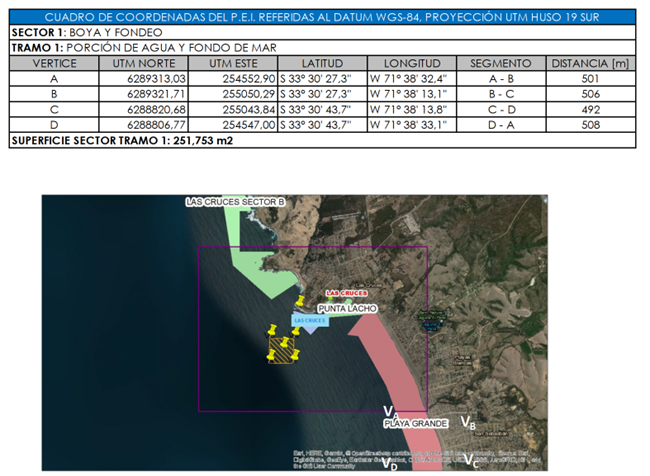
Licensing Information
Two permits were required to deploy the Open Sea Lab, the first one from the Harbour Captaincy of Algarrobo (Ministry of Defense) that has to be renewed every year about the occupation of seabed and water column/area.
And the second one is an authorization for marine research from the Hydrology and Oceanography Service of the Army, that lasts two years with one renovation.
Project Progress
The Open Sea Lab initiative was born in 2015, along with nine other R&D projects within MERIC in collaboration with Enel Green Power company Chile and Italy.
The first stage was to scope different technologies to be deployed in Chilean ocean in order to explore wave power potential in a specific marine environment. After several technologies study, the team selected the PowerBuoy three from the US company Ocean Power Technologies, Inc.
After three locations in Chile selection failed for different reasons, so the WEC was deployed in April 2021 in Las Cruces, the fourth and final site.
In April 2021, the Open Sea Lab was successfully implemented through an operation carried out from the Port of San Antonio to the vicinity of ECIM, with all necessary permits granted by the Chilean governmental authorities.
Prior to this milestone, it was essential to conduct a series of site characterization studies, including bathymetric surveys and oceanographic reports, as well as to select a date when weather conditions would be optimal for the deployment.
Thanks to the joint effort of multiple public and private organizations, the PB3 buoy, measuring 13 meters in total length, with 10 meters positioned below the sea surface, was successfully installed.
The structure remained anchored and operational at a depth of 35 meters for over two consecutive years, transmitting real-time data that significantly contributed to advancing knowledge in this field.
The main goal of the Open Sea Lab is to explore wave energy potential in central Chile, assess the WEC survivability and study the metocean conditions in which the electricity is being produced.
Key Environmental Issues
No key environmental issues have arisen from permitting or else, but all this info is in the paper just published by the MERIC team in 2022.