



Webinar
Event Access
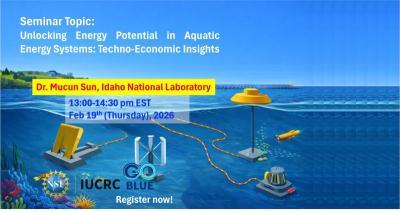
Power and energy systems are undergoing a rapid transition toward high penetrations of clean and hybrid energy resources, particularly in water-rich and offshore environments. Compared to conventional generation-dominated systems, emerging power systems increasingly rely on complex interactions among hydropower, solar photovoltaics, offshore wind, energy storage, and transmission assets. While these hybrid configurations offer significant potential to improve system reliability, asset utilization, and energy security, they also introduce new technical, economic, and operational challenges associated with resource variability, infrastructure constraints, and system-level uncertainty. This talk will highlight recent research at Idaho National Laboratory (INL) on techno-economic and operational feasibility analysis of emerging renewable hybrid systems. First, we will present a comprehensive feasibility assessment of floating photovoltaic (FPV)–hydropower hybrid systems using INL’s AquaPV tool, demonstrating how long-term techno-economic analysis and dispatch-aware modeling can quantify system value, uncertainty, and deployment tradeoffs. We will then discuss offshore wind integration challenges, with a focus on dynamic line rating (DLR) feasibility analysis for submarine transmission cables, illustrating how environmental conditions can be leveraged to unlock latent transmission capacity while maintaining thermal and reliability constraints. The talk will conclude by discussing broader implications for marine energy deployment, emphasizing how integrated techno-economic modeling, reliability-aware planning, and environmental co-optimization can reduce investment risk, improve system resilience, and accelerate commercialization of wave, offshore wind, and other marine energy technologies. Together, these approaches provide a scalable framework for enabling reliable, economically viable, and grid-ready marine energy systems.