



Webinar
Event Access
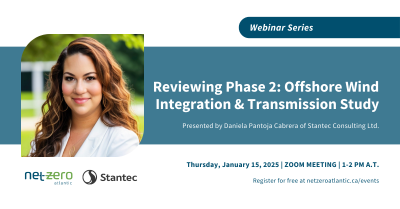
This webinar presents findings and key insights from the Net Zero Atlantic Offshore Wind Integration & Transmission Study – Phase 2. The study evaluated the technical, locational, and economic potential for offshore wind development in Atlantic Canada, including optimal wind resource areas, energy yield estimates, and cost implications. It also projects offshore wind development trajectories toward 2035 and 2050, aligning resource potential with emerging market drivers.
The webinar will provide a high-level summary of the study’s methodology, geospatial analysis, wind energy modeling, cost estimates, long-term planning, and actionable next steps for enabling offshore wind development in the region.
Learning Objectives
- Understand the technical and geographical basis for offshore wind siting in Atlantic Canada
- Recognize constraints affecting feasibility, including bathymetry, exclusion zones, shipping lanes, and permitting sensitivities
- Review capacity mapping assumptions, such as turbine selection, spacing, and yield estimation
- Identify early-stage development indicators to guide provincial and project-level planning
- Interpret how offshore wind resource potential can scale into economic deployment scenarios for 2035 and 2050
Why Attend
Canada faces pivotal decisions in renewable energy expansion, with offshore wind emerging as a scalable pathway for emissions reduction and economic growth. This webinar distills complex technical studies into actionable insights for strategic planning. Participants will gain a clear understanding of offshore wind as an energy system asset—including installed MW potential, cost competitiveness, and expected deployment increments—and will directly benefit from exposure to analytical frameworks to support informed decision-making in energy transition initiatives.
Who Should Attend
- Provincial and federal government agencies involved in energy planning
- Utilities and system operators
- Offshore wind developers
- Transmission planners and system engineers
- Environmental advisory groups and regulators
- Research organizations and academic institutions
- Indigenous communities engaged in project-area decision-making
About the presenter
Daniela Pantoja Cabrera, Renewable Energy Analyst - Stantec Consulting Ltd.
Daniela Pantoja Cabrera is a Renewable Energy Analyst at Stantec, supporting wind and hydroelectric development initiatives across Canada. She holds a Bachelor of Mechanical Engineering from the University of San Francisco de Quito (Cum Laude), a Master of Engineering in Mechanical and Industrial Engineering from the University of Toronto—where she focused on renewable energy and waterpower systems—and a complementary Master's in Business Intelligence with emphasis in analytical decision-making.
Daniela’s technical experience includes wind resource assessments, hydropower refurbishment planning, and integration of large-scale renewable systems into electrical networks. She has supported multi-disciplinary feasibility analyses, geospatial constraint mapping, and project definition packages for early-stage developments. Within the NZA Phase 2 Offshore Wind Study, Daniela worked on identifying buildable offshore areas, evaluating locational constraints, applying turbine scenarios, and analyzing transmission interconnection pathways for regional deployment. Her previous industry experience includes roles at General Motors in regional supply management and as Project Manager at Axiomatic Technologies, where she developed cross-functional strategies, performance tracking models, and engineering execution frameworks.
Daniela brings strong analytical depth, technical leadership, and stakeholder engagement skills to projects focused on scaling renewable energy infrastructure.