



Contents
Wind Project Site
(login for email address)
Details
Description
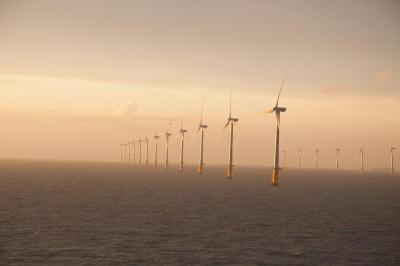
The Thanet Offshore Wind Farm is located 7 mi (11 km) off the coast of the Thanet district in Kent, England. On commissioning it was the world's largest offshore wind farm with a nameplate capacity of 300 MW. Thanet is one of fifteen Round 2 wind projects announced by the Crown Estate in January 2004 and was the first to be developed. It was officially opened on 23 September 2010, when it overtook Horns Rev 2 as the biggest offshore wind farm in the world. Thanet consists of 100 Vestas V90 wind turbines and cost roughly £780-900 million (US$1.2–1.4 billion). This is a one-phase project; all turbines were installed in rapid succession, about one every 18 hours.
Vattenfall planned to extend the Thanet Offshore Wind Farm, following 18-months of consultation with residents and businesses by Vattenfall, and submitted a development consent order in 2018 to the UK’s government agency, The Planning Inspectorate (PINS). This agency accepted the proposed project for examination in 2018, but in June 2020, the Secretary of State refused development consent for the application due to the concern of navigational safety and impact on future ports and shipping traffic.
Location
Thanet’s 100 wind turbines are spread over an area of 35 km² in the Thames Estuary. The distance between each turbine is 500 m along the rows and 800 m between the columns.
Project Timeline
- June 2020: The UK Secretary of State for Business, Energy and Industrial Strategy (BEIS) refused Vattenfall’s development consent order application for the Thanet Extension.
- November 2022: Vattenfall and Shell entered into a 5-year power purchase agreement for 300,000 MWh.
- June 2018: Vattenfall applied for the development consent order for the Thanet Extension.
- December 2014: The UK’s Office of Gas and Electricity Markets (Ofgem) granted license for Thanet offshore wind farm’s transmission assets.
- 2014: The cables, substations, and transmission infrastructure assets were sold by Vattenfall to Thanet OFTO.
- September 2010: Construction completed (world’s largest offshore wind farm at the time).
- November 2008: Vattenfall acquired CRC and the project.
- January 2008: Construction on Thanet Offshore Wind Farm began.
- 2007: License obtained under the Marine and Coastal Access Act (Marine License).
- 2007: Christofferson, Robb & Co (CRC) purchased the project and Warwick Energy continued to manage the project until October 2008 (when the buyer backed out).
- July 2006: Vestas chosen as preferred turbine supplier.
- September 2006: SLP were chosen as the preferred supplier for the foundations.
- 2004: The Crown Estate awarded Thanet in round 2 offshore licensing to Thanet Offshore Wind Ltd in the Thames Estuary Strategic Environmental Assessment (SEA).
- 2003: Thanet Offshore Wind Ltd was originally conceived in 2003 by Warwick Energy under the Round 2 offshore wind farm license applications.
Licensing Information
At the national level, the Crown Estate, responsible for managing the seabed around England, Wales and Northern Ireland, awarded development rights in 2004. At the time, the Department of Trade and Industry’s (DTI) Offshore Renewable Consents Unit (ORCU) led the consent process. Some of the key consents were included under the Food and Environment Protection Act (FEPA) 1985, Coast Protection Act 1949, Electricity Act 1989, Town and Country Planning Act 1990, etc.
In 2018 Vattenfall applied for a 340MW extension to Thanet, however in 2020 this development consent was denied by the Department for Business, Energy and Industrial Strategy.
Key Environmental Issues
The Thanet Offshore Wind Farm faced several environmental challenges, including potential impacts on marine habitats, marine mammals, seabirds, and local fisheries. The construction and operation of the wind farm raised concerns about habitat disturbances, particularly to benthic ecosystems and sandbanks. Royal Haskoning was commissioned by Thanet Offshore Wind project to undertake an Environmental Impact Assessment (EIA) of the proposed development, including both offshore and onshore elements. A scoping report was produced in July 2004 and provided an initial overview of the environmental issues associated with the Thanet project (Royal Haskoning, 2005). In the early stages of development of the wind farm, research was conducted to fulfill Thanet’s commitment to ensure that a minimum of two years of ornithological data was used to assess the likely impacts of the Thanet Offshore Wind Farm project (Royal Haskoning, 2005). This was just one example of research conducted to assess the potential impact of the project.
When Vattenfall was looking to expand their wind farm, around 2016, they proposed various ways they would approach considerations for environmental effects of the expansion including aspects such as developing a marine mammal mitigation protocol (MMMP) to mitigate effects on marine mammals (e.g., harbour porpoise from pile-driving noise (SMRU Consulting, 2018). However, the Secretary of State for Business, Energy, and Industrial Strategy refused development consent for Thanet’s expansion application in 2020. The secretary of state stated that the rejection of the application was on the grounds that it could affect navigational safety. The secretary of state also cited concerns over the effect on certain environmentally sensitive areas.