



Contents
Wind Project Site
(login for email address)
Details
Description
Hornsea 3 is currently under construction in the North Sea and will be the world’s largest offshore wind farm when completed. It represents the third phase of Ørsted’s Hornsea offshore wind zone, following Hornsea 1 and Hornsea 2. When Hornsea 3 comes online with its ~231 turbines, the combined capacity of Hornsea 1, 2, and 3 will exceed 5 GW, making it one of the world’s largest offshore wind zones. Once completed, Hornsea 3 will be capable of generating enough renewable electricity to power more than 3.3 million UK homes.
The wind farm is developed and operated by Ørsted, which maintains the project from its East Coast Hub in Grimsby, England. Ørsted has partnered with Apollo Investment Corporation, which holds a 50% stake in Hornsea 3, forming a joint venture to share ownership and investment responsibilities.
Location
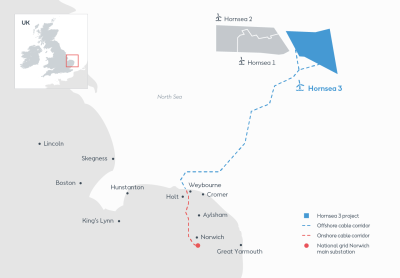
Hornsea 3 is located 160 km off the Yorkshire coast in the North Sea. The farm covers 696 square kilometres. The landfall site for Hornsea 3 is at Weybourne in North Norfolk.
Project Timeline
- Jun 2026: Reinstatement has been completed in 68/72 zones
- Nov 2025: Ørsted signs agreement to divest 50 % stake in Hornsea 3 to Apollo
- Dec 2023: Ørsted took final investment decision on Hornsea 3 offshore wind farm
- Dec 2020: Planning Inspectorate granted development consent
- June 2018: DCO application accepted by the Planning Inspectorate for examination.
- May 2018: Submitted development Consent Order (DCO) application
- Mar 2018: Carried out focussed statutory consultation on a number of minor amendments to the onshore route based on further feedback.
- Nov-Dec 2017: Carried out further statutory consultation on some proposed changes in response to feedback.
- July-Sep 2017: Carried out statutory consultation on PEIR and third round of Community Consultation Events (Phase 2)
- July 2017: Published Preliminary Environment Information Report (PEIR), presenting the results of initial assessments to inform consultation.
- Mar 2017: Held second round of Community Consultation Events (Phase 1.B)
- Dec 2016: Scoping Opinion received from Planning Inspectorate.
- Nov 2016: Held first round of Community Consultation Events (Phase 1.A)
- Oct 2016: Published Scoping Report, containing early information about the project and assessments that would be undertaken.
- Sep 2016: Published Statement of Community Consultation, marking the start of public consultation.
- Aug 2015: Ørsted acquired the rights to develop the Hornsea Zone with the acquisition of Smart Wind Ltd
Licensing Information
Hornsea 3 underwent a consenting process under the UK’s Planning Act 2008, culminating in a Development Consent Order (DCO) granted by the Secretary of State for Business, Energy and Industrial Strategy in December 2020. The planning and environmental review was led by the UK Planning Inspectorate, which carried out an Environmental Impact Assessment (EIA) examination from October 2018 to April 2019. Ørsted worked closely with RPS Group, the lead EIA consultant, to address a broad range of onshore and offshore ecological, biological, and physical impacts.
During consents, Ørsted committed to specific mitigation measures, including artificial nesting structures for kittiwake seabirds, which are embedded in a Kittiwake Implementation Management Plan (KIMP) as part of the DCO. A subsequent non-material change to the DCO was approved in 2023, adjusting how long these nesting structures must remain in place before turbines can operate. The consenting timeline, from application submission in May 2018 through examination, requests for additional information, and final decision spanned around two and a half years.
Key Environmental Issues
Hornsea 3 presents several environmental challenges, especially for benthic habitats, marine mammals, and seabirds. Survey data show the site supports a variety of seafloor communities, from worms and bivalves in mixed sediments to more mobile species like starfish and sea urchins, which could be disturbed by construction.
Construction noise, particularly from piling, may affect marine mammals. Hornsea 3’s Environmental Statement includes detailed assessments of risk (such as temporary and permanent hearing threshold shifts), along with mitigation through soft-start piling and long‑term monitoring.
The project also posed risks to black‑legged kittiwakes, a vulnerable seabird whose population may be affected by collision mortality. To address this Ørsted has built three bespoke artificial nesting structures about 1 km offshore of East Suffolk (near Minsmere and Lowestoft), designed in collaboration with Natural England, the Royal Society for the Protection of Birds (RSPB), and the Marine Management Organisation (MMO); each structure can host around 500 breeding pairs and is fitted with predator‑resistant features, remote monitoring, and observation panels. These structures are part of a long‑term monitoring plan to support the kittiwake population.