



Project Overview
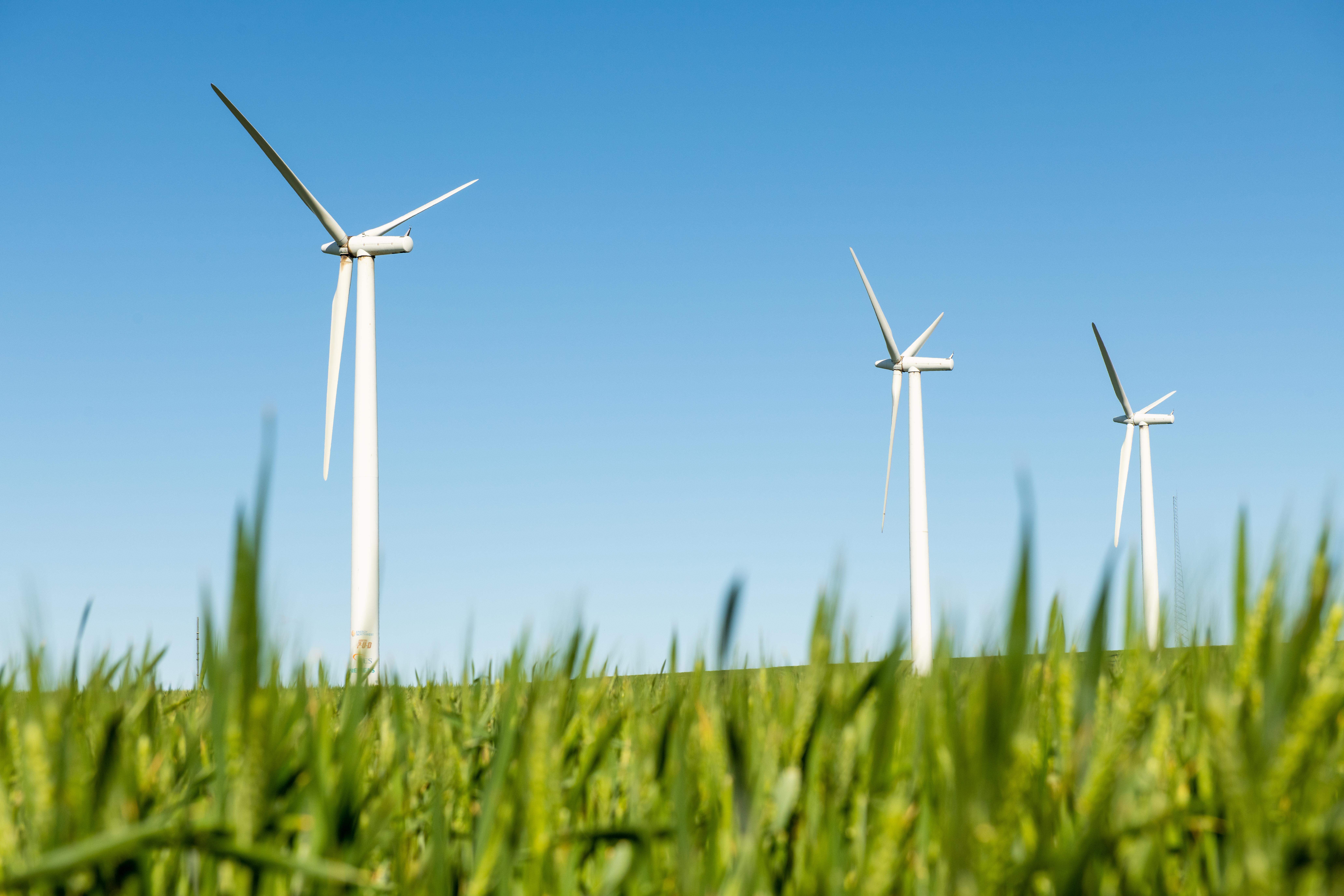
Sustainable deployment of land-based wind energy requires a balance of conservation, energy, and economic goals. Enabling Coexistence Options for Wind Energy and Wildlife (ECO Wind), initiated by the National Laboratory of the Rockies (NLR) with support from the Pacific Northwest National Laboratory (PNNL), supports efforts to reduce wildlife impacts at land-based wind energy facilities with monitoring and minimization technology solutions.
Through research, outreach, and engagement, ECO Wind works to close knowledge gaps, support collaborative organizations, and disseminate scientifically credible information. Research reduces uncertainty surrounding wind-wildlife interactions and sheds light on drivers of risk. Outreach ensures science-based results and resources are accessible to key stakeholders. Engagement builds and maintains trust among the wind-wildlife community.
View the ECO Wind Factsheet here.
Research Briefs
ECO Wind has published the following short science summaries and fact sheets focused on wind energy and bats, grouse, and raptors:
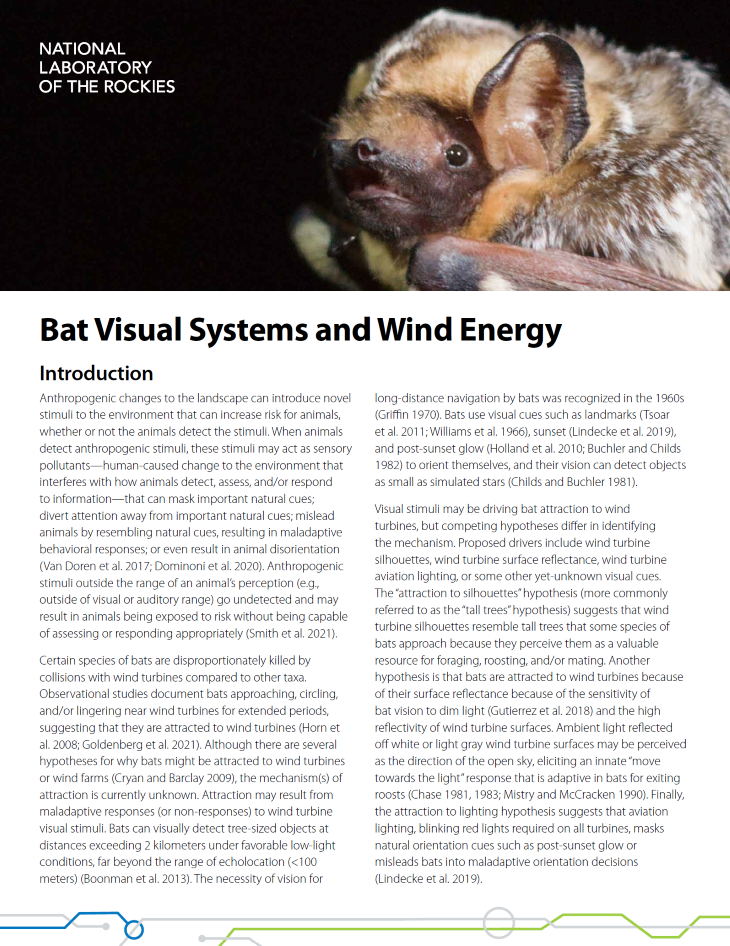
- Bat Visual Systems and Wind Energy (2026)
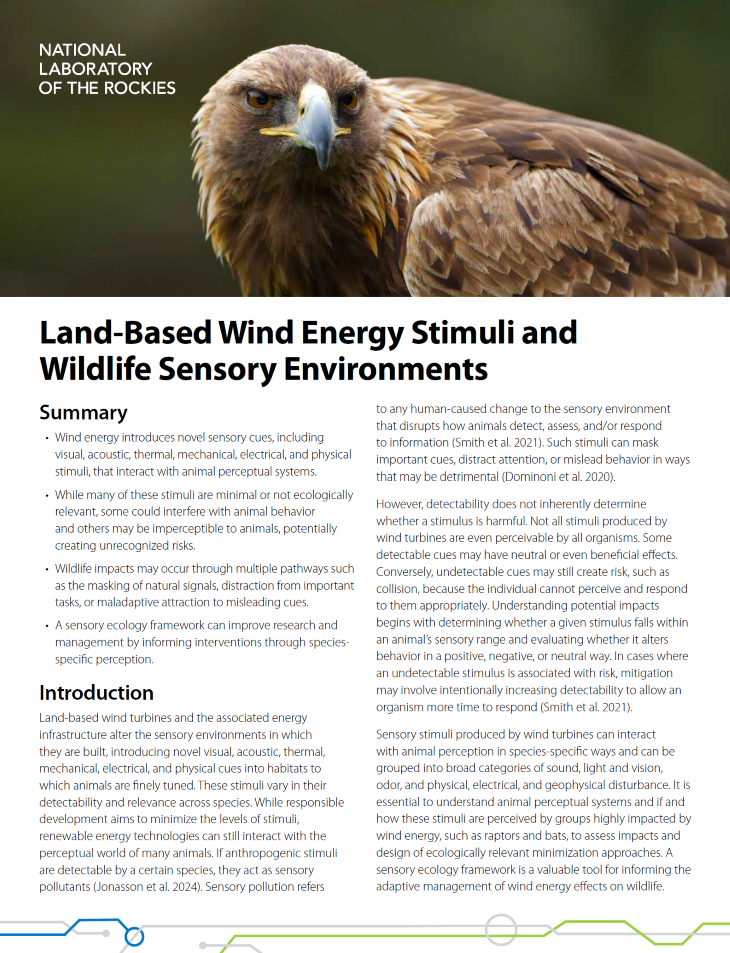
- Land-Based Wind Energy Stimuli and Wildlife Sensory Environments (2026)
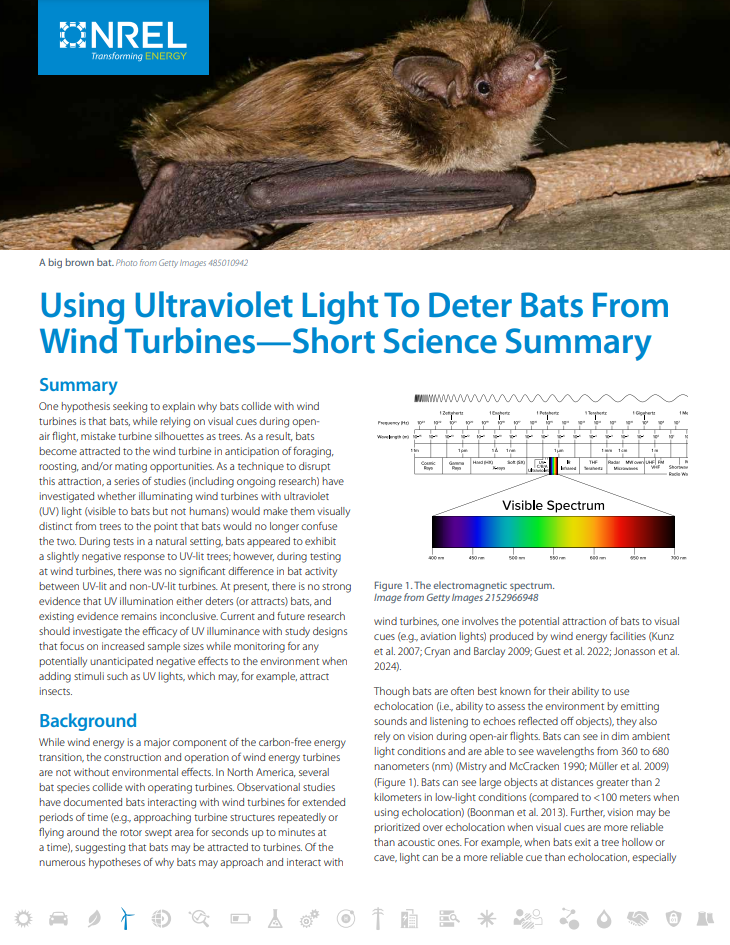
- Using Ultraviolet Light To Deter Bats From Wind Turbines—Short Science Summary (2024)
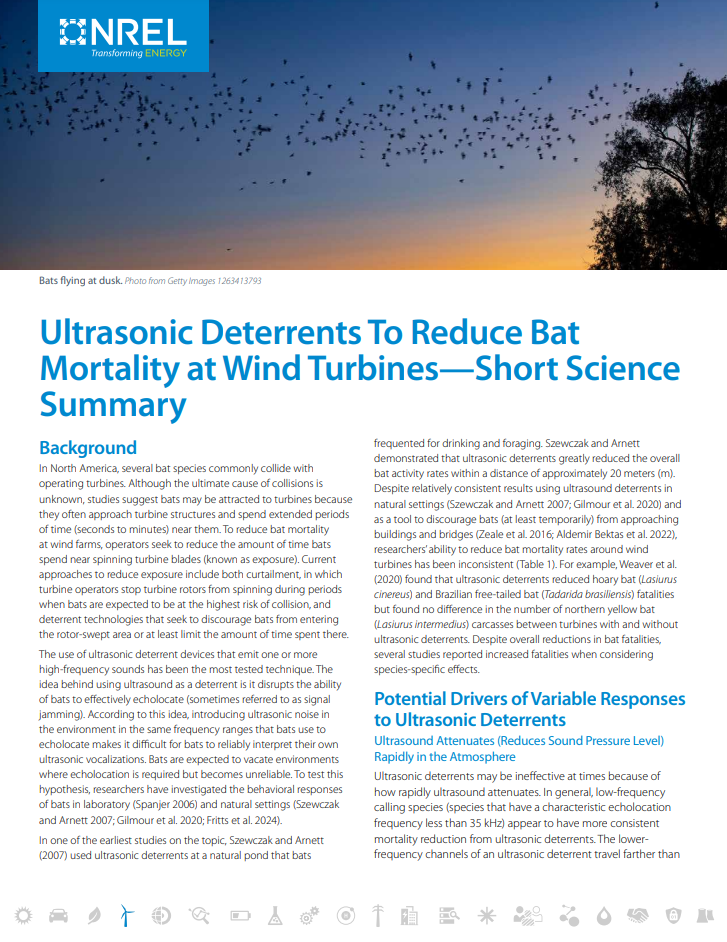
- Ultrasonic Deterrents To Reduce Bat Mortality at Wind Turbines—Short Science Summary (2024)
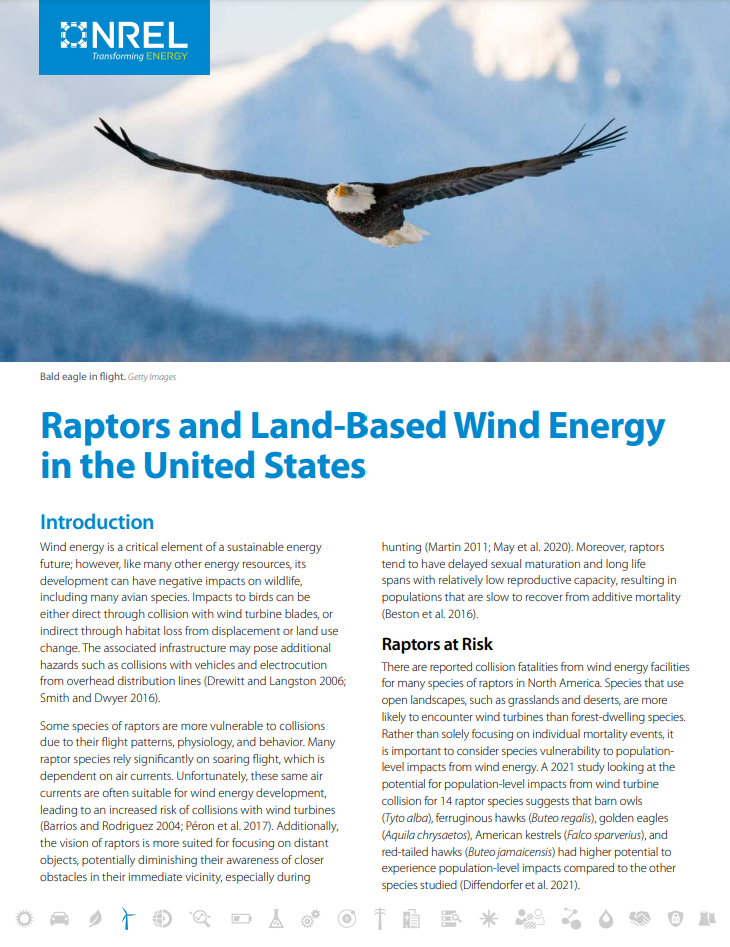
- Raptors and Land-Based Wind Energy in the United States (2024)
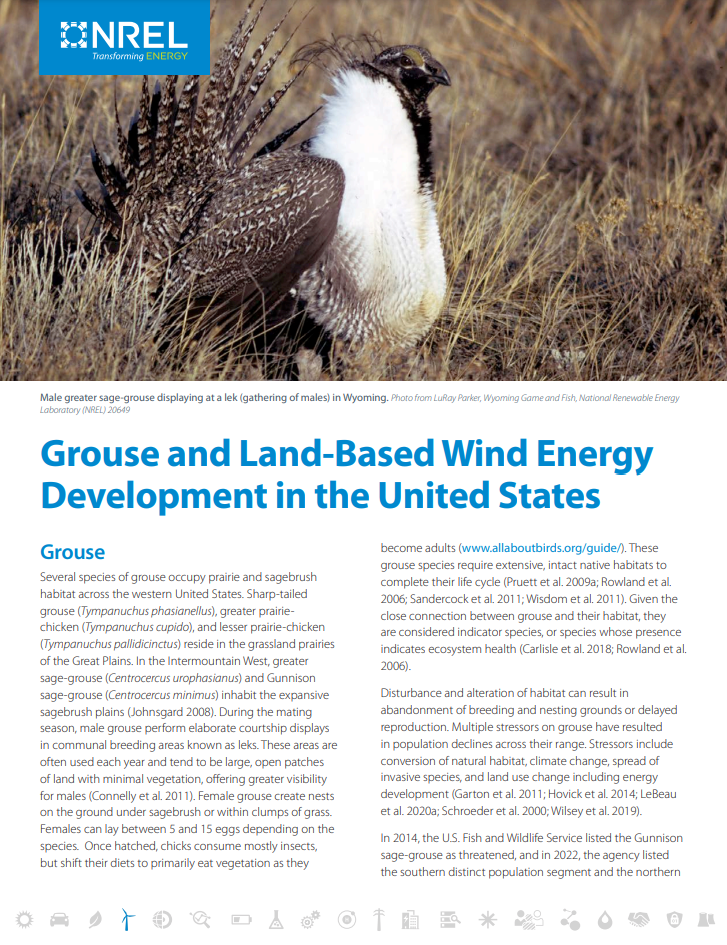
- Grouse and Land-Based Wind Energy Development in the United States (2023)
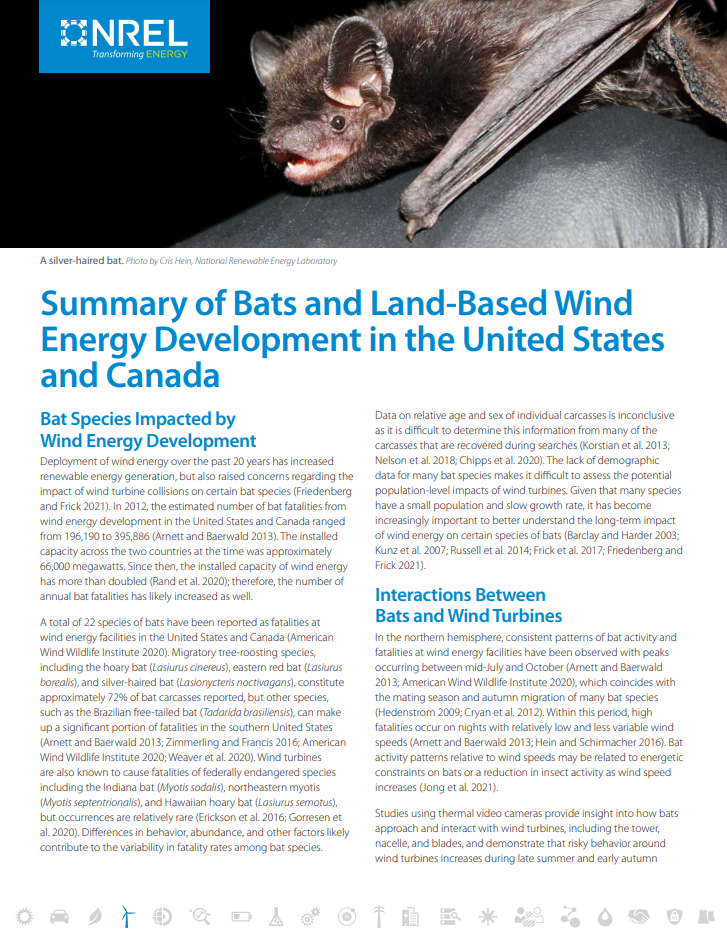
- Summary of Bats and Land-Based Wind Energy Development in the United States and Canada (2023)
Wildlife & Wind Energy Webinar Series
NLR (formerly NREL) and Defenders of Wildlife hosted a nine-part webinar series, Wildlife and Wind Energy: Considerations for Monitoring and Managing Impacts, to help familiarize stakeholders with the nuances of land-based wind energy development in the context of species conservation. Held from September through December 2021, the webinar series helped attendees understand a variety of topics ranging from species-specific discussions and methodologies for reducing impacts on wildlife to regulatory and financing perspectives on effective mitigation strategies for species protection.
- Webinar #1: History of wind energy and wildlife interactions and overview of the webinar series
- Webinar #2: Federal and State Perspectives on Environmental Review of Wind Energy and Wildlife
- Webinar #3: Grouse - Considerations for developing wind energy in grouse habitat
- Webinar #4: Bats - Methodologies and technologies used to study impacts of wind turbines on bats
- Webinar #5: Eagles: Permitting process and best practices for monitoring and mitigation
- Webinar #6: Communicating Results: How to identify and produce robust monitoring reports
- Webinar #7: Impact Reduction Strategies for Eagles and Bats
- Webinar #8: Understanding wildlife minimization in the context of development and financing
- Webinar #9: Future Priorities for Wildlife & Wind Energy - Multi-stakeholder perspectives on challenges and opportunities
NLR (formerly NREL) and the Renewable Energy Wildlife Institute are hosting a four-part webinar series, Compensatory Mitigation for Land-based Wind Energy, that will introduce regulations that influence compensatory mitigation for wind energy projects and explore real-world examples of how compensatory mitigation is applied in practice.
- Compensatory Mitigation Webinar 1: Regulatory Landscape
- Compensatory Mitigation Webinar 2: Funding Mechanisms
- Compensatory Mitigation Webinar 3: Grouse Management and Conservation
- Compensatory Mitigation Webinar 4: Thinking Outside the Box
NLR's ECO Wind project has announced a multi-part webinar series, “Perspectives on Wind-Wildlife Constraints to Buildout”, which will feature experts from diverse fields related to, but outside of, the wind-wildlife domain. Over the series, experts will address three major constraints to wind energy buildout: siting, operations, and technology.
- Perspectives on Wind-Wildlife Constraints to Buildout Webinar 1: Siting
- Perspectives on Wind-Wildlife Constraints to Buildout Webinar 2: Operations
View additional archived webinars on the Environmental Webinars page and sign up to receive invitations to future webinars here.
Additional Resources
General Wind Energy Resources
- WINDExchange
- U.S. Wind Turbine Database
- Wind Integration National Dataset (WIND) Toolkit
- U.S. Fish and Wildlife Service Land-Based Wind Energy Guidelines
- Generalized Mortality Estimator (GenEst)
Bats & Wind Energy Resources
- 3rd Edition: Summary of Bat Fatality Monitoring Data Contained in AWWIC Land-based Wind Energy Monitoring Database (REWI Report)
- Landscape Factors Associated with Fatalities of Migratory Tree-Roosting Bats at Wind Energy Facilities: An Initial Assessment (AWWI Report)
- The State of the Science on Operational Minimization to Reduce Bat Fatality at Wind Energy Facilities (Bat Conservation International Report)
- Bats and Wind Energy Cooperative (BWEC)
- Bat Acoustic Monitoring Portal (BatAmp)
- North American Bat Monitoring Program (NABat)
Raptors & Wind Energy Resources
- 3rd Edition: Summary of Bird Fatality Monitoring Data Contained in AWWIC (REWI Report)
- U.S. Fish and Wildlife Service Eagle Conservation Plan Guidance (USFWS Guidance)
- Workshop on Eagle Behavior and Risk Modeling for Wind Energy
Grouse & Wind Energy Resources
- Virtual Forum on Prairie Grouse and Wind Energy: 2021 Synthesis (AWWI Report)
- 2nd Edition: Summary of Bird Fatality Monitoring Data Contained in AWWIC (AWWI Report)
- Placement of Wind Energy Infrastructure Matters: A Quantitative Study Evaluating Response of Lesser Prairie-Chicken to a Wind Energy Facility (AWWI Report)
- Behavioral Response of Grouse to Wind Energy Turbines: A Quantitative Review of Survival, Habitat Selection, and Lek Attendance (NWCC Report)
ECO Wind Partners
| Partner | Description |
|---|---|
 |
The U.S. Department of Energy’s (DOE) mission is to ensure America's security and prosperity by addressing its energy, environmental, and nuclear challenges through transformative science and technology solutions. The DOE Wind Energy Technologies Office supports the ECO Wind project and views Tethys as one of its major outreach programs. |
 |
The National Laboratory of the Rockies (NLR) is a national laboratory of the U.S. Department of Energy. NLR leads the ECO Wind project and facilitates collaborative research, outreach, and engagement activities with project partners. |
 |
The Pacific Northwest National Laboratory (PNNL) is a national laboratory of the U.S. Department of Energy. PNNL supports the ECO Wind project and maintains Tethys. |
 |
The U.S. Geological Survey (USGS) is a federal agency within the U.S. Department of Interior dedicated to studying the landscape of the U.S., its natural resources, and the natural hazards that threaten it. USGS’s partnership through ECO Wind has helped validate early-stage technologies for monitoring and minimizing wildlife interactions with wind turbines. |
 |
Bat Conservation International’s (BCI) mission is to conserve the world’s bats and their ecosystems to ensure a healthy planet. BCI supports the ECO Wind project by researching the behavioral and physiological drivers of bat interactions with wind turbine. |
 |
Western EcoSystems Technology, Inc. (WEST) provides environmental and statistical consulting services and contract research nationally and internationally for industry, government, and private organizations. WEST provides the ECO Wind project extensive research expertise on eagle behavior which is used to develop models relating eagle flight and wind flow patterns. |
 |
Defenders of Wildlife (Defenders) is a national conservation organization dedicated to the protection and restoration of imperiled species and their habitats in North America. Defenders supports ECO Wind through outreach and engagement activities, and co-organized ECO-Wind’s 9-part webinar series on wind energy and wildlife. |
 |
The Renewable Energy Wildlife Institute (REWI) is an independent nonprofit working to solve renewable energy challenges through sound science and collaboration. REWI supports ECO Wind through outreach and engagement activities, including the grouse and wind energy workshop. |
 |
The Electric Power Research Institute (EPRI) is an independent, nonprofit organization that conducts research, development, and demonstration projects for the benefit of the public in the United States and internationally. EPRI supports ECO Wind through research activities focused on understanding the impacts of wind energy on bat populations and minimization strategies to reduce bat mortality at wind energy facilities. |
Contact Information
Any questions related to ECO Wind can be directed to the following individuals, who are leading the effort:
- Cris Hein, National Laboratory of the Rockies
- Hayley Farr, Pacific Northwest National Laboratory