



Contents
Wind Project Site
(login for email address)
Details
Description
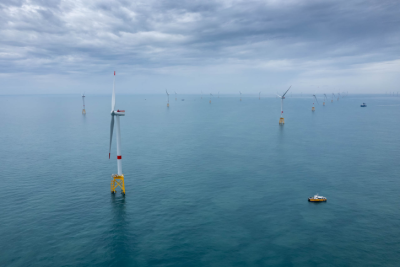
The Saint-Brieuc offshore wind farm is the second large-scale offshore wind project in France and the first in Brittany and the western English Channel. The wind farm was fully commissioned in 2024 and has a total installed capacity of 496 megawatts (MW) and a production capacity of 1,820 gigawatt hours per year. It was financed by Iberdrola for roughly 2.4 billion euros and developed and operated by subsidiary, Ailes Marines.
The development and construction of the wind farm and associated facilities mobilized more than 1,700 jobs in France, including more than 500 in Brittany. The jackets and piles were built and assembled by Navantia-Windar in Spain, then transported by sea to Brest. The assembly of the towers was carried out on the new polder at the Port of Brest, which was completed in 2022. Van Oord was responsible for the transport and installation of the jackets and offshore substation with its high-seas support vessel, Aeolus. The offshore substation was manufactured in Belgium by a joint venture between Smulder and Equans. GE Renewable Energy Grid Solutions supplied and installed the major electrical equipment for the substation. The undersea cabling connection systems were provided by Prysmian Group, which installed and commissioned 90 km of high-voltage 66 kV AC connection cables and three hubs with XLPE insulation. Réseau de Transport d’Électricité (RTE) oversees operations and maintenance of the cables from the substation to the grid connection.
Location
The Saint-Brieuc offshore wind farm covers an area of 75 km2 in the Saint-Brieuc Bay of the English Channel in Brittany, France. It is located 16 km from the nearest coast on a coarse sand and gravel seafloor, in water depths between 29-42 m. The wind farm is composed of 62 turbines arranged in 7 rows of 3 to 14 turbines, with 1,000 m between each turbine and 1,400 m between each row. An offshore substation is located at the center of the wind farm. Cable landfall occurs at the Caroual Beach, near Erquy, with connection to the grid at the Doberie substation at Hénansal. An operation and maintenance centre in located nearby at Binic-Étables-sur-Mer.
Project Timeline
- May 2024: Fully operational and commissioned.
- December 2023: Complete installation of the 62 turbines, on schedule.
- July 2023: First electrical production.
- May 2023: Installation of the first turbine.
- July 2022: Complete installation of the offshore substation.
- June 2021: Completion of cable landfall construction.
- May 2021: At-sea construction activities started in the northern part of the farm.
- 2020: Completion of the pre-construction technical and environmental analyses.
- 2017: Final decisions from French government and relevant prefectures awarded.
- 2016: Public consultation conducted.
- 2012: Ailes Marines awarded the Saint-Brieuc offshore wind farm project.
Licensing Information
Once awarded in 2012, construction and operation of the wind farm relied on securing relevant authorizations under articles L.214-1 and those that follow (a.k.a. “water law”) and L.2124-3 and those that follow of the General Code of the Property of Public Persons (a.k.a. “grant of use of the maritime domain”). Articles R.122-1 and following of the Code of the Environment list the requirements for the impact study of the operating wind farm, and article L.122-3-II of the Code of the Environment lists those for the impact study of the construction activities. In April 2017, the project received the final authorizations from the French administration (Côtes-d’Armor prefecture). Several monitoring requirements, mitigation measures, and compensation measures were required as part of the authorization.
Key Environmental Issues
Environmental studies began in 2012 and continued during construction and operations. Several key environmental issues have guided the implementation of these studies: impacts to marine mammals, birds, and bats; effects on benthic communities and fisheries (including bivalves and crustaceans); and changes in water quality (e.g., sediment, chemical releases). These studies cover four aspects: compensatory measures, environmental monitoring, mitigation measures, and research studies.
- Compensatory measures have consisted of 1) improving the protection of marine mammals in a large area from the Bay of Lannion in the west to the coastline of Normandy in the east; 2) improving nesting conditions for seabirds on the Cape Fréhel by lowering the local predatory pressure by black crows and ravens; and 3) enabling the return of nesting birds to Tomé Island by completely eradicating the invasive American mink from the island and stopping the species from settling on the nearby Seven Island Archipelago.
- Environmental monitoring measures have focused on 1) seabird species around the Bay of Saint-Brieuc to improve knowledge on nesting populations and rearing habitats; 2) marine mammals and seabirds at sea to assess any impact from wind farm construction and operation; 3) migratory birds (including seabirds) during spring and fall migrations; 4) fishery resources, including bivalves, fish, crustaceans, and cuttlefish, to determine any potential impacts of construction and operation on stocks; and 5) impacts to benthic species, sediment, and water quality from construction activities and antifouling sacrificial anodes.
- Mitigation measures have consisted of using a different port as initially selected for staging all construction activities in order to highly decrease any potential interaction with Balearic shearwater during vessel transits to and from the wind farm.
- Research studies have so far focused on 1) investigating in laboratory setups and in the field how underwater noise emissions may affect fishery resources such as scallop, other fished bivalve species, lobster, and cuttlefish; and 2) modelling the transport and accumulation of resuspended sediments during drilling and trenching, and the exposure of scallops to suspended matters.
Environmental Papers and Reports
- Bilan environnemental 2024 du parc éolien en mer de Saint-Brieuc Iberdrola Renewables 2026
- Underwater Noise from Drilling Activities During Offshore Wind Farm Construction Mathias et al. 2025
- Coastal Evolution Due To Climate Change And The Impact On Cables In The Landfall Zone Cadiou and Yates 2025
- Parc éolien au large de la Bretagne Sud (AO5) – état initial de l'environnement Couraud et al. 2025
- Bilan environnemental 2023 du parc éolien en mer de Saint-Brieuc Iberdrola Renewables 2025
- Offshore windfarm construction elevates metabolic rate and increases predation vulnerability of a key marine invertebrate Cones et al. 2024
- Noise pollution causes parental stress on marine invertebrates, the Giant scallop example Gigot et al. 2024
- Bilan environnemental 2022 du parc éolien en mer de Saint-Brieuc Iberdrola Renewables 2024
- Caractérisation de l'impact acoustique des travaux de battage de pieu et de forage associés à la construction d'éoliennes offshores sur les stades larvaires des bivalves marins Pecten maximus et Venus verrucosa Gigot 2023
- Physiological condition of the warty venus (Venus verrucosa L. 1758) larvae modulates response to pile driving and drilling underwater sounds Gigot et al. 2023
- Pile driving and drilling underwater sounds impact the metamorphosis dynamics of Pecten maximus (L., 1758) larvae Gigot et al. 2023
- Assessing the impacts of anthropogenic sounds on early stages of benthic invertebrates: The 'Larvosonic system' Olivier et al. 2023
- Bilan environnemental 2021 du parc éolien en mer de Saint-Brieuc Iberdrola Renewables 2023
- Bilan environnemental de la phase de pré-construction du parc éolien en mer de Saint-Brieuc Iberdrola Renewables 2023
- Commercial cuttlefish exposed to noise from offshore windmill construction show short-range acoustic trauma Solé et al. 2022
- Note de synthèse état de référence avifaune et mégafaune marine à Saint-Brieuc Ringelstein 2021
- Etat de référence avifaune et mégafaune marine à Saint-Brieuc Ringelstein and Misko 2021
- Etat de référence Acoustique et mammifères marins à Saint-Brieuc Chompret et al. 2021
- Note de synthèse - Suivi des pontes de seiche en plongée et observations embarquées Trebaul 2021
- Réalisation de l'état de référence de la ressource halieutique du projet éolien en mer de la baie de Saint-Brieuc et son raccordement – Rapport intermédiaire, année 2: Campagne halieutique de référence 2019-2020 Chassaing 2021
- Suivi de l'avifaune migratrice au cap Fréhel - Saint-Brieuc - 2021 Rico 2021
- Parc Eolien en Mer De La Baie De Saint-Brieuc: Suivi De La Qualite De L'eau, Des Sediments, Des Habitats Et Des Communautes Benthiques; Impact Potentiel Des Anodes Sacrificielles Sur Les Biotes. Investigations Pour L'etat De Reference Avant Travaux Etienne et al. 2021
- Suivi des colonies d'oiseaux nicheurs à proximité de Saint-Brieuc - 2021 Février 2021
- Suivi de la dispersion des poussins d'alcidés originaires du cap Fréhel (Côtes d'Armor) en 2020 Cadiou and Jorigné 2020
- Mise en oeuvre du suivi des colonies d'oiseaux nicheurs à proximité de la zone d'implantation (Mesure de Suivi 4) Février 2020
- Suivi des colonies d'oiseaux nicheurs à proximité de Saint-Brieuc - 2020 Février 2020
- Suivi de la ressource halieutique sur la zone du projet éolien et de son raccordement – Synthèse des campagnes 2018/2019 Bornens 2019
- Mesures acoustiques et analyse des bruits émis dans le cadre de la campagne géotechnique au large de Saint Brieuc. Rapport 2 : Analyse des données acoustiques pour l'estimation du bruit ambiant et du bruit de forage Mathias 2018
- Individual preferences regarding environmental offset and welfare compensation: a choice experiment application to an offshore wind farm project Kermagoret et al. 2016
Environmental Monitoring: Saint-Brieuc Offshore Wind Farm
| Phase | Stressor & Receptor | Design and Methods | Results | Publications | Data |
|---|---|---|---|---|---|
| Baseline | Displacement Human Dimensions |
Desktop Study
Analysis of fisheries datasets from local fisheries committees gathered by the nationwide VALPENA project. |
Completed
Initial description of fishing activities in the wind farm area. |
Iberdrola Renewables 2023 | No data publicly available. |
| Baseline | Displacement Human Dimensions |
Desktop Study
Analysis of fisheries datasets from local fisheries committees gathered by the nationwide VALPENA project. |
Completed
Initial description of fishing activities in the wind farm area. |
Iberdrola Renewables 2023 | No data publicly available. |
| Baseline | Displacement Human Dimensions |
Desktop Study
Analysis of fisheries datasets from local fisheries committees gathered by the nationwide VALPENA project. |
Completed
Initial description of fishing activities in the wind farm area. |
Iberdrola Renewables 2023 | No data publicly available. |
| Baseline | Changes in Flow Physical Environment |
Modeling Study
A 3-D hydrodynamic model was developed, calibrated, and validated to assess the sediment plume dispersal during pile driving and drilling, and its impact on fishery resources. |
Completed
The two scenarios showed negligeable and short-term effects from sediment resuspension and dispersal to benthic species like scallops. |
Iberdrola Renewables 2023 | No data publicly available. |
| Baseline | Noise Physical Environment |
Drifting PAM System
Drifting hydrophone transects were used to measure the background noise and the underwater noise radiating from drilling activities during the pre-construction geotechnic campaign. A noise propagation model was also implemented. |
Completed
Measurements showed that high frequencies don't propagate as far as low frequencies; neither were detectable beyond 3,750 m. Background noise included wave, wind, Risso dolphins, and fishing boats. |
Mathias 2018 | No data publicly available. |
| Baseline | Changes in Flow Physical Environment |
Modeling Study
A 3-D hydrodynamic model was developed, calibrated, and validated to assess the sediment plume dispersal during pile driving and drilling, and its impact on fishery resources. |
Completed
The two scenarios showed negligeable and short-term effects from sediment resuspension and dispersal to benthic species like scallops. |
Iberdrola Renewables 2023 | No data publicly available. |
| Baseline | Noise Physical Environment |
Drifting PAM System
Drifting hydrophone transects were used to measure the background noise and the underwater noise radiating from drilling activities during the pre-construction geotechnic campaign. A noise propagation model was also implemented. |
Completed
Measurements showed that high frequencies don't propagate as far as low frequencies; neither were detectable beyond 3,750 m. Background noise included wave, wind, Risso dolphins, and fishing boats. |
Mathias 2018 | No data publicly available. |
| Baseline | Changes in Flow Physical Environment |
Modeling Study
A 3-D hydrodynamic model was developed, calibrated, and validated to assess the sediment plume dispersal during pile driving and drilling, and its impact on fishery resources. |
Completed
The two scenarios showed negligeable and short-term effects from sediment resuspension and dispersal to benthic species like scallops. |
Iberdrola Renewables 2023 | No data publicly available. |
| Baseline | Noise Physical Environment |
Drifting PAM System
Drifting hydrophone transects were used to measure the background noise and the underwater noise radiating from drilling activities during the pre-construction geotechnic campaign. A noise propagation model was also implemented. |
Completed
Measurements showed that high frequencies don't propagate as far as low frequencies; neither were detectable beyond 3,750 m. Background noise included wave, wind, Risso dolphins, and fishing boats. |
Mathias 2018 | No data publicly available. |
| Baseline, Construction, Operations | Habitat Change Birds |
Visual Survey
To improve knowledge on nesting colonies of seabirds around the Saint-Brieuc Bay, surveys combined visual assessment, acoustic, and drones. The same protocol was used during the 2nd year of construction, as well as the 1st year of operation. |
Ongoing
Baseline – Results refine the distribution of Alcidae, kittiwakes, gulls (European herring, lesser black-backed, and great black-backed), little egret, oystercatcher, European shag, great cormorant, Manx shearwater, European storm petrel. Construction – The same trends were observed as during baseline. Operations – A new nursery area for common murres was discovered in 2024 west of the wind farm area. |
Février 2021, Février 2020, Iberdrola Renewables 2023 | No data publicly available. |
| Baseline, Construction, Operations | Displacement Birds |
Land- and Boat Based Survey
Alcidae chicks and juveniles were visually observed during hatching and fledging seasons during days and evenings. The same protocol was used during the 2nd year of construction, as well as the 1st year of operation. |
Ongoing
Baseline – Evening surveys highlighted that the male / juvenile pairs departed colonies toward the NNE to NE directions, out of the wind farm area. Construction – The same trends were observed as during baseline. Operations – The same trends were observed as during baseline. |
Khalil 2019, Cadiou and Jorigné 2020, Iberdrola Renewables 2023 | No data publicly available. |
| Baseline, Construction, Operations | Attraction, Avoidance, Displacement Birds |
Radar Survey
A land-based radar was used during baseline and construction to obtain data on migrating birds. During operations, an at-sea radar complements the land-based one. The same protocol was used during construction years 2021-2024, as well as during operations. |
Ongoing
Baseline – The 2020 surveys highlighted the presence of 51 migratory species, 41 of them during spring and 28 during fall migrations. The simultaneous use of horizontal and vertical radars enabled distinguishing flight heights. Construction – The numbers of migratory species recorded during the construction years were relatively similar to the baseline. Operations – Ongoing. |
Iberdrola Renewables 2023, Rico 2021 | No data publicly available. |
| Baseline, Construction, Operations | Habitat Change Birds |
Visual Survey
To improve knowledge on nesting colonies of seabirds around the Saint-Brieuc Bay, surveys combined visual assessment, acoustic, and drones. The same protocol was used during the 2nd year of construction, as well as the 1st year of operation. |
Ongoing
Baseline – Results refine the distribution of Alcidae, kittiwakes, gulls (European herring, lesser black-backed, and great black-backed), little egret, oystercatcher, European shag, great cormorant, Manx shearwater, European storm petrel. Construction – The same trends were observed as during baseline. Operations – A new nursery area for common murres was discovered in 2024 west of the wind farm area. |
Février 2021, Février 2020, Iberdrola Renewables 2023, Iberdrola Renewables 2023, Iberdrola Renewables 2024, Iberdrola Renewables 2025, Iberdrola Renewables 2026 | No data publicly available. |
| Baseline, Construction, Operations | Displacement Birds |
Land- and Boat Based Survey
Alcidae chicks and juveniles were visually observed during hatching and fledging seasons during days and evenings. The same protocol was used during the 2nd year of construction, as well as the 1st year of operation. |
Ongoing
Baseline – Evening surveys highlighted that the male / juvenile pairs departed colonies toward the NNE to NE directions, out of the wind farm area. Construction – The same trends were observed as during baseline. Operations – The same trends were observed as during baseline. |
Iberdrola Renewables 2023, Iberdrola Renewables 2023, Iberdrola Renewables 2024, Iberdrola Renewables 2025, Iberdrola Renewables 2026 | No data publicly available. |
| Baseline, Construction, Operations | Attraction, Avoidance, Displacement Birds |
Radar Survey
A land-based radar was used during baseline and construction to obtain data on migrating birds. During operations, an at-sea radar complements the land-based one. The same protocol was used during construction years 2021-2024, as well as during operations. |
Ongoing
Baseline – The 2020 surveys highlighted the presence of 51 migratory species, 41 of them during spring and 28 during fall migrations. The simultaneous use of horizontal and vertical radars enabled distinguishing flight heights. Construction – The numbers of migratory species recorded during the construction years were relatively similar to the baseline. Operations – Ongoing. |
Iberdrola Renewables 2023, Rico 2021, Iberdrola Renewables 2023, Iberdrola Renewables 2024, Iberdrola Renewables 2025, Iberdrola Renewables 2026 | No data publicly available. |
| Baseline, Construction, Operations | Habitat Change Birds |
Visual Survey
To improve knowledge on nesting colonies of seabirds around the Saint-Brieuc Bay, surveys combined visual assessment, acoustic, and drones. The same protocol was used during the 2nd year of construction, as well as the 1st year of operation. |
Ongoing
Baseline – Results refine the distribution of Alcidae, kittiwakes, gulls (European herring, lesser black-backed, and great black-backed), little egret, oystercatcher, European shag, great cormorant, Manx shearwater, European storm petrel. Construction – The same trends were observed as during baseline. Operations – A new nursery area for common murres was discovered in 2024 west of the wind farm area. |
Février 2021, Février 2020, Iberdrola Renewables 2023, Iberdrola Renewables 2023, Iberdrola Renewables 2024, Iberdrola Renewables 2025, Iberdrola Renewables 2026 | No data publicly available. |
| Baseline, Construction, Operations | Displacement Birds |
Land- and Boat Based Survey
Alcidae chicks and juveniles were visually observed during hatching and fledging seasons during days and evenings. The same protocol was used during the 2nd year of construction, as well as the 1st year of operation. |
Ongoing
Baseline – Evening surveys highlighted that the male / juvenile pairs departed colonies toward the NNE to NE directions, out of the wind farm area. Construction – The same trends were observed as during baseline. Operations – The same trends were observed as during baseline. |
Iberdrola Renewables 2023, Iberdrola Renewables 2023, Iberdrola Renewables 2024, Iberdrola Renewables 2025, Iberdrola Renewables 2026 | No data publicly available. |
| Baseline, Construction, Operations | Attraction, Avoidance, Displacement Birds |
Radar Survey
A land-based radar was used during baseline and construction to obtain data on migrating birds. During operations, an at-sea radar complements the land-based one. The same protocol was used during construction years 2021-2024, as well as during operations. |
Ongoing
Baseline – The 2020 surveys highlighted the presence of 51 migratory species, 41 of them during spring and 28 during fall migrations. The simultaneous use of horizontal and vertical radars enabled distinguishing flight heights. Construction – The numbers of migratory species recorded during the construction years were relatively similar to the baseline. Operations – Ongoing. |
Iberdrola Renewables 2023, Rico 2021, Iberdrola Renewables 2023, Iberdrola Renewables 2024, Iberdrola Renewables 2025, Iberdrola Renewables 2026 | No data publicly available. |
| Baseline, Construction, Operations | Attraction, Avoidance, Displacement Birds, Marine Mammals |
Boat- and Aerial-Based Surveys
Marine mammal and seabird visual surveys were performed from boats and airplanes in 2013-2014 and 2020-2021 before construction with observers (boats) and HD videos (planes). The same protocol was used during construction years 2021-2024, as well as during operations. In addition, marine mammal observers were deployed during the whole construction period. |
Ongoing
Baseline – 24 boat surveys were completed, during which 116 marine mammals from 4 species and 8403 seabirds from 71 taxa were identified. 13 aerial surveys were also completed during which 111 marine mammals from 4 species and 10886 seabirds from 41 taxa were identified. Construction – The abundance of seabirds and marine mammals was greater during the three years of construction than baseline, but proportions per families are similar year to year. Normal hunting and travel behavior by marine mammals were observed. Operations – The trends observed during construction were still observed during the first year of operation. |
Iberdrola Renewables 2023, Ringelstein and Misko 2021, Ringelstein 2021 | No data publicly available. |
| Baseline, Construction, Operations | Attraction, Avoidance, Displacement Birds, Marine Mammals |
Boat- and Aerial-Based Surveys
Marine mammal and seabird visual surveys were performed from boats and airplanes in 2013-2014 and 2020-2021 before construction with observers (boats) and HD videos (planes). The same protocol was used during construction years 2021-2024, as well as during operations. In addition, marine mammal observers were deployed during the whole construction period. |
Ongoing
Baseline – 24 boat surveys were completed, during which 116 marine mammals from 4 species and 8403 seabirds from 71 taxa were identified. 13 aerial surveys were also completed during which 111 marine mammals from 4 species and 10886 seabirds from 41 taxa were identified. Construction – The abundance of seabirds and marine mammals was greater during the three years of construction than baseline, but proportions per families are similar year to year. Normal hunting and travel behavior by marine mammals were observed. Operations – The trends observed during construction were still observed during the first year of operation. |
Iberdrola Renewables 2023, Ringelstein and Misko 2021, Ringelstein 2021, Iberdrola Renewables 2023, Iberdrola Renewables 2024, Iberdrola Renewables 2025, Iberdrola Renewables 2026 | No data publicly available. |
| Baseline, Construction, Operations | Attraction, Avoidance, Displacement Birds, Marine Mammals |
Boat- and Aerial-Based Surveys
Marine mammal and seabird visual surveys were performed from boats and airplanes in 2013-2014 and 2020-2021 before construction with observers (boats) and HD videos (planes). The same protocol was used during construction years 2021-2024, as well as during operations. In addition, marine mammal observers were deployed during the whole construction period. |
Ongoing
Baseline – 24 boat surveys were completed, during which 116 marine mammals from 4 species and 8403 seabirds from 71 taxa were identified. 13 aerial surveys were also completed during which 111 marine mammals from 4 species and 10886 seabirds from 41 taxa were identified. Construction – The abundance of seabirds and marine mammals was greater during the three years of construction than baseline, but proportions per families are similar year to year. Normal hunting and travel behavior by marine mammals were observed. Operations – The trends observed during construction were still observed during the first year of operation. |
Iberdrola Renewables 2023, Ringelstein and Misko 2021, Ringelstein 2021, Iberdrola Renewables 2023, Iberdrola Renewables 2024, Iberdrola Renewables 2025, Iberdrola Renewables 2026 | No data publicly available. |
| Baseline, Construction, Operations | Habitat Change Fish, Invertebrates |
Sample Collection and Underwater Video
Sediment samples were collected with a Day grab for characterization of infauna. An ROV was used to record video transects of the seafloor. Same protocol was used during construction years 2021-2024, as well as during operations. |
Ongoing
Baseline – 40 samples were collected and enabled the identification of 165 benthic species typical of the area. Construction – Results were very similar to baseline, though with a slight increase in diversity and density of infauna in soft sediments. Operations – Results were very similar to previous years. |
Iberdrola Renewables 2023 | No data publicly available. |
| Baseline, Construction, Operations | Habitat Change Fish, Invertebrates |
Sample Collection and Underwater Video
Sediment samples were collected with a Day grab for characterization of infauna. An ROV was used to record video transects of the seafloor. Same protocol was used during construction years 2021-2024, as well as during operations. |
Ongoing
Baseline – 40 samples were collected and enabled the identification of 165 benthic species typical of the area. Construction – Results were very similar to baseline, though with a slight increase in diversity and density of infauna in soft sediments. Operations – Results were very similar to previous years. |
Iberdrola Renewables 2023, Iberdrola Renewables 2023, Iberdrola Renewables 2024, Iberdrola Renewables 2025, Iberdrola Renewables 2026 | No data publicly available. |
| Baseline, Construction, Operations | Habitat Change Fish, Invertebrates |
Sample Collection and Underwater Video
Sediment samples were collected with a Day grab for characterization of infauna. An ROV was used to record video transects of the seafloor. Same protocol was used during construction years 2021-2024, as well as during operations. |
Ongoing
Baseline – 40 samples were collected and enabled the identification of 165 benthic species typical of the area. Construction – Results were very similar to baseline, though with a slight increase in diversity and density of infauna in soft sediments. Operations – Results were very similar to previous years. |
Iberdrola Renewables 2023, Iberdrola Renewables 2023, Iberdrola Renewables 2024, Iberdrola Renewables 2025, Iberdrola Renewables 2026 | No data publicly available. |
| Baseline, Construction, Operations | Displacement Human Dimensions |
Bottom Fishing
Fish stock surveys included various types of trawling, dredging, netting, and potting commonly used by local commercial fishers and targeting demersal fish, scallops, other bivalves, whelks, cuttlefish, and crustaceans. In addition, observers joined professional fishing trips. The same protocol was used during construction years 2021-2024, as well as during operations. |
Ongoing
Baseline – 32 surveys were conducted between 2018 and 2021. High variability was observed in scallop and whelk distribution, with low density within the wind farm area. Little spatiotemporal variability was observed in the distribution of sea spider and non-scallop bivalves, but important seasonal variability was observed for whelks, demersal fish, and cuttlefish. Construction – No effect of construction activities could be detected on abundance, biomass, diversity, or spatiotemporal distribution of surveyed species. Operations – Ongoing. |
Iberdrola Renewables 2023 | No data publicly available. |
| Baseline, Construction, Operations | Displacement Human Dimensions |
Bottom Fishing
Fish stock surveys included various types of trawling, dredging, netting, and potting commonly used by local commercial fishers and targeting demersal fish, scallops, other bivalves, whelks, cuttlefish, and crustaceans. In addition, observers joined professional fishing trips. The same protocol was used during construction years 2021-2024, as well as during operations. |
Ongoing
Baseline – 32 surveys were conducted between 2018 and 2021. High variability was observed in scallop and whelk distribution, with low density within the wind farm area. Little spatiotemporal variability was observed in the distribution of sea spider and non-scallop bivalves, but important seasonal variability was observed for whelks, demersal fish, and cuttlefish. Construction – No effect of construction activities could be detected on abundance, biomass, diversity, or spatiotemporal distribution of surveyed species. Operations – Ongoing. |
Iberdrola Renewables 2023, Iberdrola Renewables 2023, Iberdrola Renewables 2024, Iberdrola Renewables 2025, Iberdrola Renewables 2026 | No data publicly available. |
| Baseline, Construction, Operations | Displacement Human Dimensions |
Bottom Fishing
Fish stock surveys included various types of trawling, dredging, netting, and potting commonly used by local commercial fishers and targeting demersal fish, scallops, other bivalves, whelks, cuttlefish, and crustaceans. In addition, observers joined professional fishing trips. The same protocol was used during construction years 2021-2024, as well as during operations. |
Ongoing
Baseline – 32 surveys were conducted between 2018 and 2021. High variability was observed in scallop and whelk distribution, with low density within the wind farm area. Little spatiotemporal variability was observed in the distribution of sea spider and non-scallop bivalves, but important seasonal variability was observed for whelks, demersal fish, and cuttlefish. Construction – No effect of construction activities could be detected on abundance, biomass, diversity, or spatiotemporal distribution of surveyed species. Operations – Ongoing. |
Iberdrola Renewables 2023, Iberdrola Renewables 2023, Iberdrola Renewables 2024, Iberdrola Renewables 2025, Iberdrola Renewables 2026 | No data publicly available. |
| Baseline, Construction, Operations | Attraction, Avoidance, Displacement, Noise Marine Mammals |
Passive Acoustic Monitoring Study
Marine mammal presence and activity patterns were assessed using a network of 7 PAM stations: 2 within the project area and 5 at 10 to 20 km away. The same protocol was used during construction years 2021-2024, as well as during operations. |
Ongoing
Baseline – 16,036 hours were recorded over 12 months, during which 6 marine mammal species were identified. Construction – During the 4 years of construction, 23,418 hours were recorded, during which 6 marine mammal species were identified. Operations – No differences from the previous years were observed during the first year of operation. |
Iberdrola Renewables 2023, Chompret et al. 2021 | No data publicly available. |
| Baseline, Construction, Operations | Attraction, Avoidance, Displacement, Noise Marine Mammals |
Passive Acoustic Monitoring Study
Marine mammal presence and activity patterns were assessed using a network of 7 PAM stations: 2 within the project area and 5 at 10 to 20 km away. The same protocol was used during construction years 2021-2024, as well as during operations. |
Ongoing
Baseline – 16,036 hours were recorded over 12 months, during which 6 marine mammal species were identified. Construction – During the 4 years of construction, 23,418 hours were recorded, during which 6 marine mammal species were identified. Operations – No differences from the previous years were observed during the first year of operation. |
Iberdrola Renewables 2023, Chompret et al. 2021, Iberdrola Renewables 2023, Iberdrola Renewables 2024, Iberdrola Renewables 2025, Iberdrola Renewables 2026 | No data publicly available. |
| Baseline, Construction, Operations | Attraction, Avoidance, Displacement, Noise Marine Mammals |
Passive Acoustic Monitoring Study
Marine mammal presence and activity patterns were assessed using a network of 7 PAM stations: 2 within the project area and 5 at 10 to 20 km away. The same protocol was used during construction years 2021-2024, as well as during operations. |
Ongoing
Baseline – 16,036 hours were recorded over 12 months, during which 6 marine mammal species were identified. Construction – During the 4 years of construction, 23,418 hours were recorded, during which 6 marine mammal species were identified. Operations – No differences from the previous years were observed during the first year of operation. |
Iberdrola Renewables 2023, Chompret et al. 2021, Iberdrola Renewables 2023, Iberdrola Renewables 2024, Iberdrola Renewables 2025, Iberdrola Renewables 2026 | No data publicly available. |
| Baseline, Construction, Operations | Habitat Change Physical Environment |
Sample Collection and Underwater Video
Water samples were collected with Niskin bottles for water quality, and sediment samples with a Day grab for granulometry. An ROV was used to record video transects of the seafloor. Same protocol was used during construction years 2021-2024, as well as during operations. |
Ongoing
Baseline – Water quality measurements were consistent with the natural variability of the area; no pollution was detected. Sediments are mostly coarse sand to gravel and pebble. Construction – Results were very similar to baseline. Operations – Results were very similar to previous years. |
Iberdrola Renewables 2023 | No data publicly available. |
| Baseline, Construction, Operations | Habitat Change Physical Environment |
Sample Collection and Underwater Video
Water samples were collected with Niskin bottles for water quality, and sediment samples with a Day grab for granulometry. An ROV was used to record video transects of the seafloor. Same protocol was used during construction years 2021-2024, as well as during operations. |
Ongoing
Baseline – Water quality measurements were consistent with the natural variability of the area; no pollution was detected. Sediments are mostly coarse sand to gravel and pebble. Construction – Results were very similar to baseline. Operations – Results were very similar to previous years. |
Iberdrola Renewables 2023, Iberdrola Renewables 2023, Iberdrola Renewables 2024, Iberdrola Renewables 2025, Iberdrola Renewables 2026 | No data publicly available. |
| Baseline, Construction, Operations | Habitat Change Physical Environment |
Sample Collection and Underwater Video
Water samples were collected with Niskin bottles for water quality, and sediment samples with a Day grab for granulometry. An ROV was used to record video transects of the seafloor. Same protocol was used during construction years 2021-2024, as well as during operations. |
Ongoing
Baseline – Water quality measurements were consistent with the natural variability of the area; no pollution was detected. Sediments are mostly coarse sand to gravel and pebble. Construction – Results were very similar to baseline. Operations – Results were very similar to previous years. |
Iberdrola Renewables 2023, Iberdrola Renewables 2023, Iberdrola Renewables 2024, Iberdrola Renewables 2025, Iberdrola Renewables 2026 | No data publicly available. |
| Construction | Noise Physical Environment |
Acoustic Survey
A moored passive acoustic monitoring system was deployed as drilling took place for each foundation, recording continuously. |
Completed
Underwater noise levels were not correlated to substrate type, number of drill bits used, or drilling speed. Noise levels were mostly associated with drilling vessel activity (e.g., dynamic positioning) and were not louder than ambient vessel traffic. |
Mathias et al. 2025 | No data publicly available. |
| Construction | Changes in Flow Physical Environment |
Turbidity Survey
Suspended sediment was measured around 9 turbines and 5 stations, at sea surface, 1.5 m below surface, and 3m above seafloor. |
Completed
Results were on par with natural variability, with very localized and short duration impacts. |
Iberdrola Renewables 2023, Iberdrola Renewables 2024, Iberdrola Renewables 2025 | No data publicly available. |
| Construction | Noise Physical Environment |
Acoustic Survey
A moored passive acoustic monitoring system was deployed as drilling took place for each foundation, recording continuously. |
Completed
Underwater noise levels were not correlated to substrate type, number of drill bits used, or drilling speed. Noise levels were mostly associated with drilling vessel activity (e.g., dynamic positioning) and were not louder than ambient vessel traffic. |
Mathias et al. 2025 | No data publicly available. |
| Construction | Changes in Flow Physical Environment |
Turbidity Survey
Suspended sediment was measured around 9 turbines and 5 stations, at sea surface, 1.5 m below surface, and 3m above seafloor. |
Completed
Results were on par with natural variability, with very localized and short duration impacts. |
Iberdrola Renewables 2023, Iberdrola Renewables 2024, Iberdrola Renewables 2025 | No data publicly available. |
| Construction | Noise Physical Environment |
Acoustic Survey
A moored passive acoustic monitoring system was deployed as drilling took place for each foundation, recording continuously. |
Completed
Underwater noise levels were not correlated to substrate type, number of drill bits used, or drilling speed. Noise levels were mostly associated with drilling vessel activity (e.g., dynamic positioning) and were not louder than ambient vessel traffic. |
Mathias et al. 2025 | No data publicly available. |
| Construction | Changes in Flow Physical Environment |
Turbidity Survey
Suspended sediment was measured around 9 turbines and 5 stations, at sea surface, 1.5 m below surface, and 3m above seafloor. |
Completed
Results were on par with natural variability, with very localized and short duration impacts. |
Iberdrola Renewables 2023, Iberdrola Renewables 2024, Iberdrola Renewables 2025 | No data publicly available. |
| Construction, Operations | Attraction Bats |
Acoustic Survey
During construction, boat surveys were used to record bats’ acoustic activity, as well as the nearby lighthouse. During operations, 8 turbines were equipped with acoustic recorders. |
Ongoing
Construction – Several species were identified at night from acoustic recordings, with greater activity during the fall migration of the 1st and 2nd year of construction respectively. Recording from the lighthouse failed during the 3rd year of construction and only 2 species were identified from the boat surveys. Operations – No bat was detected during the 1st year of operation from the recorders on the turbines. |
Iberdrola Renewables 2023, Iberdrola Renewables 2024, Iberdrola Renewables 2025, Iberdrola Renewables 2026 | No data publicly available. |
| Construction, Operations | Attraction Bats |
Acoustic Survey
During construction, boat surveys were used to record bats’ acoustic activity, as well as the nearby lighthouse. During operations, 8 turbines were equipped with acoustic recorders. |
Ongoing
Construction – Serveral species were identified at night from acoustic recordings, with greater activity during the fall migration of the 1st and 2nd year of construction respectively. Recording from the lighthouse failed during the 3rd year of construction and only 2 species were identified from the boat surveys. Operations – No bat was detected during the 1st year of operation from the recorders on the turbines. |
Iberdrola Renewables 2023, Iberdrola Renewables 2024, Iberdrola Renewables 2025, Iberdrola Renewables 2026 | No data publicly available. |
| Construction, Operations | Attraction Bats |
Acoustic Survey
During construction, boat surveys were used to record bats’ acoustic activity, as well as the nearby lighthouse. During operations, 8 turbines were equipped with acoustic recorders. |
Ongoing
Construction – Serveral species were identified at night from acoustic recordings, with greater activity during the fall migration of the 1st and 2nd year of construction respectively. Recording from the lighthouse failed during the 3rd year of construction and only 2 species were identified from the boat surveys. Operations – No bat was detected during the 1st year of operation from the recorders on the turbines. |
Iberdrola Renewables 2023, Iberdrola Renewables 2024, Iberdrola Renewables 2025, Iberdrola Renewables 2026 | No data publicly available. |