



Contents
MRE Project Site
(login for email address)
Details
Description
The Torr Head Tidal Scheme (the “Project”) was proposed by TVL to utilise the strong tidal resource on the north east coast of Northern Ireland for electricity generation. The scheme is proposed to have a capacity of 100 MW, consisting of an array of up to 100 underwater horizontal axis turbines, each with a generating capacity of between 1 and 2 MW. The project scope of works will include the installation of the turbines and their foundations, sub-sea export cables, ancillary onshore works and the connection of the generating station to the onshore electricity distribution network.
Location
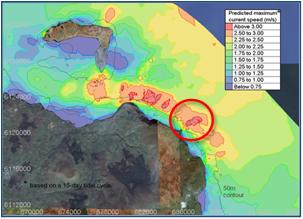
The centre of the AfL is approximately 1km offshore at Torr Head on the north coast of County Antrim Northern Ireland. Water depths in the AfL range from 30 to 100m at LAT. Tidal currents within the AfL reach up to 5m/s.
Licensing Information
In 2015 the following applications were sent out to relevant legislation to gain approval of the offshore elements of the Torr Head Tidal project:
- Marine Licence under Part 4 of the Marine and Coastal Access Act 2009;
- Article 39 consent under the Electricity (Northern Ireland) Order 1992;
- Schedule 4 of the Marine Works (Environmental Impact Assessment) Regulations 2011; and
- Regulation 5(3) of the Offshore Electricity Development (Environmental Impact Assessment) Regulations (Northern Ireland) 2008.
In addition, a number of further licenses and consents were required throughout the initial stages of the scheme, some of which are outlined below:
- Consent from the NIEA for any discharges under the Water Act (Northern Ireland) 1972;
- Article 40 consent under Electricity (Northern Ireland) Order 1992 for onshore grid connection works; and
- A Bill in the Northern Ireland Assembly may be needed to address the potential interference with the public right of navigation in the area. This procedure can normally be addresses through the FEPA licensing process.
Consent requirements and supporting EIA Regulations applying to the offshore Projecta are summarized in the following table (sourced from Table 1-1 of the Torr Head Environmental Statement):
| Offshore project component | Consent | Description | Relevant EIA regulations | Consenting authority |
| Tidal turbines, Turbine Support Structures (TSSs), inter-array cables and export cables to shore | Marine Licence under Part 4 of the Marine and Coastal Access Act 2009 | A Marine Licence is required to deposit or remove any substance or object in or from the sea – or on or under the seabed. This includes marine renewable energy generating infrastructure | Marine Works (Environmental Impact Assessment) Regulations 2011 | DoENI Marine Division |
| Tidal turbines | Article 39 consent under the Electricity (Northern Ireland) Order 1992 | Consent required for any proposal to construct or operate an offshore generating station wholly or partly driven by wind or water with a capacity in excess of 1 MW | Offshore Electricity Development (Environmental Impact Assessment) Regulations (Northern Ireland) 2008 | Department for the Economy (formerly Department of Enterprise, Trade and Investment (DETI)) |
In December 2016 the NI Department of Agriculture, Environment and Rural Affairs’ Marine and Fisheries Division issued TVL a Marine License (ref. ML115_15).
Project Progress
In October 2012, TVL was awarded an AfL from The Crown Estate (TCE) to investigate the feasibility of developing a commercial scale 100 MW tidal energy array in the waters offshore of Torr Head on the north coast of County Antrim in Northern Ireland (NI).
TVL submitted an application for consent to construct and operate the tidal array to the NI Department of Enterprise, Trade and Investment in 2015.
Unfortunately in July 2018, project partner OpenHydro’s parent company, Naval Energies, made the decision to liquidate OpenHydro. TVL’s project has not been consented since its application in 2015. The company TVL was dissolved as of January 2019.
TVL submitted an application for consent to construct and operate the tidal array to the NI Department of Enterprise, Trade and Investment in 2015.
Key Environmental Issues
There are a number of conservation designations in the area around the proposed project site. These include the European designations of Special Protection Area (SPA) and Special Area of Conservation (SAC), collectively known as Natura 2000 sites, and the national designation of Area of Special Scientific Interest (ASSI). Three sites were of particular concern for the proposed project; the Rathlin Island SAC, Rathlin Island SPA and Torr Head ASSI.
The Antrim Coastline, including Torr Head and its environs, hosts a number of marine and coastal bird species. The site qualifies under the EU Directive by supporting internationally important breeding numbers of the following seabird species: Razorbill (Alca torda), Guillemot (Uria aalge) and Kittiwake (Rissa tridactyla). The SPA also regularly supports over 20,000 breeding seabirds including puffin (Fratercula arctica), fulmar (Fulmarus glacialis), shag (Phalacrocorax aristotelis) and gannet (Morus bassanus).
Species such as puffin, razorbill, guillemot, gannet and shag are diving species and forage for their food underwater and as such are more at risk from collision with the moving underwater turbines. Species which are surface feeders, such as kittiwakes and gulls may be more at risk from disturbance from vessels, as are those species which rest or moult on the sea surface.
The Irish Whale and Dolphin Group (IWDG) manage a sightings database of all cetacean sightings in Ireland, totaling 13,000 records. This cetacean sightings data indicates that Harbour Porpoise, Bottlenose Dolphin, Common Dolphin (Delphinus delphis) and Minke Whale (Balaeanoptera acutorostrata) are present in the waters around Rathlin Island and Torr Head. An acoustic survey was undertaken at a number of test sites off the north Antrim and Rathlin Island coasts in waters up to 200m depth, approximately 10 km from the area of investigation. A number of likely Sperm Whale (Physeter macrocephalus) vocalizations were recorded, indicating that this species may be present in the area. However, it should be noted that sperm whales are a deep diving species and are therefore unlikely to be present close to shore in shallower waters.
The terrestrial habitats of Torr Head and its environs are typical of the North Antrim coast, which represents an extensive area of exposed hard cliff. The basalt and chalk maritime cliff and slopes represent a diverse range of communities including those associated with rock crevices and cliff ledges, and with a range of typical maritime grasslands and heath. Notable species on the basalt cliffs include Wilson’s Filmy-fern (Hymenophyllum wilsonii), Thyme Broomrape (Orobanche alba), Hare’s Foot Clover (Trifolium arvense), Zigzag Clover (Trifolium medium) and Common Juniper (Juniperus communis). The chalk cliffs support neutral and species rich calcareous grasslands. Plants present in the grassland include Pignut (Conopodium majus), Harebell (Campanula species), Kidney Vetch (Anthyllis vulneraria) and several orchid species.