



Contents
MRE Project Site
(login for email address)
Details
Description
The project was started in 2004 and old consents did run until the end of 2013. A new round for permanent permits, and for an extended test site, was initiated in 2014 and was filed to the Environmental Court in December 2014. A 20-year permit was issued in June 2015 by the Environmental Court in Vänersborg. The new permit allows arrays of maximum 20 wave power devices, 2 substations, and land cables, plus related equipment.
During the first 10 years of the project a maximum of 10 generators was allowed to be deployed simultaneously, plus two submarine substations. Additionally, the project was/is allowed to use 30 smaller buoys, with foundations, for studies on environmental impact, and a surveillance tower for monitoring the interaction between waves and converters was installed on a nearby islet. At the time the research area holds one sea cable connected to a measuring station onshore and a Datawell Wave Rider ™ buoy for wave measurements. The measuring station is connected to the grid. The wave energy converters are based on a linear synchronous generator (with ferrite or permanent magnets depending on tests) which are placed on the seabed and driven by a heaving point absorber at the ocean surface. The converter is directly driven, i.e. it has no gearbox or other mechanical or hydraulic conversion system. This results in a simple and robust mechanical system and a sophisticated electrical system. As of 2024, more than 10 different generators have been tested.
Location
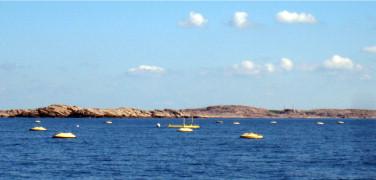
The Lysekil research site is situated on the Swedish West coast, about 100 km North of Gothenburg, near the municipality of Lysekil. The site is located 2 km offshore, between a northern (58º 11’ 85” N, 11º 22’ 46” E) and a southern navigational marker (58º 11’ 63” N, 11º 22’ 46” E) signalling the research area to avoid interference with shipping.
Licensing Information
During 2004–2011 the County Administration gave several necessary consents for ten wave energy converters, along with an additional 30 buoys for environmental impact studies. Special consents were needed, such as for the sea cable from the project area to the mainland grid at the nearby island of Gullholmen. All old consents ran until the end of 2013. At the end of 2014, a full-scale application was filed to the Environmental Court which was proceeded by a large number of consultations and full-scale Environmental Impact Assessment. Consultations with stakeholders involved local inhabitants, fishing organizations, local governments and the National Maritime Administration and were necessary in order to obtain the permits referred to above and thereby the use of the area. The new permit came into legal force in June of 2015 and lasts through 2034. It allows arrays of maximum 20 wave power devices, 2 substations and land cables, plus related equipment. The new permit allows for the use of an area of 0.5 km2 and will make it possible for external use of test site area. External users, however, will need consent from regional authority regarding equipment whereas the EIA can be used for area description, etc.
Project Progress
The establishment of the research test site has been done in several steps. The launch of the first wave power generator, including the sea cable to shore, was made in March 2006. The number of WECs deployed and active has varied over the years, depending on current research focus and funding. Several different contractors have been working within the project during the commissioning and decommissioning phases of equipment. Current permit ends in 2034.
Key Environmental Issues
The environmental studies have so far focused on marine organisms living in the seabed (the infauna), organisms involved in biofouling and on mobile fauna, mainly fish and more recently crustaceans. Reef effects directly after deployment of the devices/foundations have been assessed, and continuous investigations on long-term effects have recently been finished. A significant difference in number of edible crabs, even 12 years after deployment, between foundations with and without cavities is one of the findings, showing how habitat complexity can be applied on a low-cost basis (Bender et al. 2020). Focus has also been set on measuring underwater noise with extensive development of hydrophone equipment. A PhD program where sonars are developed and adapted for passive or remotely controlled underwater monitoring ended in 2019 (Francisco et al. 2022). Seabed mounted sonars have been found to aid in monitoring the abundance and behaviour of fish and marine mammals (harbour seals) in the vicinity of wave energy (and other marine energy) installations, being able to operate continuously and autonomously for longer periods. Cage fishing studies over a four-year period aimed to reveal the influences of the Lysekil research site on the abundance and size of local decapod species (Bender et al. 2021).
The purpose of the environmental studies being undertaken at the Lysekil test site is to follow up expected, known possible stressors/receptors, follow up new findings, and develop “new” monitoring techniques. Also, and as a condition for the 20-year project, post-construction studies are required by the permit, and under the control of the regional authorities. Monitoring is being undertaken by Uppsala University, Department of Electric Engineering (former Engineering Sciences), Division of Electricity, and funded by various research foundations, utility companies, etc. So far, and a key finding, is that effects/impact by presence or operation of WEC’s is low and that positive effects in terms of artificial reef effects, FAD’s and no take zone (esp. crustaceans) also are important. Since 2020 there has been no active field research activities and for the next few years no additional environmental studies are anticipated.
For additional information on current research areas, view the wave energy research group at Uppsala University’s current research site here.