
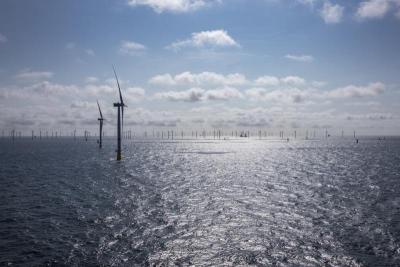
Description
SeaMade is a combination of two offshore wind projects, formerly known as Mermaid (235 MW) and SeaStar (252 MW), making it Belguim’s largest offshore wind farm with a total capacity of 487 MW. SeaMade is Belgium’s eighth offshore wind project and was constructed during the Covid-19 pandemic. SeaMade is located 40-50 km off the coast of Ostend, Belgium and is connected to Belgium’s offshore switchyard, the Elia modular offshore grid (MOG) platform. SeaMade is managed by Otary and was developed as a joint venture between Otary, Eneco, and Ocean Winds.
Watch a short video about SeaMade here.
Location
SeaMade is located in the Belgian Exclusive Economic Zone in the Belgian North Sea. The 235 MW Mermaid site is located next to the Northwester II wind farm, 54 km off the coast of Belgium at a water depth of 40 m. The 252 MW SeaStar site is located between the Nobelwind and Northwind wind farms, 40 km away from shore at a depth of 38 m. The Otary logistical hub in the port of Ostend supports the operations and maintenance of the wind farm and the nearest port is Oostende. The two-cable system of MOG makes land fall at Zeebrugge.
Project Timeline
- October 2021: Official inauguration by the Belgian Prime Minister
- December 2020: Start of commercial operation
- November 2020: Last turbine installed
- July 2020: First turbine began producing power
- 20 June 2020: First turbine installed
- September 2019: Offshore construction started
- December 2018: Project reached financial close
- November 2018: Environmental and Social Impact Assessments completed
- May 2015: Original concession split into 2 farms but remained combined through ownership
- June 2012: Mermaid granted domain concession
Licensing Information
A series of permits and concessions related to marine environmental activities were obtained from relevant authorities between 2010 and 2018. Key milestones include the issuance of domain concessions for SeaStar and Mermaid by the State Secretary for Energy in 2012, following the withdrawal of a previous concession for SeaStar in 2011. Environmental permits for SeaStar and Mermaid were granted by the Minister responsible for the marine environment between 2014 and 2015, with a permit transfer from Mermaid to SeaStar NV finalized in July 2018. Additionally, bottom survey permits were approved for both entities in 2012 and 2013.
Key Environmental Issues
Much of the monitoring is coordinated by the Operational Directorate Natural Environment of the Royal Belgian Institute of Natural Sciences (OD Nature), in collaboration with the Research Institute for Nature and Forest, the Flanders Research Institute for Agriculture, Fisheries and Food, Ghent University, and the Department of Information Technology at Ghent University, which oversees ecological monitoring for all Belgian offshore wind farms collectively. While dedicated environmental monitoring at SeaMade itself has been limited, the wind farm is located adjacent to C-Power (Thornton Bank) and Belwind, two sites with more extensive long-term monitoring data. As a result, much of what is known about the ecological dynamics around SeaMade is informed by studies conducted at these neighboring sites of the wind farm zone.
Environmental Papers and Reports
- Cetacean passive acoustic network in the Belgian part of the North sea (Calonge et al. 2024)
- Environmental Impacts of Offshore Wind Farms in the Belgian Part of the North Sea: Progressive Insights in Changing Species Distribution Patterns Informing Marine Management (Degraer et al. 2023)
- Environmental Impacts of Offshore Wind Farms in the Belgian Part of the North Sea: Attraction, avoidance and habitat use at various spatial scales (Degraer et al. 2021)
- Environmental Impacts of Offshore Wind Farms in the Belgian Part of the North Sea: Empirical Evidence Inspiring Priority Monitoring, Research and Management (Degraer et al. 2020)
- Environmental and Social Data Sheet: Mermaid and Seastar Offshore Wind Farm (European Investment Bank 2018)
- Windpark Mermaid Milieueffectenrapport (International Marine and Dredging Consultants 2014)
- Windpark SeaStar Milieueffectenrapport (International Marine and Dredging Consultants 2013)
- Offshore Wind Farms in the Belgian Part of the North Sea: Heading for an Understanding of Environmental Impacts (Degraer et al. 2012)
Environmental Monitoring: SeaMade
| Phase | Stressor & Receptor | Design and Methods | Results | Publications | Data |
|---|---|---|---|---|---|
| Baseline, Construction, Operations | Marine Mammals | Passive Acoustic Monitoring (PAM) C-PODs were deployed at multiple fixed stations in the Belgian part of the North Sea between 2016 and 2022 to detect and log echolocation clicks from cetaceans like toothed whales and especially harbour porpoises. The collected acoustic data were then processed using standardized detection algorithms to identify and quantify cetacean presence over time and space. | Ongoing The results showed that harbour porpoises were detected year-round, with seasonal and spatial variations in their presence, including highest in spring and in certain coastal areas. | Calonge et al. 2024 | |
| Construction | Noise Marine Mammals |
Passive Acoustic Monitoring (PAM) During construction in 2019, researchers analyzed whether applied noise mitigation measures (Double Big Bubble Curtain) influenced the likelihood of detecting harbour porpoise (Phocoena phocoena) during pile driving. | Complete Detection rates near the pile driving site (0-5 km and 5-10 km) decreased by 11% and 31% respectively during the acoustic disturbance. At distances beyond 10 km, changes in detection rates were minimal (less than 15%), and at distances greater than 20 km, there were no changes across different time periods. | Degraer et al. 2021 | No data available |
| Construction | Noise Physical Environment |
Passive Acoustic Monitoring (PAM) Underwater sound from the installation of steel monopiles using a Double Big Bubble Curtain was measured in situ during pile-driving events with calibrated hydroacoustic equipment. Two moored recording stations, equipped with hydrophones, sound recorders, and acoustic releases, captured key acoustic metrics. | Complete The in situ measured L z-p values mainly remained below the threshold imposed by the Marine Strategy Framework Directive (MSFD) in Belgian waters. On some occasions the limit of 185 dB re 1 µPa at 750 m from the source was exceeded. See data table for exact values. | Degraer et al. 2020 | No data available |
| Operations | Collision, Displacement Birds |
Long-Term Operational Environmental Monitoring and Impact Assessment Seabird monitoring combined systematic vessel-based counts (2021–2023) with spatial modeling to evaluate displacement effects. Collision risk assessment integrated flight height data with turbine specifications, while mitigation strategies were evaluated through regional curtailment during peak migration periods. | Complete Seabird responses were species-specific, with gulls and cormorants showing attraction while gannets demonstrated avoidance. Migratory passerines faced collision risks, with curtailment measures showing promise but requiring further optimization. | Degraer et al. 2023 | No data available |
| Operations | Collision Birds |
Collision Risk Modeling Post-construction seabird density data was utilized from 2016 and 2019 to estimate the total number of collision victims within all Belgian OWFs for the six most abundant seabird species occurring inside the wind farms, including SeaMade. | Complete The results showed collision estimates significantly lower than the outcome of earlier collision risk studies in the Belgian OWF area. | Degraer et al. 2020 | No data available |
| Operations | Displacement, Habitat Change Fish, Invertebrates, Marine Mammals |
Long-Term Operational Environmental Monitoring and Impact Assessment Offshore wind farm monitoring in the Belgian North Sea employed multi-trophic sampling approaches. Macrobenthic communities were assessed through 13 years of sediment sampling, correlating diversity metrics with environmental variables. Plaice ecology was investigated using diving transects, beam trawl sampling, and acoustic telemetry, complemented by dietary analyses. Harbour porpoise distribution (2009–2022) was mapped via aerial surveys and analyzed against environmental factors and anthropogenic stressors. | Complete Macrobenthic communities showed increased richness near turbines but remained in ecological transition after 13 years. Plaice utilized turbine-associated habitats with enhanced prey availability without significant physiological benefits. Harbour porpoises exhibited seasonal distribution patterns influenced by wind farm proximity and vessel traffic. | Degraer et al. 2023 | No data available |