



Contents
Wind Project Site
(login for email address)
Details
Description
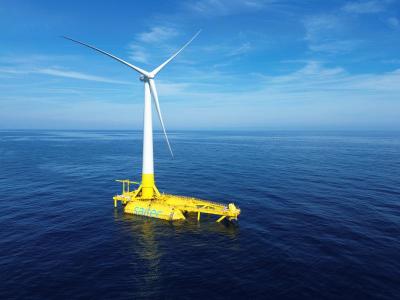
DemoSATH is Spain's first grid-connected floating wind turbine. Led by Saitec in collaboration with RWE and the Kansai Electric Power Co. (KEPCO), the 2MW unit is deployed at the BiMEP test site off the coast of Bizkaia (Spain). Beyond power generation, the project monitors environmental impacts and researches biodiversity enhancement. Globally, DemoSATH marks a milestone as the fifth European floating technology—and the third using a concrete structure—to operate a turbine exceeding 1MW in open waters.
Location
The project is located in the Cantabrian Sea (Bay of Biscay), known for its demanding metocean conditions, including significant wave heights and strong wind gusts. It is installed within the BiMEP (Biscay Marine Energy Platform), an open-sea laboratory specifically designated for renewable energy trials. The unit was constructed and assembled at the Port of Bilbao. It was then towed approximately 11 miles from the port to its final installation site at BiMEP. The coastal town of Armintza (Bizkaia) serves as the primary land-based reference point and access hub for the site. The energy is exported via a dynamic cable connected to a static submerged cable on the seabed. The cable runs to the BiMEP substation onshore, where the electricity is injected into the national Spanish power grid.
Project Timeline
- 2024–Ongoing: Operational testing & DemoSATH Lab launched to conduct advanced environmental monitoring, focusing on underwater noise, bird interactions, and marine biodiversity
- September 2023: Commissioning & first power
- 2022–Early 2023: Assembly & tow-out
- 2020–2021: Fabrication
- 2016–2019: Design and tank test campaigns
Licensing Information
BiMEP (Biscay Marine Energy Platform) is an open-sea marine energy test infrastructure located off Armintza, in the Basque Country, Spain. It provides grid-connected facilities for demonstrating and validating wave energy devices and floating offshore wind platforms under real offshore conditions.
RWE is an international energy company active in electricity generation, energy trading, storage, and the development of renewable energy projects, including offshore wind. Within DemoSATH, RWE contributes offshore wind experience and supports the validation of floating wind technologies as part of the wider energy transition.
The Kansai Electric Power Co., Inc. (KEPCO) is a Japanese energy utility headquartered in Osaka. Its main business areas include electric power, heat supply, telecommunications, and gas supply. Its participation in DemoSATH reflects its interest in offshore wind and the development of future low-carbon energy technologies.
Saitec SAU is a multidisciplinary engineering company providing technical and consultancy services across infrastructure, energy, environment, industry, architecture, and digital engineering. In the context of DemoSATH, Saitec SAU contributes engineering expertise and technical support linked to the development and deployment of floating offshore wind solutions.
Saitec Offshore Technologies is the floating offshore wind technology developer behind SATH (Swinging Around Twin Hull) a concrete floating platform concept designed for offshore wind turbines in shallow and deep waters. DemoSATH is the full-scale offshore demonstrator of this technology at BiMEP.
Key Environmental Issues
DemoSATH is installed at BiMEP, approximately two nautical miles off Armintza, in an open-sea test area at around 85 m water depth. The main environmental sensitivity is that BiMEP lies within the ES0000490 “Mundaka–Cape Ogoño” marine Special Protection Area for Birds, an area important for breeding and migratory seabirds. Key species include European storm petrel (Hydrobates pelagicus), European shag (Phalacrocorax aristotelis), Balearic shearwater (Puffinus mauretanicus), sooty shearwater (Puffinus griseus) and northern gannet (Morus bassanus). The Balearic shearwater and European shag are of particular conservation concern.
Potential impacts relate mainly to bird collision risk, disturbance or displacement, underwater noise, and interactions with marine fauna and seabed habitats. Cetaceans such as common dolphin, striped dolphin, bottlenose dolphin and long-finned pilot whale have been recorded in the BiMEP area, while the floating structure, moorings, anchors and cables may interact with benthic communities, fish, invertebrates and fouling organisms.
To address these issues, DemoSATH includes an environmental monitoring programme through DemoSATH Lab. This includes bird detection and collision monitoring using the DTBird system and CCTV cameras, monitoring of bird activity over different seasons, underwater noise monitoring compared with pre-installation baseline data, and periodic ROV surveys to observe marine biodiversity around the substructure, moorings, anchors and power cables. Other complementary topics such as marine biodiversity monitoring with e-DNA, oceanographic conditions, bat monitoring, radar-based detection, flight tracking, and modelling of environmental interactions are covered by collaboration with specialised research and technical entities, including the Spanish Institute of Oceanography, the University of Thessaloniki, the Plentzia Marine Station, ETSIAE-UPM School of Aeronautics, AZTI and other relevant organisations.
The programme is designed to improve understanding of floating wind–ecosystem interactions and to support adaptive mitigation, including operational restrictions or other corrective measures if significant risks are detected.
Mitigation will focus on early detection of risks, continuous monitoring during operation, and adaptive measures where needed. These may include adjusting operational procedures during sensitive periods, validating bird detection and deterrence systems, monitoring the ecological role of the platform, mooring system and dynamic cables, preventing pollution during maintenance activities, and assessing environmental recovery during decommissioning. Where feasible, the project will also explore nature-positive opportunities linked to floating offshore wind infrastructure.