
Description
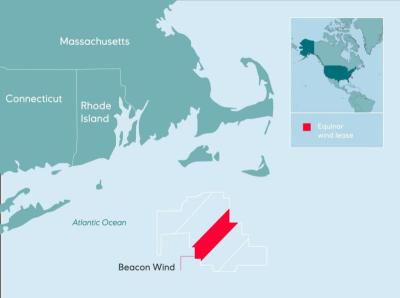
Beacon Wind was a proposed offshore wind farm that JERA Nex bp planned to develop in two phases, Beacon Wind 1 (BW1) and Beacon Wind 2 (BW2). BW1, previously owned by Equinor and bp, obtained a 25-year offtake agreement with New York for its 1,230 MW of power. In October 2025, JERA Nex bp halted investment in Beacon Wind citing unfavorable market conditions, but plans to maintain the Beacon Wind lease and wait to resume project development.
Location
The 128,000-acre Beacon Wind lease area is located approximately 32 km southwest of Nantucket, Massachusetts, and 97 km east of Montauk Point, New York. BW1 would have provided power to a point of interconnection (POI) in Queens, New York and BW2 to identified POIs either in Connecticut or New York. The project also planned to creatively reuse the Astoria (New York) Power Complex.
Project Timeline
- October 2025: JERA Nex bp halts investment in Beacon Wind citing unfavorable market conditions
- February 2025: Beacon Wind Transmission Application withdrawn
- December 2024: BP and JERA form offshore wind joint venture, JERA Nex bp
- April 2024: BP took full ownership of the Beacon Wind projects and Equinor took full ownership of the Empire Wind projects, through a cash-neutral swap transaction
- May 2024: BOEM issued Final Environmental Assessment
- 2023: BOEM announced a Notice of Intent (NOI) to prepare an Environmental Impact Statement for Beacon Wind’s project
- 2022: Federal and state permits submitted
- 2020: Marine surveys began
- 2019: Aerial wildlife surveys began
- April 2019: Lease effective
- December 2018: Lease awarded to Equinor
Status updates may be found on Beacon Wind's FAST-41 dashboard.
Licensing Information
- May 2024: BOEM, Finding of No Significant Impact (FONSI)
- January 2024: BOEM, No Historical properties affected
2023: NOI to prepare an Environmental Impact Statement (BOEM) - 2022: NOI to apply for an air permit submitted to Environmental Protection Agency
- 2022: Section 106 Review: Consultation initiated with State Historic Preservation Officer/Tribal Historic Preservation Officer.
- 2021: Site Assessment Plan (SAP) was approved.
- 2019: Commercial wind energy lease OCS-A 0520 was executed
Key Environmental Issues
Per Beacon Wind's environmental protection statement, when survey work is conducted, the following measures are taken by the offshore wind industry to protect marine mammals:
- During High Resolution Geophysical (HRG) surveys, geophysical survey equipment must be shut down when marine mammals are observed approaching or within “Exclusion Zones” ~1,600 ft or over 500 yards (500 m) for North Atlantic right whales, ~300 ft or 100 yards (100 m) for all other species).
- During HRG surveys, independent and NMFS-approved Protected Species Officers (PSOs) on duty to enforce Exclusion Zones, document all marine mammal observations, and report to NMFS on marine mammal observations and mitigation actions taken.
- For all survey work, vessel speeds reduced to 10 knots or less when mother/calf pairs, pods, or large assemblages of whales/dolphins observed near the vessel.
- For all survey work, vessels must maintain a minimum separation distance of ~1,600 ft or over 500 yards (500 m) from North Atlantic right whales and ~300 ft or 100 yards (100 m) from all other whale species.
- When marine mammals are observed while a vessel is underway, the vessel must attempt to remain parallel to the animal’s course, avoid excessive speed or abrupt changes in direction until the animal has left the area. If marine mammals are sighted within the relevant separation distance, the vessel must reduce speed and shift the engine to neutral, not engaging the engines until animals are clear of the area.
Additionally, BP has publicly released two years of detailed wave heights, currents, wind speeds, and wind direction data collected by buoys south of Long Beach and east of Montauk, NY. The data are available here.
Environmental Papers and Reports
- The presence, persistence, and movements of highly migratory pelagic fishes (HMS) in southern New England offshore wind lease areas from 2022-2023 determined by acoustic telemetry (Kneebone et al. 2025)
- Final Environmental Assessment for Additional Site Assessment Activities on Beacon Wind, LLC’s Renewable Energy Lease OCS-A 0527 (Bureau of Ocean Energy Management (BOEM) 2024)
- Beacon Wind Project: Beacon Wind 1 and Beacon Wind 2 Construction and Operations Plan (AECOM 2023)
- A Geospatial Analysis of Species of Interest in US Atlantic Wind Energy Areas (O'Brien 2023)
- Site Assessment Plan: Beacon Wind (AECOM 2021)
- Digital Aerial Wildlife Survey of BOEM Lease Area OCS-A 520 (Beacon Wind) Annual Report: December 2019 to November 2020 (Arundale et al. 2021)
- Megafauna Aerial Surveys in the Wind Energy Areas of Massachusetts and Rhode Island with Emphasis on Large Whales: Interim Report Campaign 6A, 2020 (O'Brien et al. 2021)
- Beacon Wind Fisheries Mitigation Plan (Equinor and New York State Energy Research and Development Authority (NYSERDA) 2020)
- Habitat Mapping and Assessment of Northeast Wind Energy Areas (Guida et al. 2017)
- Estimating the distribution and relative density of satellite-tagged loggerhead sea turtles in the western North Atlantic using geostatistical mixed effects models (Winton et al. 2017)
NOAA Fisheries has developed Offshore Wind Lease Reports that summarize previous fishing activity within each offshore wind lease area along the U.S. Atlantic Coast. View Descriptions of Selected Fishery Landings and Estimates of Vessel Revenue from Areas: A Planning-level Assessment and Descriptions of Selected Fishery Landings and Estimates of Recreational Party and Charter Vessel Revenue from Areas: A Planning-level Assessment for Beacon Wind (OCS-A-0520) here.
Environmental Monitoring: Beacon Wind
| Phase | Stressor & Receptor | Design and Methods | Results | Publications | Data |
|---|---|---|---|---|---|
| Baseline | Bats | Passive Acoustic Monitoring Between August and November 2020 and between March and April 2021, Song Meter Mini Bat units (manufactured by Wildlife Acoustics Inc.) were deployed on the vessel Stril Explorer. | Complete A total of 861 files were identified as likely bat passes. Autoclassification identified four species (big brown bat, eastern red bat, hoary bat, and silver-haired bat) and two unidentified species. | AECOM 2023 | No data publicly available. |
| Baseline | Bats | Bat Impact Assessment The potential exposure of bats to Beacon Wind project components within the lease area was evaluated and coupled with the known vulnerability of bats to collisions with wind turbines. | Complete AECOM identifies potential impact-producing factors, discusses bat community characteristics and key factors that may influence the type and severity of effects posed by those impact producing factors, and provides qualitative discussion of the effects anticipated as a result of the Project development. | AECOM 2023 | No data publicly available |
| Baseline | Birds | Avian Impact Assessment The exposure of seabirds to proposed development in the Lease Area was assessed using a spatiotemporal approach that accounted for the distribution, abundance, and movement of seabirds. | Complete Birds with very high exposure score included Razorbills in spring and winter, and Cory’s shearwater in summer. Exposure scores for each species of bird present in the lease area are identified for each season. | AECOM 2023 | No data publicly available |
| Baseline | Birds, Fish, Marine Mammals, Reptiles | Aerial Surveys A series of 16 digital aerial surveys were conducted between December 2019 and November 2020 (monthly and occasional bimonthly) to characterize abundance and distribution of birds, fish, marine mammals, and reptiles in the lease area. Additional surveys were collected between March 2021 and October 2021. | Complete Most abundant species (which varied by survey) included dolphins, waterfowl, auks, loons, terns, shearwaters, sharks, large bony fish, gulls, and passerines. A small number of Federally Listed sharks, terns, tuna, and turtles were also recorded. | Arundale et al. 2021 | Normandeau-APEM, OBIS-SEAMAP, OBIS-SEAMAP, Beacon Wind Digital Aerial Wildlife Surveys for BOEM Lease Area OCS-A 0520, Equinor Wind US LLC, December 2019 – November 2020 |
| Baseline | Birds, Fish, Marine Mammals, Reptiles | Aerial Surveys The New England Aquarium performed aerial surveys of wind energy areas off of Massachusetts and Rhode Island between March and October 2020. General surveys were conducted on a monthly basis, additional condensed surveys explored areas with high densities of whales, and directed surveys were flown in areas of right whale aggregations. | Complete Survey data showed the study area includes seasonal aggregations of protected species of whales and sea turtles. North Atlantic right whales occur in all seasons, baleen whales are present largely in spring and summer, and endangered sea turtles are present in summer and fall. | O'Brien et al. 2021 | |
| Baseline | Fish | Bottom trawl surveys NOAA Northeast Fisheries Science Center completed bottom trawl surveys for adult sand lance between 2010 and 2017. | Complete Data are compiled and mapped in Beacon Wind’s construction and operations plan. Adult sand lance are abundant in the lease area year-round and are heavily fed on by several demersal and pelagic fishes. | AECOM 2023 | No data publicly available. |
| Baseline | Fish | Offshore Electric and Magnetic Field Assessment Integral Consulting quantitatively modelled the EMF for the BW1 and BW2 offshore components of the electric transmission system, which includes wind turbines, offshore substation facilities, HVAC interraray cables, and HVDC export cables. | Complete Maximum magnetic field strengths and induced electric fields have a “de minimis” risk, indicating risk that is so minor it does not merit consideration, for all demersal marine species for the majority of the cable route where the cable will be buried and either bundled or separated. | AECOM 2023 | No data publicly available. |
| Baseline | Fish, Pelagic Fish | Acoustic Telemetry Study This study included collecting baseline information about when and how highly migratory species use popular fishing grounds within the area leased for offshore wind development, and to test the performance of acoustic telemetry as a long-term monitoring technique. Focus was placed on bluefin tuna, blue shark, shortfin mako, and yellowfin tuna as these species composed the largest number of individuals. | Complete Seasonal distributions of highly migratory species across both 2022 and 2023 corroborate the anticipated habitation of the area in warmer months (June to October) and the gradual departure of animals with progression towards cooler months (November to January). Numerous tagged individuals returned to the area and were detected in years subsequent to tagging. Further monitoring will continue and data from the acoustic monitoring performed in 2024 will be compiled, analyzed and synthesized into a forthcoming report. | Kneebone et al. 2025 | No data publicly available. |
| Baseline | Invertebrates | Dredge surveys NOAA Northeast Fisheries Science Center completed scallop dredge surveys between the years 1966 and 2014 in the northeastern United States. | Complete Scallop shell heights, number and height of dead scallop shells, and any finfish, cephalopods, and lobsters caught during the survey are reported for the northeastern United States, including the Beacon Wind lease area. | ||
| Baseline | Physical Environment | Benthic video, sediment sampling, photography, and sediment profile imaging Surveys were performed using a high-definition drop/tow camera system, sediment profile and plan view imaging system, Smith-McIntyre grab sampler, and grab-mounted HD benthic video camera, all deployed from a single survey vessel. 157 benthic stations were sampled throughout the lease area. | Complete Results indicate that foundation sites mainly consisted of finer grained particles, and the area was classified into two Geoform Level 2 classifications (geologic-flat or biogenetic-burrows/bioturbation). | AECOM 2023 | No data publicly available. |
| Baseline | Reptiles, Sea Turtles | Satellite tagging 271 satellite tags were deployed on large juvenile and adult loggerheads in the northwest Atlantic by 6 tagging programs between 2004 and 2016. | Complete Highest track densities occur between 25 and 41.5 degrees north and between 81.5 and 65 degrees west, though some individuals ventured further north or into the Gulf of Mexico. | Winton et al. 2017 |