



Contents
MRE Project Site
(login for email address)
Details
Description
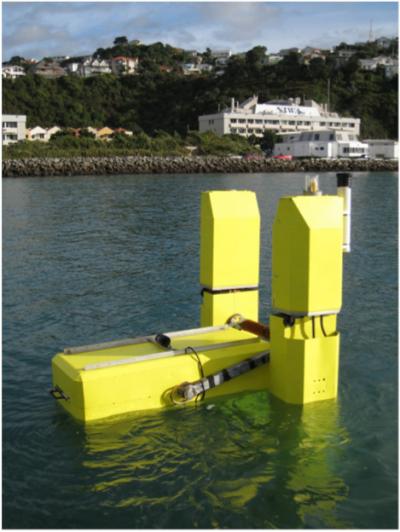
The aim of the WET-NZ programme is to design and develop a WEC that maximises engineering efficiency through the novel use of direct drive and adaptive response to changes in wave motion. The device consists of two rigid bodies or parts, a reactive hull and an active float, which are hinged together at the waterline. The bulk of the hull is submerged but floating and so it is moored to keep it on location. Refer to the website for an animation of the 1:2 scale device in operation. WET-NZ has a New Zealand patent for its device and has submitted for patents in Europe, the US, Australia, and elsewhere.
Location
WET-NZ has tested scaled devices in three locations in New Zealand and one in the United States.
Two test sites are near Christchurch, off the east coast of New Zealand's South Island in the Pacific Ocean. The 1:4 scale experimental device was moored in relatively shallow water at Taylor's Mistake and the first generation 1.2 scale device was evaluated at a deeper water site at Akaroa Heads. Both of these sites are close to accessible cliff top locations which allows for excellent shore based visual observation of performance under varying wave conditions. The 1:2 scale device was then tested for 6 weeks at a consented site called Moa Point, which is located along the south coast of Wellington on the edge of the Cook Strait, the body of water between the North and South Islands. A site off the Taranaki coast near Waitara, east of the North Island, has also been consened for future use.
Licensing Information
In New Zealand, a resource consent is required from a regional, city, or district council to use a resource in any way or to do something that might affect the environment. The type of consent, application procedures and durations of the consent process vary depending on the scale and type of the proposed activity and its potential impacts. Approvals from Maritime New Zealand are also required to install, relocate or remove any aids to navigation marking devices at offshore sites.
WET-NZ has secured approval from three regional councils for its New Zealand test sites: Taranaki Regional Council for Waitara, Environment Canterbury for Taylor's Mistake and Akaroa, and Greater Wellington Regional Council for Moa Point. The resource consent obtained for the Waitara site was the first ever content granted in New Zealand for a wave energy project.
Project Progress
WET-NZ is currently the only developer in New Zealand to have deployed a marine energy converter of any configuration; and its scaled prototypes are currently being tested in open ocean conditions. Two 1:4 scale devices have been built and successfully rested during numerous short-term deployments up to 163 continuous days. The first 'proof-of-concept' device was deployed in 2008 and the second more robust experimental test unit in 2010.
Fabrication of a 1:2 scale prototype was completed in June 2011 and it was deployed at the Akaroa site mentioned above for three months until December 2011. In early 2012, it was refurbished and transferred to the Moa Point test site near Wellington where WET-NZ has a consent to deploy it for up to five years with the option to deploy two more scaled devices for array testing. It has been tested for 6 weeks so far with more deployments planned.
In the USA, laboratory wave tank tests were conducted on a 1:30 scale model in October 2011, and a second generation 1:2 scale device, based on data from the initial 1:2 scale model and the wave tank testing, was fabricated and deployed off the Oregon coast for 6 weeks in 2012.
Key Environmental Issues
Environmental monitoring of the WET-NZ device is of particular importance at the Moa Point test site due to the intended deployment duration of at least 2 years.
During the resource consenting process for the site, an Assessment of Environmental Effects was produced. This identified potential environmental impacts, both negative and positive, that could potentially arise as a result of deploying a single 1:2 scale device for at least two years and ways these impacts could be mitigated, reduced or avoided if necessary. Subsequently an Environmental Monitoring Plan was created that laid out a proposed plan for monitoring environmental effects through three stages: before deployment, during deployment, and post decommissioning.
Desktop reports and baseline surveys have been completed to establish the baseline environmental conditions at the test site. The most significant environmental concern is for marine mammals that frequent the areas surrounding the test sites, in particular endangered or critically endangered species such as the Maui's dolphin, killer whale and southern right whale. Details on monitoring plans for marine mammals and other aspects of the marine environment, such as fisheries, the seabed, benthos, are outlined in the tables below.