



Contents
MRE Project Site
(login for email address)
Details
Description
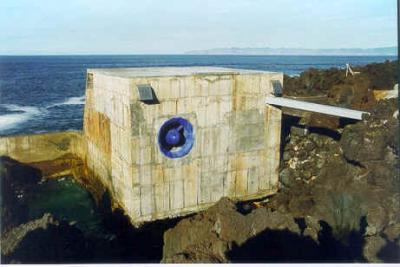
Shoreline gully Oscillating Water Column; the wave chamber is integrated in a natural gully, fitted into the rocky coastline.
Location
The device is located on the shore of Pico Island, Azores, Portugal.
Licensing Information
At that time, the licensing of the device and its evaluation with respect to environmental issues was new to the authorities. As EDA (Electricidade dos Açores) was a project partner, some facility in obtaining the required permission can be assumed. However, the regional authorities showed their serious concern regarding the environmentally acceptability of the plant, which proved very difficult to overcome, however no specific studies have been developed for baseline and impacts characterization.
Project Progress
The plant was completed in 1999 but flooding and malfunction of the Wells turbine affected the testing program of the plant, leading to long delays (Falcão, 2000). Full scale testing was only performed during a short period in October 1999. In 2003, the Wave Energy Centre (WavEC; renamed in 2013 as WavEC Offshore Renewables), a non-profit association dedicated to the development and promotion of ocean wave energy, created in Portugal, obtained national funding to proceed with the refurbishment of the plant, under a specific national funding scheme for pilot projects related to scientific innovated systems (PRIME/DEMTEC).
In 2004-2006 a set of relevant repair works were undertaken under the co-ordination of WavEC, as part of a national funding scheme and a program of monitoring tests accompanied the commissioning of the plant.
The basic function of the plant was reconstituted in autumn 2005. Substantial limitations of the operation persisted, mainly due to the inappropriate design of the turbine support structure, inherited from the original project. The automatic operational modus was insufficient due to the original plant layout and equipment. Since 2005, three minor accidents (affecting guide vanes, bearing, and glassfibre of the air tunnel) and insufficient funding prevented the project from a faster and complete recovery. Progress has been made and the plant started to be capable of operating at rated power autonomously since 2008. EDP provided the investment to refurbish the functional and visual aspects of the Pico OWC. In 2012 the plant started working with autonomous operation. During 2013 electrical problems were diagnosed and several repair works have been done.
The plant was facing structural deficiencies and several initiatives had been taken by WavEC in collaboration with the Azores Regional Government in order to recover the structure and promote the plant within the region.
Considering that the plant had already fulfilled its objectives as a pilot demonstration project, and in view of the wear and tear on the submerged part of the structure, in February 2016 WavEC’s Board of Directors communicated its decision to close the plant, requesting the requirements to ensure safe and environmental conditions.
In January 2017, due to the interest shown by the Regional Government in a viability analysis of the recovery of the plant, WavEC suspended its decision to close. However, as it was not possible to conclude its feasibility, the project to dismantle the plant went ahead, being prepared by EDA and EDP ( the two Portuguese utilities).
After the partial collapse of the plant on April 17 2018, all the necessary measures were taken to contain potential risks, the plant was disconnected from the network and security measures were taken.
The Pico Plant has made a very valuable contribution to the promotion of wave energy research, development and innovation, both at a national and international level. During its lifetime it attracted funding from more than 11 national and European projects. The Pico Plant was part of two European networks of test infrastructure for wave energy technologies (MARINET AND MARINET2), promoting the access of international teams to the plant. The plant originated more than 100 international scientific articles and was associated with more than 8 doctoral theses and numerous master's theses and scientific internships.
Project was decommissioned in April 2018.
The following is the Pico Plant annual electricity production (MWh):

Key Environmental Issues
To date, and mainly due to the short operational periods of the plant, there are no systematic monitoring regarding environmental issues however an acoustic monitoring survey has been carried out to characterize both airborne and underwater noise levels.