



Contents
MRE Project Site
(login for email address)
Details
Description
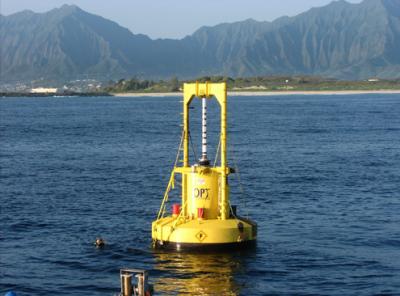
The utility PowerBuoy PB40 was a prototype with unique, direct-drive Power Take-Off system. Compact and modular in design, the PowerBuoy was less than 12 feet in diameter and 55 feet long. It was based on OPT's proprietary design which is primarily below the sea surface when deployed, with minimal visual impact.
Location
Kaneohe Bay, Oahu, Hawaii.
Project Progress
OPT has been collecting data since the first OPT unit was deployed in June 2004 and has completed an extensive EA. This congressionally funded project, managed by Naval Facilities Engineering Command (NAVFAC), was intended to demonstrate the feasibility of wave power for naval facilities worldwide. The Buoy was installed in 2009, connected to the grid in September 2010, and decommissioned in 2011.
Key Environmental Issues
The OPT wave power project at Oahu underwent an extensive environmental assessment by an independent environmental firm in accordance with the National Environment Policy Act (NEPA). This study featured evaluation of potential impacts on: the seabed, fish and benthic organisms, mammals, vegetation, and water quality, all within the sensitive ecosystems of Oahu. The project study resulted in a Finding Of No Significant Impact (FONSI), which is the highest environmental rating. The results of this study are included in a Report to Congress prepared by the US Department of Energy, titled “Potential Environmental Effects of Marine and Hydrokinetic Technologies”.