



Contents
Wind Project Site
(login for email address)
Details
Description
The Firefly (Bandibuli) Floating Offshore Wind Farm project is being developed by Equinor as part of the Ulsan floating offshore wind farm and is on track to become one of the first floating offshore wind farms in Korea. The Firefly Offshore Wind Farm will cover approximately 160 km2 and will have a total installed capacity of 750-800 MW.
Location
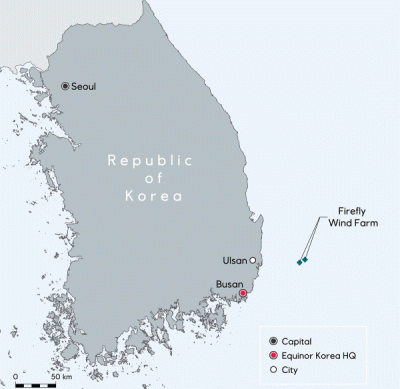
The Firefly Floating Offshore Wind Farm is located 70 km off the coast of Ulsan with the nearest port being the Port of Ulsan. The two export cables will have a landfall point at Onsan (Southern Ulsan).
Project Timeline
- July 2024: Equinor obtained approval of the Environmental Impact Assessment (EIA)
- 2022: Submitted EIA scoping report, Draft EIA report, conducted Information session of EIA
- 2022: Site Investigations (environmental impact statement: ex. Marine Sediment and Ecosystem, Underwater noise, Seabird, and Mammal, etc.), Geophysical Survey (by Geoview), and Front End Engineering esign (FEED) Study
- 2021: Project Memorandums of Understanding (MOUs) signed
- December 2021: Equinor obtained the electric business licence (EBL) from the Korean authorities.
- 2020: Metocean data collection
- May 2019: Equinor signed an MoU with Ulsan city
Licensing Information
The Firefly/Bandibuli Floating Wind Farm is overseen by several South Korean government agencies. The Ministry of Environment reviewed and approved the project's Enviornmental Impact Assessment (EIA) in July 2024 following a two-year evaluation process. The Ministry of Oceans and Fisheries and the Ministry of Trade, Industry and Energy also participate in the regulatory process, overseeing marine use and energy infrastructure development in accordance with national policies.
Key Environmental Issues
In December 2021, Equinor started surveys to collect data for the Environmental Impact Assessment (EIA), which are undertaken to ensure any potential significant environmental effects that may arise because of the construction and operation of the Firefly Offshore Wind Project, are properly understood.
The surveys were conducted initially over a 2-year period and included: marine mammals, seabirds, seawater and sediment quality, marine ecology, fish, marine physics, underwater noise, etc. Sekwang Engineering Co. Ltd., was appointed by Equinor to manage the surveys which were undertaken by specialist subcontractors and conducted in the offshore wind turbine array area as well as the proposed cable route to shore and onshore.