



Overview
The Scottish Government Marine Directorate (SG-MD) leads a programme of research to better understand the movement of migratory fish in Scottish coastal waters and to assess the potential for interaction with offshore marine renewable developments. With the increase of offshore windfarms in Scottish waters (ScotWind Leasing), data from acoustic telemetry studies and epipelagic trawling surveys, combined with Genetic Stock Identification (GSI), aim to provide critical evidence to support sustainable offshore renewable developments. This evidence helps to address the knowledge gaps identified by the Scottish Marine Energy Research (ScotMER) programme. The findings of the research will be used throughout the planning and regulatory process of offshore marine renewable developments.
Atlantic salmon (Salmo salar) and sea run Brown trout (Salmo trutta) are fish of high conservation importance and economic value in Scotland. Atlantic Salmon are listed in the EU Habitats Directive Annex 2 and 5. In Scotland, salmon are a qualifying feature for 17 Special Areas of Conservation (SAC) and, out of these, 11 have salmon as a primary feature for their designated status. Brown trout are listed as priority species for conservation in the UK and Scottish Biodiversity Action Plan. In 2014, wild fisheries (wild salmon and freshwater fisheries) in Scotland provided around 4,300 full time jobs and £79.9m Gross Value added (Value of Wild Fisheries in Scotland). However, relatively little is known about their early marine migration as they move from Scottish rivers towards feeding grounds in the Norwegian Sea / Greenland (Atlantic salmon) and in the coastal waters (sea trout). Improving this evidence base is increasingly important as the number of offshore renewable energy developments increases in Scottish waters.
Acoustic telemetry and surface trawling – primary methods for studying salmonid migration
The SG-MD has primarily used two methods to study the early marine migration of salmonids: acoustic telemetry and surface trawling. Acoustic telemetry provides information on the movement of fish using uniquely coded transmitters (tags) that are surgically implanted or attached externally to the fish, and acoustic receivers strategically located in the river and/or marine environment. The acoustic receiver detects a signal transmitted by the tag and records the date and time of that detection. It is possible to infer the migratory behaviour of tagged individual fish using information on the location of the receiver and the date and time of when they are detected.
Since 2017, several large-scale acoustic telemetry projects and trawling surveys have been conducted by SG-MD to determine the movements of migratory fish in relation to proposed and operational renewable developments in Scotland.Surface trawling, using modified surface trawled nets, is an effective method to capture migrating salmonids in the marine environment. With the use of genetic markers, GSI enables captured salmon to be assigned to their region/river of origin.
This article sets out the programme of research delivered by the SG-MD to address key evidence gaps in our understanding of migratory fish movement in Scottish coastal waters, particularly in relation to offshore renewable energy developments. It provides an overview of the primary research approaches used and summarises the objectives and spatial coverage of individual projects. The data generated through these programmes are presented spatially in Figure 1, which illustrates the locations of acoustic receiver deployments and trawling surveys, alongside a brief description of each project outlined below.
Key Research Projects
Aberdeen Bay Telemetry Study (2017–2021)
This project investigated the spatial distribution of seaward migrating juvenile salmon and sea trout leaving the rivers Dee and Don and passing through Aberdeen Harbour on the northeast coast of Scotland (Figure 1, pink dots). This work provided some of the first detailed information on how salmon and trout move through industrialised coastal environments in Scotland that may overlap with future renewable developments.
PrePARED Telemetry Project (2022–2025)
The Predators and Prey Around Renewable Energy Developments (PrePARED) project examines predator–prey relationships and fish behaviour within and around operational offshore wind farms in the Moray Firth (Figure 1, purple triangles). Using an array of more than 80 acoustic receivers, the movement and residency of migratory salmonids and marine fish species (e.g., gadoids) are tracked to investigate whether turbine structures influence fish aggregation behaviour. Early findings provide new insight into how renewable energy infrastructure may affect fish distribution and local ecosystem dynamics.
Moray Firth/Wick Telemetry Project (2023–2024)
This ScotMER funded project is an extension of the PrePARED project. An additional 74 receivers were added to the PrePARED array to determine the migratory routes of Atlantic salmon from the River Wick on the north-east coast of Scotland (Figure 1, black diamonds). The study aims to improve our understanding of salmon movement through areas with operational and proposed offshore wind farms. Translocation studies using sea run brown trout within windfarm areas were undertaken to assess potential interactions with renewable developments.
Inner Moray Firth (2025)
In spring 2025 SG-MD deployed 24 receivers in the Moray Firth in the northeast of Scotland (Figure 1, green stars) to detect salmon smolts tagged in the River Ness catchment as part of a study examining their movement through the Moray Firth.
North Coast Telemetry Project (2022–2025)
Delivered in collaboration with the Atlantic Salmon Trust and other partners, the North Coast Telemetry Project monitored salmon migration from multiple rivers on the west coast of Scotland. Between 2023 and 2025, over 1,000 salmon were tagged and tracked using up to 54 acoustic receivers (2023 = 21, 2024 = 40, 2025 = 54) deployed off the northwest coast of Scotland (Figure 1, blue dots) in a region with proposed offshore renewable development.
Trawling Surveys and GSI (2017–2021)
Between 2017 and 2021, SG-MD conducted epipelagic trawling surveys in coastal waters along the east coast of Scotland and in the North Sea (Figure 1). In combination with GSI, this project revealed that salmon from different rivers and regions exhibit distinct migratory patterns during their early marine phase. This information complements telemetry data by providing broader spatial and population level context.
Ongoing Work
In spring 2026, a ScotMER funded large-scale acoustic telemetry project (The Southeast Coast Salmon Tracking Project) commenced to monitor the migratory patterns of salmon leaving four large salmon producing rivers with SAC status on the east coast of Scotland (Figure 1). The findings of this project will provide information on the movement of salmon populations in a marine area of consented and proposed renewable energy developments.
Further work is ongoing in developing a biochemical tool from archival tissue in otoliths and eye lenses to determine the river of origin of salmon smolts from the east coast of Scotland. The findings of this project should contribute to more effective management and protection of salmon populations from rivers designated as SACs.
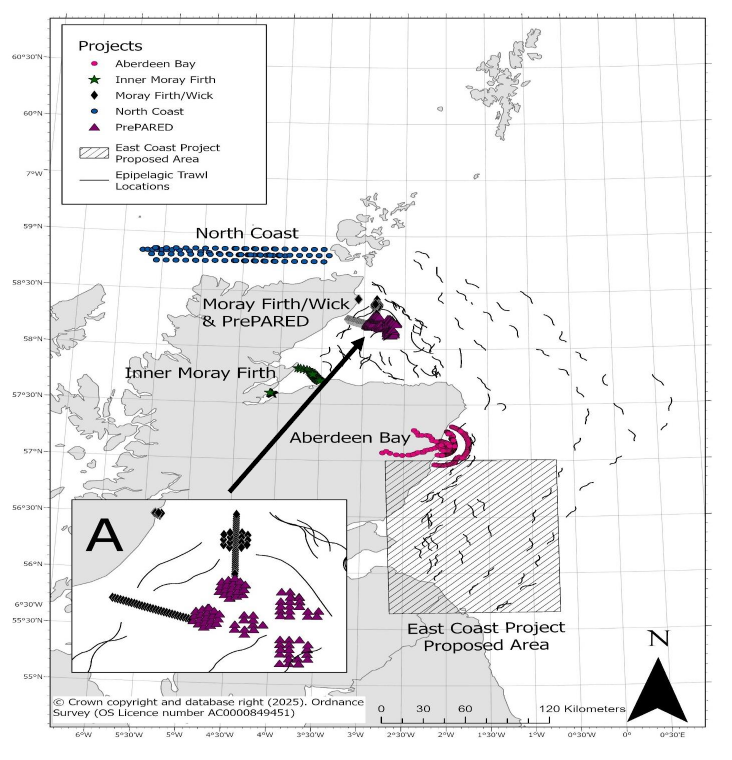
Figure 1. Map of Scotland showing the spatial coverage of each project. Coloured points indicate areas where acoustic receivers were deployed, and black lines indicate locations of epipelagic trawling surveys. Inset A is a more detailed view of the receivers deployed for the PrePARED and Moray Firth/Wick projects.
Conclusion
The data from the telemetry studies along with findings from the trawling and GSI has and will continue to improve our understanding of the movement patterns and distribution of salmonids and the potential for environmental effects associated with offshore wind development. This knowledge contributes to addressing high priority evidence gaps surrounding the movement patterns of migratory fish in Scottish waters. A good next step would be to use the empirical data gathered from both the telemetry and trawling studies with hydrodynamic models of the Scottish continental shelf and particle tracking models to further our understanding of the early marine migration of salmonids and contribute to effective conservation and marine planning.