




Contents
MRE Project Site
(login for email address)
Details
Description
In 2003 the Highlands and Islands Enterprise proposed to construct the infrastructure which would allow wave energy devices to be tested under working conditions. The purpose of the project was to allow the generating capacity of wave devices to be verified, in order that further investment could be obtained for establishing the technology on other offshore sites.
After a site selection study, Billia Croo was identified as the most suitable location for the test site. This site is an area with one of the highest wave energy potentials in Europe with an average significant wave height of 2 – 3 metres, reaching extremes of up to 18m. The site has a total of six berths; five cabled test berths in up to 70m water depth (four at 50m, one deeper), located approximately 2km offshore and 0.5km apart and one nearshore berth situated closer to the substation for shallow water projects.
Two waverider buoys are located on site measuring the wave height, period and direction, and a purpose-built weather station provides real-time met data for the site. This data is fed into a sophisticated SCADA (Supervisory, Control and Data Acquisition) system, with live data feeds on the marine and met conditions available to view on the EMEC website.
The test site berths are monitored by CCTV situated at an observation point at the Black Craig - a former coastguard lookout station which has been converted to house powerful cameras for monitoring the activity out at sea. This is controlled remotely from the data centre and office facilities.
Location
EMEC’s wave test facility is ideally placed on the western edge of the Orkney mainland, Billia Croo, Stromness. Subjected to the powerful dynamic forces of the North Atlantic Ocean, it is an area with one of the highest wave energy potentials in Europe with uninterrupted Atlantic waves of up to 18m. Four of the test berths are at 50m depth, while the fifth is located at 70m depth, all situated 1-2 km from the shore and 0.5 km apart. Shallow water test facilities situated close to the substation are also available.
Licensing Information
EMEC has been examined and accredited as a test laboratory for full-scale wave and tidal test facilities by the United Kingdom Accreditation Service (UKAS), since 2005. EMEC is accredited to test the performance of wave and tidal energy devices against IEC Technical Specifications. EMEC can provide developers with independent verification in accordance with ISO 17020 to confirm that your technology satisfies conceptual reliability, survivability and performance targets.
EMEC has been granted the consents required to install an agreed ‘envelope’ of device types and activities at the site, holding licences and consents relating to the following legislation:
- Town and Country Planning (Scotland) Act 1997
- Marine (Scotland) Act 2010
- Crown Estate Act 1971
- Food & Environment Protection Act 1985 Part II Deposits in the sea (FEPA)
- Coast Protection Act 1949 (section 34) (CPA)
- Electricity Act 1989 (section 36)
- The Conservation (Natural Habitats, &c.) Regulations 1994
- The Wildlife and Countryside Act 1981
All projects at EMEC require a Marine Licence under the Marine (Scotland) Act 2010. For clients wishing to install at EMEC’s test sites the consenting process requires the client to produce the following documentation to accompany their Marine Licence applications, alongside the relevant site-wide environmental report and navigational risk assessment: Project Information Summary, Project-specific Environmental Monitoring Programme (PEMP), Project-specific Navigational Risk Assessment (NRA), Third-party Verification/Certificate (TPV/TPC), and Decommissioning Programme (DP). The project-specific assessments should make reference to the findings from the site-wide assessments and be direct in their findings and recommendations. EMEC is continually working with regulators to make sure that the most efficient and effective licensing processes are put in place at the sites.
Project Progress
The Centre was established with around £30 million of funding from the Scottish Government, Highlands and Islands Enterprise, the Carbon Trust, the UK Government, Scottish Enterprise, the European Union and Orkney Islands Council. Construction of the wave test facility was completed in October 2003 and operational activities commenced shortly after.
The following is a list of all EMEC wave clients:
- Pelamis Wave Power P1 Demonstration, Pelamis Wave Power - Installed August 2004 to 2007
- Wave Roller, AW Energy - Installed 2005 to 2005
- Oyster 1, Aquamarine Power - Installed November 2009 to March 2011
- Pelamis Wave Power P2 Demonstration, E.ON & Scottish Power Renewables - Installed October 2010 & May 2012
- Penguin, Wello Oy - Installed July 2012, reinstalled March 2017
- Oyster 800, Aquamarine Power - Installed June 2012
- Oceanus 1, Seatricity - Installed 2013 to 2014
In 2019 EMEC submitted an application to Marine Scotland for site-wide consent under Section 36 of the Electricity Act 1989, for a maximum installed generating capacity of up to 20 MW at the Billia Croo test site. Following a formal consultation exercise carried out by Marine Scotland, in 2021 EMEC conducted further consultations and contracted supplementary work to address additional information requests.
Consent was awarded in 2023, and has additionally allowed for the site to be expanded by an area of 2.6 km2 to the north-west enabling access to deeper water. Technologies over 1 MW can now demonstrate at the Billia Croo test site without having to apply for individual section 36 consents.
To support the section 36 application, seascape, landscape and visual impact assessments were conducted alongside an environmental appraisal. These assessments focused on an agreed ‘envelope’ of device types and activities that could be deployed within the test site boundaries and considered the potential impacts that may occur during the installation, operation and decommissioning phases of device and infrastructure testing. The site-wide consent lasts until 2040, future-proofing the consenting process for clients accessing EMEC’s facilities.
Key Environmental Issues
Several potential environmental issues were identified in the Environmental Impact Assessment, these were:
- Disturbance/modification to benthic habitats/communities as a result of cable and anchor laying in inshore waters;
- Disturbance to intertidal environment from cable laying activities;
- Effects of energy removal on adjacent marine biotopes;
- Device noise;
- Hydro acoustic signals from subsea cables;
- Physical presence of devices interacting with birds and mammals; and
- Colonization of subsea infrastructure and antifouling effects
Environmental Webpage: http://www.emec.org.uk/services/consents/ and https://www.emec.org.uk/services/environmental-services/
Mitigation Measures:
Note: the following section describes environmental mitigation measures undertaken during construction of the Billia Croo site only, and not those undertaken for ongoing developer testing activities.
During installation, general good civil engineering practices were adhered to in an attempt to reduce and contain disturbance to the shore and seabed habitats within as small an area as possible.
Due to the limited knowledge on certain potential impacts arising from the presence of test devices, further research was encouraged. In particular in relation to:
- Impacts on shoreline ecology from the removal of energy from the marine environment. The presence of Fucus distichus subsp. anceps. provides a useful sentinel species on the shore, which can be simply and cheaply monitored.
- Characterisation of background noise prior to device installation and an attempt to determine the zones over which device sound signatures may be detectable.
The presence of the CCTV cameras at the coastguard lookout enable any significant effects on general marine life and ecology to be observed, and more generally provide data of interest to SMRU, the Orkney Field Club, local recorders and the Orkney Whale and Dolphin Group.
At the time of decommissioning, a BPEO study (best practicable environmental option) should be undertaken to fully investigate the impacts associated with different decommissioning options.
Export Cables
Each of the six berths has an 11kv cable on the seabed to export electricity to the onshore substation.These cables are wet-type composite cables consisting of three EPR-insulated stranded copper power cores designed for alternating current, three 2.5mm2 copper signal/pilot trip cables and a 12-core single-mode fibre-optic bundle. The cable is then armoured with two layers of galvanised steel wire. Cables were provided by AEI (wave test site cables) & Pirelli (tidal test site cables). The conductors on these cables are 50mm², giving a nominal rating of 2.2MW.
The cables were laid as standard sub-sea cables on the sea bed. As the cables approached the shore, in 15m of water, ductile iron cable protectors were attached. At the low water spring tide mark, each cable passes into a trench dug 12m into the seabed and beach. On shore, the cables are fed into a manhole and then into the substation. At the offshore mooring positions, a seabed anchor, of reinforced concrete, is installed to anchor the end of the cable, before it rises to connect to the wave energy device. A fibre optic communications cable will be incorporated within each of the armoured cables.
Onshore Infrastructure
The substation at Billia Croo is broadly similar to that at the tidal test site at the Fall of Warness. Each cable coming from the test site terminates in the substation at an 11kV circuit breaker, along with the tripping cable. This provides an isolation switch for the devices under test and operates as the interface between EMEC and the UK national grid. The electrical output performance of each of the devices is measured by equipment within the substation and transmitted to the data centre. The quality of the electricity can then be analysed by EMEC to demonstrate that the devices can provide a smooth and reliable supply of electricity to the grid. The metered data is also provided to the developer through the Supervisory Control and Data Acquisition (SCADA) system and the power data is logged in the data historian to be made available for historical trending. EMEC ensures the confidentiality of the data collected.
Vessel Spread
Vessels used in the installation of the EMEC wave test site are:
| Vessel type | Activity | Comment |
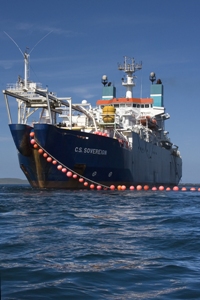
| Cable lay vessel | Installation of sub-sea export cables |
CS Sovereign
|
| Survey vessel | Benthic and bathymetric surveys | Exact vessel used unknown |
| Dive vessel | Used to deploy divers for benthic surveys | Exact vessel used unknown |
Environmental Datasets
EMEC Wildlife Data Analysis Project - Cleansed Data (Marine Scotland 2016)
European Marine Energy Centre Billia Croo Wildlife Observation Data. DOI: 10.7489/1683-1 (EMEC 2015)
Other relevant environmental datasets for this project are available on MARENDATA.