




Contents
MRE Project Site
(login for email address)
Details
Description
Wello Oy (Wello) conducted a full scale demonstration of its ‘Penguin’ wave energy converter (WEC) at the European Marine Energy Centre’s (EMEC’s) wave test site facility at Billia Croo in Orkney, during 2011-2014. The device’s nominal capacity was 1 MW and during operation, it fed electricity into the local grid via EMEC’s pre-installed subsea cable. The device was installed at a new deep water berth (~60m) at the north end of the site. In January 2016 the Penguin device was towed from Hatston Pier in Orkney to Falmouth Port on the Cornish Court, where it was planned for deployment (along with two other penguin devices) at the Wave Hub test facility, as part of the Clean Energy from Ocean Waves (CEFOW) project. The project is funded under the EU’s Horizon 2020 programme and aims to test arrays of devices in challenging sea conditions over a period of several years. However, in December 2016 it was announced that the deployment location would be changed to EMEC as a result of a change in schedule. This change in schedule led to the need for a challenging winter deployment, setting the requirements for fast connections that are available at EMEC.
The Penguin device was deployed again in Orkney early during 2017. The installation methods set out below refers to the initial deployment of the Penguin device at the EMEC site (2011), however, the installation method remained broadly similar for the most recent deployment. No additional environmental baseline data was gathered for the 2017 deployment. In March 2019, Wello’s Penguin marked its two-year anniversary of continuous deployment.
Construction of a second device started during the summer of 2017. The second device is also planned for deployment at the EMEC site.
More recently, after a long deployment, on March 22nd 2019, the Penguin prototype sank at EMEC test site. This marked the end of the first test period in the EU funded CEFOW-project, which will continue with the new devices. The prototype, which was launched in 2010, had been deployed four times altogether over a period of nine years. During the testing period, the device fulfilled expectations and accomplished what the prototype was built for, having survived waves of over 18 meters, proving invaluable insights on the technology, mooring construction, cable connection, control software, and power take-off construction for subsequent models.
The CEFOW project, coordinated by Fortum will continue with the deployment of two commercially ready devices. The first, the new Penguin WEC2, is an optimised Penguin model based on proven technology. The WEC2 has been towed to Orkney from the Tallinn shipyard, Estonia and is expected to be installed to the EMEC test site later during 2019.
Penguin WEC2 sets the benchmark for state-of-the-art wave energy technology, improving energy generation compared to the previously deployed WEC1, and boasting an increase in 380% in power production. The WEC2 is a key milestone towards the full potential of ocean-wave energy conversion technology, confirming all calculations and energy costs Wello presented on the Global Wave Energy Potential and Wave Energy Levels map.
WEC2 is funded by both the European Commission’s research and innovation program Horizon 2020 Clean Energy From Ocean Waves (CEFOW), and project participants.
Location
The device was installed at European Marine Energy Centre (EMEC) wave device test area in Billia Croo, Orkney, UK.
Licensing Information
The project has an installed capacity of less or equal to 1 MW; therefore no Section 36 Consent was required. In addition, EMEC test site deployments require no terrestrial planning applications. No Licence to Disturb European Protected Species or Basking Shark was required for this project, therefore only a Marine Licence was necessary.
| Licence | Competent Authority | Reference |
| Marine Licence (Marine (Scotland Act) 2010 | Marine Scotland | 04064/12/2 |
Key Environmental Issues
The following potential impacts were considered during the environmental assessment:
- Seabed disturbance during installation and removal of the mooring system
- Disturbance to marine mammals and fish from the presence of the mooring system and device
- Potential disturbance of marine mammals and fish from underwater noise
- Disturbance to other sea users from support vessel activity and sustained presence of structures offshore
- Change in local seascape through increased activity and sustained presence of the device
- Disturbance to seabed communities and during connection to and disconnection from the EMEC connector.
- Temporary change in water quality during installation and removal activities
- Effects on air quality from vessel emissions
- Effects on marine birds from vessel operations and device presence on the test site
- Effects on marine fish from EMF emitted during electricity transmission
- Effects on flows and fluxes from the presence of subsea structures
- Employment opportunities for local residents and businesses
- Utilisation of local infrastructure and subsequent investment in local services and economy
- Generation of marine renewable energy will contribute towards government targets
As shown, a number of potential interactions were identified that could potentially arise from the proposed deployment; however, none of these were anticipated to have a significant effect on the particular receptors within the receiving environment. This clearly demonstrates the benefits of Wello’s approach to technology design and operational planning. The general character of the device and its mooring system, along with the ability to use vessels which are relatively small and can be locally sourced mean that the project is relatively benign in its nature and can bring significant benefits to local maritime support businesses.
Mitigation: The following project mitigation measures were identified during the environmental assessment and included in the project Commitments Register:
- Embedment anchors were selected which removes the need for any subsea excavation and minimises the footprint of the mooring system. This also allows the scale of the clump weights to be minimised - further reducing potential footprint
- The mooring system design allows the use of relatively small workboats; minimising underwater noise generated during activities
- The mooring system is also designed for rapid deployment; reducing time at sea
- Selection of mooring system lines (wire) under tension removes the possibility of entanglement
- Ensuring vessels are well maintained will reduce noise and potential for accidental events
- Noise generating components of the device are only required as back-up therefore any effects will be temporary and minimal
- The size and character of structure should minimise the risk of collision – it has no external moving parts
- Vessel anchoring will be limited to when necessary
- Placement of clump weights will be as accurate as possible to ensure minimal ‘re-positioning’ manoeuvres
- Anchors and clump weights will as far as possible, be removed in a single attempt so as to reduce the duration of noise and other forms of disturbance
- The final stages of operational planning shall minimise sea time for tugs and workboats as far as practically possible
- The back-up cooling system will only be used when absolutely necessary, normally in rough weather where the sea itself will generate most noise
- Vessel crews will keep a lookout for sea mammals and basking sharks at all times.
- Vessel crews will be briefed on marine life sensitivities and will have ID materials supplied
- Vessel operations will be limited to quiet activities if marine mammals or basking sharks are in close proximity (<50 m) to the works, unless safety considerations require an activity to continue[1]
Supplementary Licence Conditions
The following supplementary licencing conditions were specified in the Marine Licence issued by Marine Scotland:
- The device shall be predominantly coloured yellow and fitted with a light flashing yellow once every five seconds (FL Y 5s) and visible from all directions. The light should be mounted on the highest part of the superstructure and have a nominal range of 2 nautical miles.
- The Licensee shall provide Marine Scotland with Third Party Verification of the mooring system prior to installation.
- The Licensee must comply with the Environmental Monitoring Plans (EMP) submitted in support of the Marine Licence Application. Prior to installation the EMP must be signed off and submitted to Marine Scotland.
- A passive radar reflector must be positioned on the highest part of the superstructure.
- Statutory Sanction of the Commissioners of Northern Lighthouses must be sought to
Deploy and subsequently remove the proposed buoy station. The 'Application for Statutory Sanction' form enclosed with this letter must be completed as fully as possible for each buoy and returned to the Northern Lighthouse Board either via fax on 0131-220-0235 or via e-mail tonavigation@nlb.org.uk for the necessary sanction to be granted prior to deployment. The proposed duration of deployment should be included within the sanction application[2].
Environmental Webpage: http://www.wello.eu/en/environment
[1] Aquatera Ltd, 2011Deployment of Wello Oy’s wave energy converter at EMEC’s wave test facility in Orkney Environmental Statement
[2] Marine Scotland, 2012, Marine Licence Determination Letter
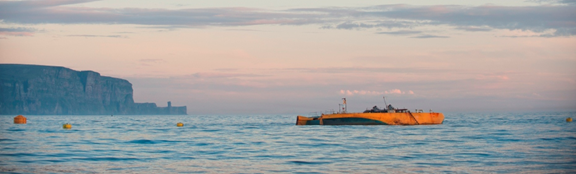
Wello Penguin being tested at EMEC
The Wello Penguin produces electricity using a rotating mass encassed in a asymetrically designed hull which rolls with the pitch and heave of the waves. The rotation of the mass drives an electric motor which in turn produces electricity. The device itself is 9 metres high with a draft of 7 metres, weighs over 1600 tonnes (excluding ballast) and has a width of 30 metres. The device is rated upto 1 MW and 2013 testing showed that continuous current control ranges for the device were between 160–180 kWs with peak performance periods of up to 700 kW in sea conditions of 3 metres and up.
Mooring Deployment
The mooring system was pre-laid at the test berth. This part of the operation was completed using a multicat-type support vessel. During this process, the following was installed:
- Embedment anchors
- Clump weights and chains attaching each to an embedment anchor
- Subsurface buoys and associated lines/wires attached to clump weights
- Recovery lines and small surface buoys (to allow access to the subsurface buoys when attaching device tethers during device installation)
The multicat vessel used to deploy the mooring spread was fitted with survey equipment for accurate plotting, recording and positioning of the anchors. The multicat was then loaded with the anchors, buoys, the short mooring pennants and marker buoys. Each section of mooring spread was taken out and deployed using the anchor handling winch and roller of the multicat. The anchor was rendered out to the required position on the seabed followed by the ground chain clump weight and riser wire, the main buoy was deployed followed by small mooring pennant and marker buoy and lastly a suitable messenger line to facilitate pick up of the marker buoy. This process was repeated for each of the three mooring sections. Once the anchors and sections of mooring were deployed the anchors were allowed to “soak” for at least 24 hours. On completion of the soaking period a tug was deployed and preceded to pick up each buoy and secured the short mooring pennant to its tow wire and then a suitable sustained pull will be applied to ensure that each of the anchors was fully bedded in.
Device Deployment
The Penguin was towed from Lyness to the pre laid moorings at the EMEC test site at Billia Croo. The Penguin had a lead tug (multicat) and a stern tug to facilitate control during the tow and while the moorings were connected. A RHIB was also in attendance throughout on safety standby duties.
Electrical Connection
After the Penguin had been attached and secured at its moorings and its roll plates deployed, the electrical connection was undertaken. An ROV with a manipulator was deployed and attached a pick up line from the EMEC cable connector to a pick up buoy on the surface. The cable from the Penguin has a diameter of 51 mm and is 200 metres long.
Vessel Spread
The following vessels were used during construction and operation:
| Name and type of vessel | Activity |
| Survey vessel (Lodesman) |
Installation / operation. Undertake ROV surveys of the device and moorings |
| Tug (Einar / Green Isle) |
Installation, decommissioning and unplanned maintenance. Act as stern tug from Lyness to Billia Croo, assist with mooring connection, provide safety/emergency response backup. |
| Large Multicat (Green Isle / C-Odyssey / C-Salvor) |
Mooring and device installation, decommissioning, unplanned maintenance. Lay moorings, Main tow from Lyness to Billia Croo, assist with mooring and unmooring the device and with electrical connections. |
| General purpose Multicat and other vessels (Orcadia; Barge GM700) |
Used if large multicat is unavailable. |
| RHIB (Blaze) |
Mooring and device installation, decommissioning, planned maintenance. Transfer crew to and from the penguin, safety response. |